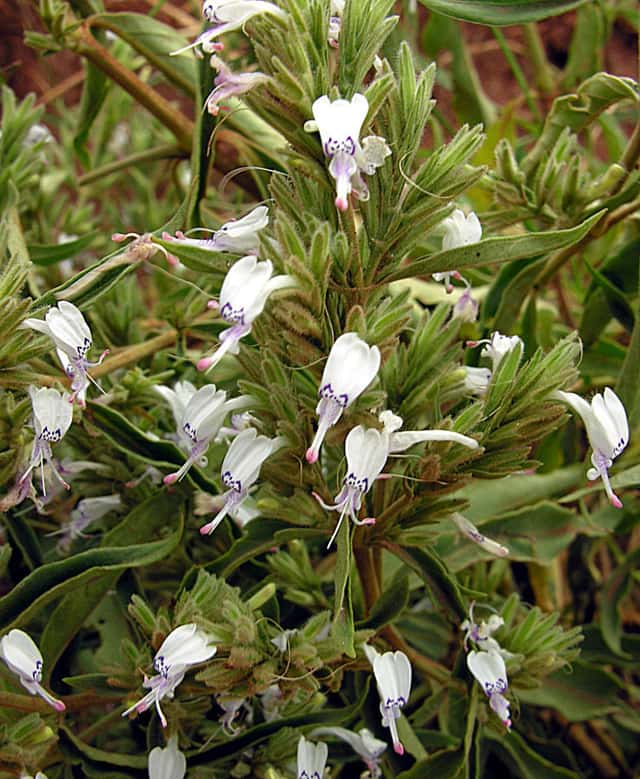
Acanthaceae
White Ribbon Bush — Hypoestes forskaolii
Hypoestes forskaolii
Plant in well-draining, organically rich soil. Maintain high humidity (50-80%) and water every 7 days, allowing the top half of the soil to dry between waterings. Provide bright indirect light, shielding from direct afternoon sun. Fertilize every 30 days during the growing season. Pinch back regularly to maintain a compact shape and encourage bushy growth.
Every 7 days
Partial shade
15° - 30°C
50% - 80%
Categories
What is White Ribbon Bush?
White Ribbon Bush (Hypoestes forskaolii) is a medium-care plant from the Acanthaceae family. Hypoestes forskaolii, commonly known as White Ribbon Bush, is a perennial or annual herb native to tropical Africa and the Arabian Peninsula. It belongs to the family Acanthaceae and is prized both as an ornamental plant and for its remarkable medicinal properties. The plant produces smooth, oval le...
White Ribbon Bush grows up to 1.0m, spread of 60cm, watering every 7 days, 15°C – 30°C, 50–80% humidity. It is suitable for indoor environments and safe for pets.
Unlike many popular species, White Ribbon Bush is safe to keep around pets. Without adequate drainage, root rot can develop within 14 days.
How to Care for White Ribbon Bush?
TLDR: White Ribbon Bush needs Partial shade, watering every 7 days, and temperatures between 15-30°C with 50-80% humidity.
How Often Should You Water White Ribbon Bush?
Water every 7 days, allowing the upper half of the soil to dry out between waterings. Hypoestes forskaolii is particularly sensitive to overwatering — waterlogged roots quickly lead to root rot. Avoid wetting the foliage directly, as this encourages powdery mildew. During winter, reduce watering frequency to every 10-14 days.
How Much Light Does White Ribbon Bush Need?
Place in a location with bright indirect light, ideally within 1 meter of a north- or east-facing window. The plant tolerates gentle morning sun, but direct afternoon sunlight can scorch the leaves. In low-light conditions, growth becomes weak and the plant may drop leaves. Artificial grow lights can supplement in darker spaces.
What Is the Best Soil for White Ribbon Bush?
Use porous, well-draining soil rich in organic matter. A mix of potting soil and perlite or coarse sand in a 2:1 ratio works well. The ideal soil pH is between 6.0 and 7.0. Avoid compacted or clay-heavy soils that retain excess moisture, as these predispose the plant to root rot.
What Pot Should You Use for White Ribbon Bush?
Terracotta or ceramic pots with drainage holes. Porous materials help regulate substrate moisture and prevent waterlogging. Use saucers filled with pebbles and water beneath the pot to increase ambient humidity without keeping roots in standing water.
Care Schedule
Fertilize
Every 30 days
Misting
Every 3 days
Repot
Every 365 days
What Is White Ribbon Bush and Where Does It Come From?
Hypoestes forskaolii, commonly known as White Ribbon Bush, is a perennial or annual herb native to tropical Africa and the Arabian Peninsula. It belongs to the family Acanthaceae and is prized both as an ornamental plant and for its remarkable medicinal properties. The plant produces smooth, oval leaves forming dense, vivid green foliage, with delicate small flowers that range from white to pale pink. In its natural habitat, it grows under shrubs and trees, thriving in filtered shade and well-drained tropical soils. Of particular scientific interest are its diterpene compounds, which have demonstrated antimicrobial, anticancer, and antioxidant properties in laboratory studies.
How to Propagate White Ribbon Bush?
Stem Cutting
Change water every 3-4 days if propagating in water. Use rooting hormone powder when propagating in soil for better success rates.
- 1 Cut a healthy stem with 2-3 nodes using clean, sharp scissors
- 2 Remove leaves from the lower nodes
- 3 Place in clean water or moist perlite-enriched potting mix
- 4 Keep in a warm location with bright indirect light
- 5 Transplant when roots reach 3-5 cm in length
Materials needed:
Seed Propagation
Start seeds 8-10 weeks before the last frost if growing outdoors in cooler climates.
- 1 Sow seeds in moist, well-draining propagation mix
- 2 Cover lightly with a thin layer of potting mix
- 3 Maintain temperature around 20°C
- 4 Seeds germinate in 4-7 days
- 5 Transplant seedlings once they develop 2-3 true leaves
Materials needed:
How Big Does White Ribbon Bush Grow?
TLDR: White Ribbon Bush can reach up to 1.0m tall with Medium growth rate.
Max height
1.0m
Spread
60cm
Growth rate
Medium
Foliage
Evergreen
Plant Uses
Ornamental
Great for decoration
Medicinal
Medicinal properties
Medicinal Uses
- Root extracts of H. forskaolii have demonstrated larvicidal activity against Anopheles, Aedes, and Culex mosquitoes, making it a subject of research for natural vector control
- Diterpene compounds in the plant have shown antimicrobial and anticancer properties in laboratory studies
Is your plant showing symptoms?
Click on the symptom to discover possible causes:
What Diseases Commonly Affect White Ribbon Bush?
TLDR: White Ribbon Bush is susceptible to 9 known diseases. Monitor regularly for early detection.
Root Rot
Root rot is a serious fungal disease that affects the root system of plants, causing them to decay and die. It is primarily caused by overwatering, poor drainage, or soil-borne fungi such as Pythium, Phytophthora, Rhizoctonia, and Fusarium. The disease thrives in waterlogged conditions where roots are deprived of oxygen, making them susceptible to fungal infection.
Powdery Mildew
Powdery mildew is a common fungal disease caused by various fungi species including Erysiphe, Podosphaera, Oïdium, and Leveillula. It affects over 10,000 plant species worldwide. The disease thrives in warm, dry climates with high humidity and appears as a distinctive white powdery coating on plant surfaces.
Aphids
Aphids are small, soft-bodied, pear-shaped insects (1/16 to 1/8 inch long) that feed by sucking nutrient-rich sap from plants. They reproduce rapidly and can quickly weaken plants, causing distorted growth and transmitting plant viruses. Aphids come in various colors including green, black, red, yellow, brown, and gray. They secrete honeydew, a sticky substance that attracts ants and encourages sooty mold growth.
Spider Mites
Spider mites are tiny arachnids (less than 1/20 inch long) related to spiders and ticks that feed on plant sap. They thrive in hot, dry conditions and can cause significant damage to ornamental and vegetable plants. During severe infestations, crop losses can reach 14% or higher as these pests disrupt vital plant processes including photosynthesis, carbon dioxide absorption, and transpiration.
Meaning & Symbolism
In its native range across Africa and the Arabian Peninsula, the White Ribbon Bush symbolizes resilience and understated natural beauty. It represents adaptability — the quiet strength of a plant that thrives in the wild under challenging conditions.
Fun Facts
One of the few ornamental plants with proven larvicidal activity against mosquitoes that transmit malaria and dengue fever
The species name honors Swedish botanist Pietr Forsskal, who joined a Danish Arabian expedition in 1761-1763
Can reach up to 1 meter (3 feet) in height both in cultivation and in its native African habitat
Frequently asked questions
How often should I water Hypoestes forskaolii?
Is Hypoestes forskaolii toxic to pets?
Why are the leaves of my Hypoestes turning yellow?
How do I propagate Hypoestes forskaolii?
What soil is best for Hypoestes forskaolii?
Compare with similar plants
| Attribute | Difficulty | Light | Watering | Pet Safe |
|---|---|---|---|---|
| Dark Fieldcap | Medium | Low light | 2d | ⚠️ |
| Azalea | Medium | Partial shade | 3d | ⚠️ |
| Bougainvillea | Medium | Direct sun | 7d | ⚠️ |
| Wild Lettuce | Medium | Direct sun | 7d | ⚠️ |



