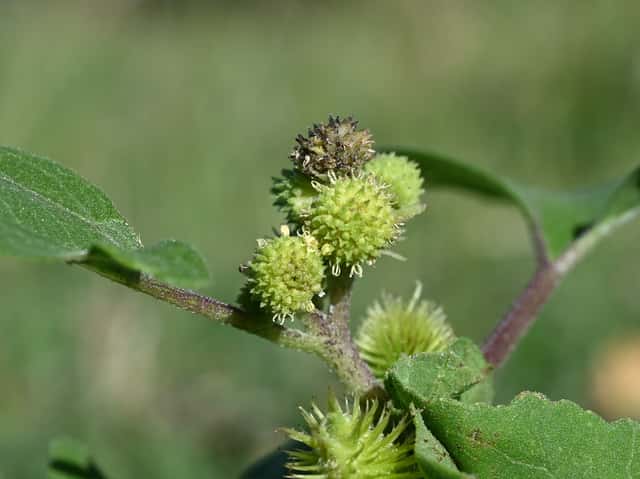
Asteraceae
Cocklebur (Xanthium)
Xanthium
A hardy, fast-growing weed requiring minimal care. Thrives in full sun and well-drained soil. Drought-tolerant once established. WARNING: all plant parts, especially seeds and seedlings, are highly toxic to humans and animals.
Every 7 days
Direct sun
10° - 38°C
30% - 70%
Categories
What is Cocklebur?
Cocklebur (Xanthium) is a easy-care plant from the Asteraceae family. Xanthium is a genus of annual herbaceous weeds in the family Asteraceae, native to the Americas and eastern Asia. It is best known for its spiny bur fruits that cling to clothing and animal fur, aiding seed dispersal. Plants grow in disturbed soils, roadsides, and open fields, reaching up to 120 cm...
Cocklebur grows up to 1.2m, spread of 60cm, watering every 7 days, 10°C – 38°C, 30–70% humidity. It is not suitable for indoor environments and not safe for pets.
Unlike many tropical plants, Cocklebur tolerates watering mistakes. Best for beginners. Without precautions, ingestion can cause irritation in pets. Keep out of reach of cats and dogs.
How to Care for Cocklebur?
TLDR: Cocklebur needs Direct sun, watering every 7 days, and temperatures between 10-38°C with 30-70% humidity.
How Often Should You Water Cocklebur?
Water every 7 days or when soil is completely dry. Drought-tolerant; avoid waterlogging.
How Much Light Does Cocklebur Need?
Requires full sun (6-8 hours daily). Does not tolerate shade.
What Is the Best Soil for Cocklebur?
Prefers loamy to sandy, well-draining soil with pH 6.0-7.0. Thrives in disturbed soils.
What Is Cocklebur and Where Does It Come From?
Xanthium is a genus of annual herbaceous weeds in the family Asteraceae, native to the Americas and eastern Asia. It is best known for its spiny bur fruits that cling to clothing and animal fur, aiding seed dispersal. Plants grow in disturbed soils, roadsides, and open fields, reaching up to 120 cm tall.
How to Propagate Cocklebur?
Direct seeding
Seeds germinate best in warm soils above 15°C. Wear gloves when handling spiny burs.
- 1 Collect mature seeds from spiny bur fruits
- 2 Lightly scarify seeds to improve germination
- 3 Sow directly in soil 1-2 cm deep
- 4 Keep soil slightly moist until germination
Materials needed:
How Big Does Cocklebur Grow?
TLDR: Cocklebur can reach up to 1.2m tall with Fast growth rate.
Max height
1.2m
Spread
60cm
Growth rate
Fast
Foliage
Deciduous
Warning: Toxic Plant
This plant can be toxic if ingested. Keep out of reach of:
Plant Uses
Medicinal
Medicinal properties
Medicinal Uses
- Used in traditional Chinese medicine (cang er zi) to treat nasal congestion and sinusitis
- Scientifically studied for anti-inflammatory and antimicrobial properties
Is your plant showing symptoms?
Click on the symptom to discover possible causes:
What Diseases Commonly Affect Cocklebur?
TLDR: Cocklebur is susceptible to 5 known diseases. Monitor regularly for early detection.
Powdery Mildew
Powdery mildew is a common fungal disease caused by various fungi species including Erysiphe, Podosphaera, Oïdium, and Leveillula. It affects over 10,000 plant species worldwide. The disease thrives in warm, dry climates with high humidity and appears as a distinctive white powdery coating on plant surfaces.
Rust
Rust is a common fungal disease caused by fungi in the order Pucciniales that affects a wide variety of plants. The disease gets its name from the characteristic orange, yellow, or reddish-brown pustules that appear on leaves, resembling metal rust. This obligate fungal parasite requires living plants to survive and can cause significant economic losses in agricultural crops.
Root Rot
Root rot is a serious fungal disease that affects the root system of plants, causing them to decay and die. It is primarily caused by overwatering, poor drainage, or soil-borne fungi such as Pythium, Phytophthora, Rhizoctonia, and Fusarium. The disease thrives in waterlogged conditions where roots are deprived of oxygen, making them susceptible to fungal infection.
Aphids
Aphids are small, soft-bodied, pear-shaped insects (1/16 to 1/8 inch long) that feed by sucking nutrient-rich sap from plants. They reproduce rapidly and can quickly weaken plants, causing distorted growth and transmitting plant viruses. Aphids come in various colors including green, black, red, yellow, brown, and gray. They secrete honeydew, a sticky substance that attracts ants and encourages sooty mold growth.
Fun Facts
The spiny burs of cocklebur inspired George de Mestral to invent Velcro in 1948
A single plant can produce up to 1,000 seeds per season
It is one of the most invasive weeds globally, present on every inhabited continent
The genus name Xanthium comes from the Greek word for yellow, referencing its use as a yellow dye
Frequently asked questions
Is cocklebur toxic?
How do I get rid of cocklebur?
What is cocklebur used for medicinally?
When does cocklebur flower?
Compare with similar plants
| Attribute | Difficulty | Light | Watering | Pet Safe |
|---|---|---|---|---|
| Field Maple | Easy | Bright indirect | 14d | ✓ |
| Silver Birch | Easy | Direct sun | 14d | ✓ |
| Cushion Bush | Easy | Direct sun | 14d | ✓ |
| Wild Lettuce | Medium | Direct sun | 7d | ⚠️ |





