Sapindaceae
Bigleaf maple: Edible Plant
Acer macrophyllum
A robust and fast-growing tree, suitable only for outdoor ground cultivation (not suitable as an indoor plant). It prefers full sun in cooler coastal areas and partial shade with protection from the afternoon sun in hotter regions. It requires deep, organic-rich, and well-drained soil, kept consistently moist but never waterlogged. It tolerates cold down to approximately -18°C (USDA hardiness zones 6a-9b). No known toxicities for humans or pets.
Every 7 days
Bright indirect
-18° - 35°C
40% - 80%
Categories
What is Bigleaf maple?
Bigleaf maple (Acer macrophyllum) is a medium-care plant from the Sapindaceae family. The Bigleaf maple (Acer macrophyllum) is a large deciduous tree native to the western coast of North America, from southern Alaska to California, where it often grows along streams and in moist forests up to 450 m in altitude. It is the maple with the largest leaves in the world, reaching up to 15-3...
Bigleaf maple grows up to 30.0m, spread of 2000cm, watering every 7 days, -18°C – 35°C, 40–80% humidity. It is not suitable for indoor environments and safe for pets.
Unlike many popular species, Bigleaf maple is safe to keep around pets.
How to Care for Bigleaf maple?
TLDR: Bigleaf maple needs Bright indirect, watering every 7 days, and temperatures between -18-35°C with 40-80% humidity.
How Often Should You Water Bigleaf maple?
Water regularly, especially during the first few years and throughout the summer, keeping the soil moist but never allowing it to become waterlogged: excess moisture promotes root rot. Mature and well-established specimens show a fair amount of drought tolerance.
How Much Light Does Bigleaf maple Need?
Full sun in cooler coastal areas; in regions with hot summers, it prefers morning sun and partial shade in the afternoon to avoid heat stress on its large leaves.
What Is the Best Soil for Bigleaf maple?
Deep, fertile soil rich in organic matter with excellent drainage; pH from slightly acidic to neutral (approx. 5.5-7.5). It adapts to sandy or clay soils as long as they are well-drained.
What Pot Should You Use for Bigleaf maple?
Not suitable for permanent pot cultivation due to its large final size: it should be planted in the ground in spacious areas. Only young specimens can be kept temporarily in large containers (e.g., bonsai style/bonsai in training) with frequent repotting.
Care Schedule
Fertilize
Every 365 days
What Is Bigleaf maple and Where Does It Come From?
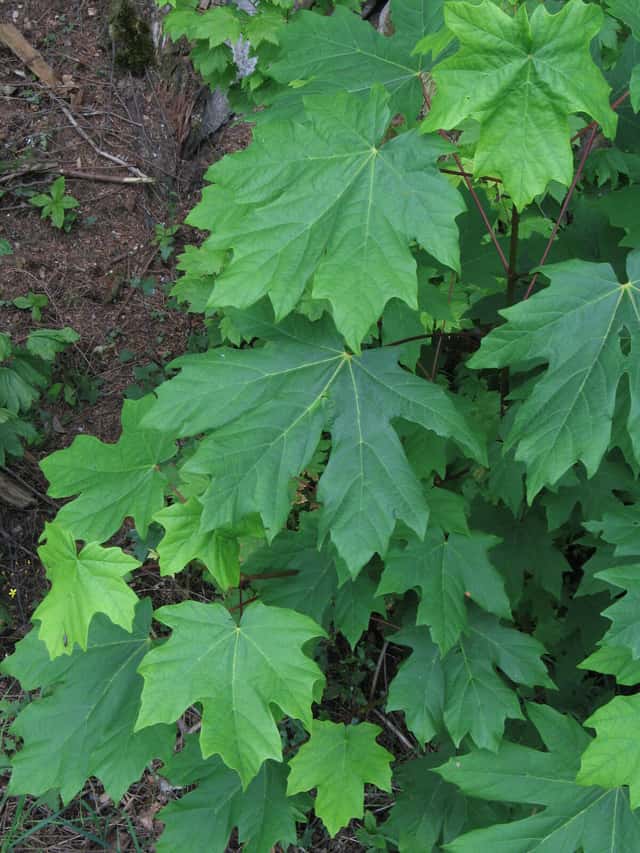
The Bigleaf maple (Acer macrophyllum) is a large deciduous tree native to the western coast of North America, from southern Alaska to California, where it often grows along streams and in moist forests up to 450 m in altitude. It is the maple with the largest leaves in the world, reaching up to 15-30 cm in width and divided into five deep palmate lobes, which turn spectacular golden and yellow hues in autumn. In spring, it produces hanging clusters of small, inconspicuous greenish-yellow flowers that appear before the leaves. It can reach considerable heights in the wild, with record specimens exceeding 40 meters.
How to Propagate Bigleaf maple?
How Big Does Bigleaf maple Grow?
TLDR: Bigleaf maple can reach up to 30.0m tall with Fast growth rate.
Max height
30.0m
Spread
20.0m
Growth rate
Fast
Foliage
Deciduous
Plant Uses
Ornamental
Great for decoration
Edible
Can be consumed
Medicinal
Medicinal properties
Medicinal Uses
- Bark infusion traditionally used for sore throats
- Bark decoction used in Native American traditional medicine for tuberculosis-like symptoms
- Resin-rich spring buds mixed with oils as a hair tonic
Culinary Uses
- Sap used to produce maple syrup, in smaller quantities compared to Acer saccharum
- Seed sprouts consumed by the native peoples of the Pacific Northwest
- Dried and ground inner bark used as a thickener for soups or mixed with flours
Is your plant showing symptoms?
Click on the symptom to discover possible causes:
What Diseases Commonly Affect Bigleaf maple?
TLDR: Bigleaf maple is susceptible to 7 known diseases. Monitor regularly for early detection.
Anthracnose
Anthracnose is a fungal disease caused by fungi in the genus Colletotrichum that affects many plants, including vegetables, fruits, and trees. The disease thrives in cool, wet conditions, causing dark, sunken lesions on leaves, stems, flowers, and fruits.
Verticillium Wilt
Verticillium wilt is a soil-borne fungal disease caused primarily by the fungi Verticillium dahliae and V. albo-atrum. These pathogens infect plant roots and grow within the vascular tissues, blocking water and nutrient transport, resulting in wilting and eventual plant death. The disease affects over 350 plant species including vegetables, fruits, ornamental flowers, and trees. The fungi can survive in soil for more than 10 years as resistant structures called microsclerotia.
Powdery Mildew
Powdery mildew is a common fungal disease caused by various fungi species including Erysiphe, Podosphaera, Oïdium, and Leveillula. It affects over 10,000 plant species worldwide. The disease thrives in warm, dry climates with high humidity and appears as a distinctive white powdery coating on plant surfaces.
Canker
Canker is a disease caused by various fungi and bacteria that create necrotic, sunken areas on bark of branches, stems, and trunks. Pathogens enter through wounds and natural openings, especially when plants are stressed. Canker can gradually weaken or kill branches by disrupting water and nutrient flow.
Meaning & Symbolism
Known among the indigenous peoples of the Pacific Northwest as the "paddle tree": the wood was carved for canoe paddles, tools, and bowls, the inner bark woven for baskets, and the large leaves used as natural food wraps. It symbolizes the connection between coastal communities and the moist forests that sustain them.
Compare with similar plants
| Attribute | Difficulty | Light | Watering | Pet Safe |
|---|---|---|---|---|
| Dark Fieldcap | Medium | Low light | 2d | ⚠️ |
| Azalea | Medium | Partial shade | 3d | ⚠️ |
| Field Maple | Easy | Bright indirect | 14d | ✓ |
| Muriel's Bamboo | Medium | Partial shade | 3d | ✓ |
Choose & Compare
Sources & References
- Acer macrophyllum - Wikipedia
- Big Leaf Maple (Acer macrophyllum) Growing Guide - PlantNative
- Complete and detailed care of the Acer macrophyllum - Jardineria On
- Big-Leaf Maple Plant Care - Greg App
- Common Disease Pests of Maple - NC State Extension
- Maple (Acer macrophyllum) Wood Decay - PNW Pest Management Handbooks
- Acer macrophyllum Plant Guide - USDA NRCS




