Asteraceae
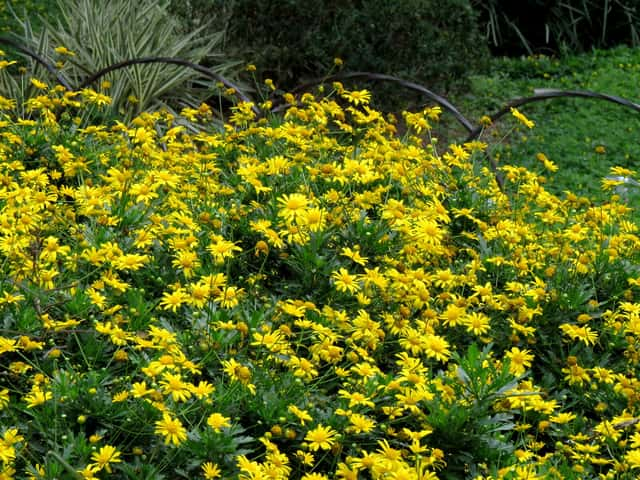
African Bush Daisy (Euryops chrysanthemoides)
Euryops chrysanthemoides
An easy shrub for full sun in well-drained soil; it flowers less in part shade. Once established it handles drought: water deeply now and then, more in hot summers or in pots, and never let water stand. Deadhead to keep it blooming and prune hard after flowering, in late winter. It takes light frosts but suffers in hard, long freezes.
Every 7 days
Bright indirect
-1° - °C
% - %
Categories
What is African Bush Daisy?
African Bush Daisy (Euryops chrysanthemoides) is a easy-care plant from the Asteraceae family. Euryops chrysanthemoides is an evergreen shrub in the daisy family (Asteraceae), native to eastern South Africa and Eswatini, where it grows on forest margins, riverbanks and coastal scrub. It forms a dense, rounded bush 0.5 to 2 m tall, with dark green leaves cut into deep lobes. The flowers are go...
African Bush Daisy grows up to 2.0m, spread of 120cm, watering every 7 days. It is not suitable for indoor environments and safe for pets.
Unlike many tropical plants, African Bush Daisy tolerates watering mistakes. Best for beginners. Unlike many popular species, African Bush Daisy is safe to keep around pets.
How to Care for African Bush Daisy?
TLDR: African Bush Daisy needs Bright indirect, watering every 7 days, and temperatures between -1-30°C with 40-70% humidity.
How Often Should You Water African Bush Daisy?
In hot summers or in pots, water once or twice a week; in spring and autumn, every 2 or 3 weeks is enough. Soggy soil rots the roots.
How Much Light Does African Bush Daisy Need?
Full sun for the most flowers. It accepts part shade but blooms less. Not suited to growing indoors.
What Is the Best Soil for African Bush Daisy?
Light, well-drained sandy or gritty soil, ideally with compost. It tolerates poor, dry, acid or slightly alkaline soil.
What Pot Should You Use for African Bush Daisy?
Large pot with drainage holes and a gritty, free-draining mix; water more often in summer.
What Is African Bush Daisy and Where Does It Come From?
Euryops chrysanthemoides is an evergreen shrub in the daisy family (Asteraceae), native to eastern South Africa and Eswatini, where it grows on forest margins, riverbanks and coastal scrub. It forms a dense, rounded bush 0.5 to 2 m tall, with dark green leaves cut into deep lobes. The flowers are golden-yellow daisies 3 to 4 cm across on wiry stalks, appearing almost all year with a peak from autumn to spring. It draws butterflies and other pollinators. It used to be called Gamolepis chrysanthemoides.
How to Propagate African Bush Daisy?
Semi-hardwood cutting
Use a gritty mix and do not overwater so the cuttings do not rot.
- 1 In early spring, cut 8 to 10 cm semi-ripe shoots
- 2 Strip the lower leaves
- 3 Insert in moist, well-drained mix
- 4 Keep in bright light, out of strong sun, until rooted
Materials needed:
Sowing
It self-seeds in the garden; volunteer seedlings can be moved.
- 1 Sow in spring or summer in a tray of light mix
- 2 Cover lightly and keep moist
- 3 Pot up the seedlings once they have a few leaves
Materials needed:
How Big Does African Bush Daisy Grow?
TLDR: African Bush Daisy can reach up to 2.0m tall with Medium growth rate.
Max height
2.0m
Spread
1.2m
Growth rate
Medium
Foliage
Evergreen
Plant Uses
Ornamental
Great for decoration
Is your plant showing symptoms?
Click on the symptom to discover possible causes:
What Diseases Commonly Affect African Bush Daisy?
TLDR: African Bush Daisy is susceptible to 4 known diseases. Monitor regularly for early detection.
Root-Knot Nematodes
Root-knot nematodes (Meloidogyne species) are microscopic roundworms that parasitize plant roots, causing characteristic galls or knots. These soil-borne pests are among the most economically damaging plant pathogens worldwide, affecting a wide range of ornamental and edible plants. The nematodes inject enzymes into root cells, causing abnormal swelling and disrupting water and nutrient uptake.
Aphids
Aphids are small, soft-bodied, pear-shaped insects (1/16 to 1/8 inch long) that feed by sucking nutrient-rich sap from plants. They reproduce rapidly and can quickly weaken plants, causing distorted growth and transmitting plant viruses. Aphids come in various colors including green, black, red, yellow, brown, and gray. They secrete honeydew, a sticky substance that attracts ants and encourages sooty mold growth.
Spider Mites
Spider mites are tiny arachnids (less than 1/20 inch long) related to spiders and ticks that feed on plant sap. They thrive in hot, dry conditions and can cause significant damage to ornamental and vegetable plants. During severe infestations, crop losses can reach 14% or higher as these pests disrupt vital plant processes including photosynthesis, carbon dioxide absorption, and transpiration.
Root Rot
Root rot is a serious fungal disease that affects the root system of plants, causing them to decay and die. It is primarily caused by overwatering, poor drainage, or soil-borne fungi such as Pythium, Phytophthora, Rhizoctonia, and Fusarium. The disease thrives in waterlogged conditions where roots are deprived of oxygen, making them susceptible to fungal infection.
Fun Facts
It flowers almost all year, with a peak from autumn to spring.
It was once placed in a separate genus, Gamolepis, and moved to Euryops based on chromosome counts.
The flowers last well in arrangements.
Frequently asked questions
When should I prune African bush daisy?
Is it frost hardy?
Why is it yellowing and wilting?
What pests attack it?
Compare with similar plants
| Attribute | Difficulty | Light | Watering | Pet Safe |
|---|---|---|---|---|
| Field Maple | Easy | Bright indirect | 14d | ✓ |
| Iberian Houseleek | Easy | Direct sun | 14d | ✓ |
| Silver Birch | Easy | Direct sun | 14d | ✓ |
| Common Blanketflower | Easy | Direct sun | 10d | ✓ |





