Crassulaceae
Sempervivum vicentei (Iberian Houseleek)
Sempervivum vicentei
Grow this Iberian houseleek outdoors in full sun, in poor, gritty, sharply drained soil: a rock garden, a gravel bed, a wall crevice or a shallow trough. It is very hardy (to about -20 °C) and drought tolerant, so its only real enemy is wet: water only when the soil is completely dry and protect it from prolonged winter wet. No feeding or pruning is needed; just remove dead flowering rosettes and let the offsets fill the gap.
Every 14 days
Direct sun
-20° - °C
% - %
Categories
What is Iberian Houseleek?
Iberian Houseleek (Sempervivum vicentei) is a easy-care plant from the Crassulaceae family. Sempervivum vicentei is a small mat-forming houseleek in the stonecrop family (Crassulaceae), native to the mountains of Spain and Portugal, where it grows among rocks at 600-2,300 m in the Cantabrian Mountains and the Central Iberian System. It forms dense cushions of stemless rosettes up to 9 cm a...
Iberian Houseleek grows up to 34cm, watering every 14 days. It is not suitable for indoor environments and safe for pets.
Unlike many tropical plants, Iberian Houseleek tolerates watering mistakes. Best for beginners. Unlike many popular species, Iberian Houseleek is safe to keep around pets.
How to Care for Iberian Houseleek?
TLDR: Iberian Houseleek needs Direct sun, watering every 14 days, and temperatures between -20-30°C with 40-70% humidity.
How Often Should You Water Iberian Houseleek?
Water thoroughly only when the soil has dried out completely, roughly every 2 weeks in warm dry weather for plants in pots, and much less in cool weather. Plants in the ground usually manage on rainfall. Keep it on the dry side in winter and never let the pot stand in water: soft, translucent or rotting rosettes are a sign of too much water.
How Much Light Does Iberian Houseleek Need?
Give it full sun, ideally in an east, south or west-facing spot. Strong light keeps the rosettes compact and brings out the purple leaf tips; in shade they stretch, turn plain green and flower poorly. It is not a good indoor plant, as it needs bright outdoor light and a cold winter rest.
What Is the Best Soil for Iberian Houseleek?
Use poor to moderately fertile, sharply drained soil: sandy, loamy or chalky ground all work, whatever the pH. In containers, mix equal parts loam-based, peat-free potting compost and grit, and top-dress with gravel so the rosettes sit dry.
What Pot Should You Use for Iberian Houseleek?
A shallow terracotta pan or alpine trough with drainage holes. Clay dries quickly, which suits a houseleek that rots in wet soil.
What Is Iberian Houseleek and Where Does It Come From?
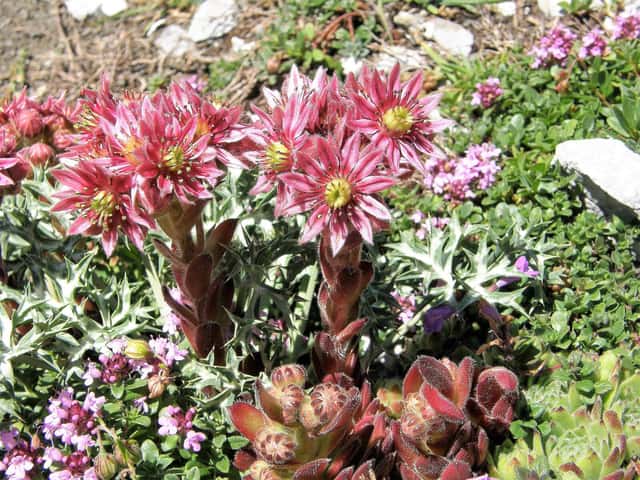
Sempervivum vicentei is a small mat-forming houseleek in the stonecrop family (Crassulaceae), native to the mountains of Spain and Portugal, where it grows among rocks at 600-2,300 m in the Cantabrian Mountains and the Central Iberian System. It forms dense cushions of stemless rosettes up to 9 cm across, made of fleshy, lance-shaped green leaves with purple tips, covered in fine glandular hairs and fringed with conspicuous marginal hairs. In summer a rosette sends up an erect, leafy stalk up to about 34 cm tall topped by a cluster of star-shaped pink to purple flowers about 2.5 cm wide. The flowering rosette then dies, but it is replaced by the young rosettes it has produced on short side runners. Three subspecies are recognised: vicentei, paui and cantabricum.
How to Propagate Iberian Houseleek?
Separating offsets
Remove offsets in spring and early summer. Rosettes without roots root easily if simply placed on gritty soil.
- 1 Choose a young rosette that has formed at the end of a side runner
- 2 Cut or pull it away from the mother plant, keeping any roots it already has
- 3 Set it on gritty, barely moist mix and press it in lightly
- 4 Keep it in bright light and water sparingly until it roots and starts to grow
Materials needed:
How Big Does Iberian Houseleek Grow?
TLDR: Iberian Houseleek can reach up to 34cm tall with Slow growth rate.
Max height
34cm
Growth rate
Slow
Foliage
Evergreen
Plant Uses
Ornamental
Great for decoration
Ground Cover
Soil coverage
Is your plant showing symptoms?
Click on the symptom to discover possible causes:
What Diseases Commonly Affect Iberian Houseleek?
TLDR: Iberian Houseleek is susceptible to 5 known diseases. Monitor regularly for early detection.
Root Rot
Root rot is a serious fungal disease that affects the root system of plants, causing them to decay and die. It is primarily caused by overwatering, poor drainage, or soil-borne fungi such as Pythium, Phytophthora, Rhizoctonia, and Fusarium. The disease thrives in waterlogged conditions where roots are deprived of oxygen, making them susceptible to fungal infection.
Overwatering
Overwatering occurs when plants receive too much water, depriving roots of oxygen and causing root rot. This environmental stress is one of the most common causes of houseplant death, as waterlogged soil prevents roots from breathing and functioning properly.
Rust
Rust is a common fungal disease caused by fungi in the order Pucciniales that affects a wide variety of plants. The disease gets its name from the characteristic orange, yellow, or reddish-brown pustules that appear on leaves, resembling metal rust. This obligate fungal parasite requires living plants to survive and can cause significant economic losses in agricultural crops.
Curculionidae
Curculionidae (weevils) are small beetles that feed on plants. Adults chew leaf margins, leaving crescent-shaped notches, primarily at night. The larvae live in the substrate and consume roots, causing decline, yellowing, and wilting even when the substrate is moist, and in severe cases, plant death. They frequently affect ornamentals and garden plants such as strawberries, citrus, roses, hydrangeas, azaleas, blueberries, begonias, and many potted plants.
Fun Facts
It grows wild among rocks up to about 2,300 m in the Cantabrian Mountains and the mountains of central Spain and Portugal.
The name probably honours Vicente Cutanda, a 19th-century director of the Royal Botanic Garden of Madrid.
Sempervivum means always alive in Latin, a nod to how tough these plants are.
Its leaves are covered in tiny glandular hairs and fringed with longer hairs along the edges.
Frequently asked questions
How often should I water Sempervivum vicentei?
Can Sempervivum vicentei survive frost?
Why did my rosette die after flowering?
Can I grow it indoors?
Compare with similar plants
| Attribute | Difficulty | Light | Watering | Pet Safe |
|---|---|---|---|---|
| Field Maple | Easy | Bright indirect | 14d | ✓ |
| Silver Birch | Easy | Direct sun | 14d | ✓ |
| Common Blanketflower | Easy | Direct sun | 10d | ✓ |
| Cushion Bush | Easy | Direct sun | 14d | ✓ |





