Lamiaceae
American beautyberry: Edible Plant
Callicarpa americana
A hardy and easy-to-care-for shrub: it prefers full sun or partial shade, moderate watering with good drainage, and light pruning in late winter to encourage dense foliage and abundant flowering and fruiting.
Every 7 days
Bright indirect
-20° - 38°C
40% - 80%
Categories
What is American beautyberry?
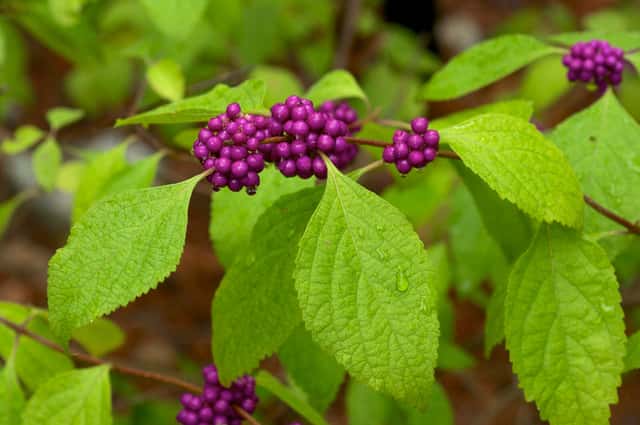
American beautyberry (Callicarpa americana) is a easy-care plant from the Lamiaceae family. The American beautyberry (Callicarpa americana) is a deciduous shrub with an arching habit, native to the southeastern United States. It is highly prized for the striking contrast between its green foliage and the dense clusters of vibrant violet berries that cover its stems from late summer through...
American beautyberry grows up to 2.4m, spread of 183cm, watering every 7 days, -20°C – 38°C, 40–80% humidity. It is not suitable for indoor environments and safe for pets.
Unlike many tropical plants, American beautyberry tolerates watering mistakes. Best for beginners. Unlike many popular species, American beautyberry is safe to keep around pets.
How to Care for American beautyberry?
TLDR: American beautyberry needs Bright indirect, watering every 7 days, and temperatures between -20-38°C with 40-80% humidity.
How Often Should You Water American beautyberry?
Water regularly during the first year to help establish the roots; once established, the plant can tolerate short periods of drought, but it produces more berries if the substrate is kept slightly moist without becoming waterlogged.
How Much Light Does American beautyberry Need?
It grows best in full sun, where it develops a more compact habit and more abundant fruiting; it also tolerates partial shade, although it flowers and fruits less in dense shade.
What Is the Best Soil for American beautyberry?
It adapts to sandy, clay, or loamy soils as long as they drain well; it prefers a slightly acidic to neutral pH and does not tolerate prolonged waterlogging.
What Pot Should You Use for American beautyberry?
While it grows best directly in the ground, it can grow in a large (16-20 inch) terracotta pot with good drainage if watered more frequently and pruned to control its size.
What Is American beautyberry and Where Does It Come From?
The American beautyberry (Callicarpa americana) is a deciduous shrub with an arching habit, native to the southeastern United States. It is highly prized for the striking contrast between its green foliage and the dense clusters of vibrant violet berries that cover its stems from late summer through winter. In spring and early summer, it produces small, inconspicuous lilac or white flowers that attract bees and butterflies before giving way to the famous berries, which are a vital food source for birds and other wildlife. It is a low-maintenance, heat-resistant plant that tolerates various soil types, making it ideal for pollinator gardens and naturalized landscapes.
How to Propagate American beautyberry?
How Big Does American beautyberry Grow?
TLDR: American beautyberry can reach up to 2.4m tall with Medium growth rate.
Max height
2.4m
Spread
1.8m
Growth rate
Medium
Foliage
Deciduous
Plant Uses
Ornamental
Great for decoration
Edible
Can be consumed
Medicinal
Medicinal properties
Medicinal Uses
- The leaves contain callicarpenal, a compound traditionally used as a natural repellent against mosquitoes, ticks, and other insects.
- Native American peoples used decoctions of the leaves and roots to treat fevers, rheumatic pains, and digestive discomfort.
- Leaf extracts have shown antibacterial and antioxidant properties in preliminary studies, though they do not replace medical treatment.
Culinary Uses
- The ripe berries are used to prepare jellies, jams, and homemade sauces in the Southern United States.
- They can be eaten raw directly from the plant, although their flavor is mild and somewhat bland.
Is your plant showing symptoms?
Click on the symptom to discover possible causes:
What Diseases Commonly Affect American beautyberry?
TLDR: American beautyberry is susceptible to 6 known diseases. Monitor regularly for early detection.
Leaf Spot
Leaf spot is a common fungal disease caused by various pathogens including Alternaria, Ascochyta, Colletotrichum, Septoria, and Venturia. It primarily affects leaves, causing discolored spots that can lead to premature leaf drop if left untreated.
Powdery Mildew
Powdery mildew is a common fungal disease caused by various fungi species including Erysiphe, Podosphaera, Oïdium, and Leveillula. It affects over 10,000 plant species worldwide. The disease thrives in warm, dry climates with high humidity and appears as a distinctive white powdery coating on plant surfaces.
Aphids
Aphids are small, soft-bodied, pear-shaped insects (1/16 to 1/8 inch long) that feed by sucking nutrient-rich sap from plants. They reproduce rapidly and can quickly weaken plants, causing distorted growth and transmitting plant viruses. Aphids come in various colors including green, black, red, yellow, brown, and gray. They secrete honeydew, a sticky substance that attracts ants and encourages sooty mold growth.
Spider Mites
Spider mites are tiny arachnids (less than 1/20 inch long) related to spiders and ticks that feed on plant sap. They thrive in hot, dry conditions and can cause significant damage to ornamental and vegetable plants. During severe infestations, crop losses can reach 14% or higher as these pests disrupt vital plant processes including photosynthesis, carbon dioxide absorption, and transpiration.
Meaning & Symbolism
Its clusters of violet berries, which appear after discreet flowers, symbolize unexpected abundance and beauty revealed over time. In Southern U.S. folklore, its leaves were rubbed on the skin as a natural insect repellent, also associating it with the idea of home protection.
Compare with similar plants
| Attribute | Difficulty | Light | Watering | Pet Safe |
|---|---|---|---|---|
| Field Maple | Easy | Bright indirect | 14d | ✓ |
| Silver Birch | Easy | Direct sun | 14d | ✓ |
| Common Blanketflower | Easy | Direct sun | 10d | ✓ |
| Cushion Bush | Easy | Direct sun | 14d | ✓ |





