Anacardiaceae
Peruvian peppertree: Aromatic Plant
Schinus molle
A very robust and easy-to-grow plant, ideal for sunny outdoor environments. Once rooted in the ground, it tolerates long periods of drought without needing frequent watering. It requires full sun and well-drained substrate; it only fears prolonged waterlogging, which can promote root rot. Fertilization is optional but useful during its juvenile phase. Light annual pruning in spring to remove dry or cold-damaged branches.
Every 14 days
Direct sun
-5° - 45°C
20% - 60%
Categories
What is Peruvian peppertree?
Peruvian peppertree (Schinus molle) is a easy-care plant from the Anacardiaceae family. Schinus molle, known in Italy as "false pepper" or "pink pepper," is a majestic evergreen tree native to the arid and semi-arid regions of Peru and the South American Andes. It can reach 15 meters in height, developing a broad, dense, and weeping canopy that gives it an unmistakable appearance, simi...
Peruvian peppertree grows up to 15.0m, spread of 1000cm, watering every 14 days, -5°C – 45°C, 20–60% humidity. It is not suitable for indoor environments and not safe for pets.
Unlike many tropical plants, Peruvian peppertree tolerates watering mistakes. Best for beginners. Without precautions, ingestion can cause irritation in pets. Keep out of reach of cats and dogs.
How to Care for Peruvian peppertree?
TLDR: Peruvian peppertree needs Direct sun, watering every 14 days, and temperatures between -5-45°C with 20-60% humidity.
How Often Should You Water Peruvian peppertree?
Young plants require regular watering during their first summer to encourage rooting, with watering every 7-10 days, allowing the soil to dry out between waterings. Once established, the mature plant is extremely drought-resistant and only needs watering during prolonged summer dry spells (every 14-21 days). Absolutely avoid waterlogging: root rot is the main problem for this species.
How Much Light Does Peruvian peppertree Need?
It prefers full sun exposure for at least 6-8 hours a day. In overly shaded positions, growth slows down, and the production of flowers and berries is significantly reduced. It tolerates coastal salty winds and intense summer heat well.
What Is the Best Soil for Peruvian peppertree?
It grows well in any type of soil as long as it is well-drained: sandy, loamy-sandy, gravelly, or even poor and stony. It tolerates pH values between 5.0 and 8.0, including slightly alkaline soils. Add coarse sand or pumice to predominantly clayey substrates to improve drainage. Absolutely avoid compact soils with waterlogging.
What Pot Should You Use for Peruvian peppertree?
Not suitable for prolonged container cultivation due to its final size. If temporarily grown in a container, use large pots (at least 60-80 cm in diameter) with excellent drainage at the bottom, made of terracotta or UV-resistant plastic. Repot every 2-3 years until it is permanently planted in the ground.
Care Schedule
Fertilize
Every 180 days
What Is Peruvian peppertree and Where Does It Come From?
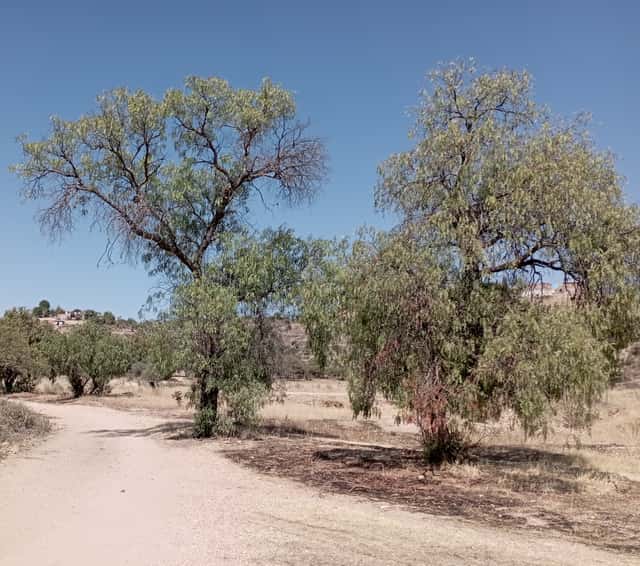
Schinus molle, known in Italy as "false pepper" or "pink pepper," is a majestic evergreen tree native to the arid and semi-arid regions of Peru and the South American Andes. It can reach 15 meters in height, developing a broad, dense, and weeping canopy that gives it an unmistakable appearance, similar to a weeping willow. Its leaves are pinnate, very aromatic to the touch, composed of numerous bright green, lanceolate leaflets. In spring and summer, it produces small white or cream flowers gathered in pendulous panicles, followed in autumn by abundant clusters of pinkish-red berries — the so-called pink peppercorns — which are highly ornamental and used as a spice. Thanks to its extraordinary drought resistance and ability to adapt to poor and stony soils, it is widely used in Mediterranean landscaping, as street trees, and in parks. It was considered sacred by pre-Columbian Peruvian populations, who used it in religious rituals and traditional medicine.
How to Propagate Peruvian peppertree?
seed
cutting
layering
How Big Does Peruvian peppertree Grow?
TLDR: Peruvian peppertree can reach up to 15.0m tall with Fast growth rate.
Max height
15.0m
Spread
10.0m
Growth rate
Fast
Foliage
Evergreen
Warning: Toxic Plant
This plant can be toxic if ingested. Keep out of reach of:
Plant Uses
Ornamental
Great for decoration
Aromatic
Pleasant fragrance
Medicinal
Medicinal properties
Edible
Can be consumed
Medicinal Uses
- Infusion of leaves and bark traditionally used as an anti-inflammatory and analgesic in Andean cultures
- The berries possess antibacterial and antioxidant properties, used in phytotherapy for digestive disorders
- The resin (oleoresin) is used to treat skin infections, wounds, and as a natural healing agent
- Leaf decoctions used against headaches and feverish conditions in traditional Peruvian medicine
- Antimicrobial properties demonstrated in scientific studies against certain pathogenic bacteria
Culinary Uses
- The dried berries, known as "pink peppercorns," are used as an aromatic spice in cooking
- Used in mixed pepper blends, marinades, sauces, risottos, white meats, and fish
- Can be ground into powder as a substitute for black pepper, with a more delicate and floral aroma
- Used to flavor vinegars, oils, and artisanal liqueurs
- Preparation of digestive herbal teas with dried berries
- Caution: excessive consumption of raw berries can cause gastrointestinal upset, especially in children
Is your plant showing symptoms?
Click on the symptom to discover possible causes:
What Diseases Commonly Affect Peruvian peppertree?
TLDR: Peruvian peppertree is susceptible to 7 known diseases. Monitor regularly for early detection.
Aphids
Aphids are small, soft-bodied, pear-shaped insects (1/16 to 1/8 inch long) that feed by sucking nutrient-rich sap from plants. They reproduce rapidly and can quickly weaken plants, causing distorted growth and transmitting plant viruses. Aphids come in various colors including green, black, red, yellow, brown, and gray. They secrete honeydew, a sticky substance that attracts ants and encourages sooty mold growth.
Scale Insects
Scale insects are small sap-sucking pests that appear as brown, shell-like bumps on plant stems and leaves. There are over 25 species, divided into armored (hard) and unarmored (soft) scales. They feed by piercing plant tissue and extracting sap, which weakens the plant and can lead to yellowing, stunted growth, and even death if left untreated. They also excrete honeydew, which attracts ants and promotes sooty mold growth.
Root Rot
Root rot is a serious fungal disease that affects the root system of plants, causing them to decay and die. It is primarily caused by overwatering, poor drainage, or soil-borne fungi such as Pythium, Phytophthora, Rhizoctonia, and Fusarium. The disease thrives in waterlogged conditions where roots are deprived of oxygen, making them susceptible to fungal infection.
Mealybugs
Mealybugs are small, soft-bodied insects covered with a white, waxy, cottony material. They are common pests of houseplants and outdoor plants in mild climates. These sap-sucking insects feed on plant tissue, causing damage, stunted growth, and can lead to plant death if left untreated. They produce sticky honeydew which attracts sooty mold.
Meaning & Symbolism
In ancient Andean cosmology, Schinus molle (called "molle" in Quechua) was considered a sacred tree, associated with purification, protection, and contact with the spiritual world. Inca priests used its leaves and resin in religious rituals. Even today, it is a symbol of resilience and vitality in South American popular traditions.
Compare with similar plants
| Attribute | Difficulty | Light | Watering | Pet Safe |
|---|---|---|---|---|
| Field Maple | Easy | Bright indirect | 14d | ✓ |
| Silver Birch | Easy | Direct sun | 14d | ✓ |
| Common Blanketflower | Easy | Direct sun | 10d | ✓ |
| Cushion Bush | Easy | Direct sun | 14d | ✓ |





