Fagaceae
American Beech (Fagus grandifolia)
Fagus grandifolia
A large tree for parks and big gardens in climates with cold winters (USDA zones 3 to 9). Plant it in full sun or part shade in fertile, moist, well-drained soil, ideally slightly acid. It does not tolerate wet sites, long droughts, road salt or compacted soil. It grows slowly, needs almost no pruning and resents being moved once established. Watch for beech bark disease and nematode-caused beech leaf disease.
Every 7 days
Partial shade
-40° - °C
% - %
Categories
What is American beech?
American beech (Fagus grandifolia) is a medium-care plant from the Fagaceae family. American beech (Fagus grandifolia) is a deciduous tree native to eastern North America, from Nova Scotia and Ontario south to eastern Texas and northern Florida. It grows slowly to 16-35 m, with a broad crown and a trunk of smooth, silver-gray bark. The 6-12 cm leaves are dark green and toothed; in...
American beech grows up to 35.0m, spread of 2400cm, watering every 7 days. It is not suitable for indoor environments and safe for pets.
Unlike many popular species, American beech is safe to keep around pets.
How to Care for American beech?
TLDR: American beech needs Partial shade, watering every 7 days, and temperatures between -40-30°C with 40-70% humidity.
How Often Should You Water American beech?
Keep the soil moist, watering deeply about once a week in the first years and during dry spells. Mature trees handle little drought. Avoid waterlogged soil.
How Much Light Does American beech Need?
Full sun (6+ hours) or part shade. It tolerates deep shade but grows denser with sun.
What Is the Best Soil for American beech?
Fertile, deep, moist and well-drained clay, loam or sand. Prefers slightly acid pH but tolerates alkaline soil. Roots are shallow: avoid compacting or trampling the area under the canopy.
What Pot Should You Use for American beech?
Not a container tree. Plant it in the ground in a spacious spot away from buildings: the crown can exceed 20 m across.
What Is American beech and Where Does It Come From?
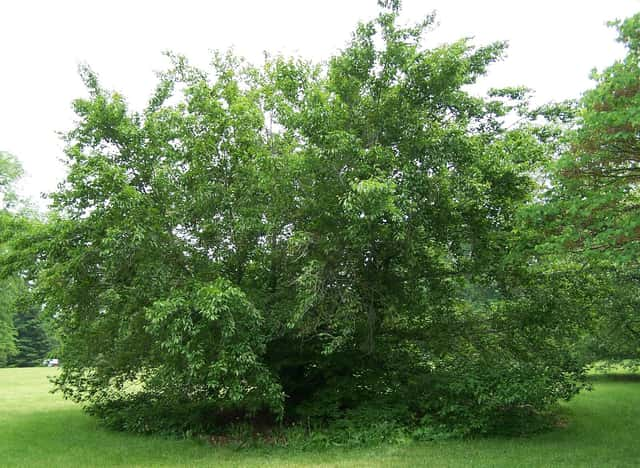
American beech (Fagus grandifolia) is a deciduous tree native to eastern North America, from Nova Scotia and Ontario south to eastern Texas and northern Florida. It grows slowly to 16-35 m, with a broad crown and a trunk of smooth, silver-gray bark. The 6-12 cm leaves are dark green and toothed; in fall they turn golden bronze and many stay on the branches through winter. Inconspicuous yellow-green flowers open in spring, and in fall the tree bears small three-sided nuts inside a prickly husk, a valuable food for birds and mammals. It is one of the most shade-tolerant trees in its range and can live 200 to 300 years.
How to Propagate American beech?
Seed
Dried seed loses viability quickly. Plant in the final spot early: American beech transplants poorly once large.
- 1 Collect the nuts in fall as soon as the husks open
- 2 Sow straight away 2-3 cm deep, or store in moist sand in the cold for about 3 months
- 3 Protect the seedbed from rodents
- 4 Keep seedlings in part shade the first year and plant out while young
Materials needed:
How Big Does American beech Grow?
TLDR: American beech can reach up to 35.0m tall with Slow growth rate.
Max height
35.0m
Spread
24.0m
Growth rate
Slow
Foliage
Deciduous
Warning: Toxic Plant
This plant can be toxic if ingested. Keep out of reach of:
Plant Uses
Ornamental
Great for decoration
Edible
Can be consumed
Culinary Uses
- Nuts can be eaten raw in small amounts or roasted
- Roasted, ground nuts have been used as a coffee substitute
Is your plant showing symptoms?
Click on the symptom to discover possible causes:
What Diseases Commonly Affect American beech?
TLDR: American beech is susceptible to 6 known diseases. Monitor regularly for early detection.
Scale Insects
Scale insects are small sap-sucking pests that appear as brown, shell-like bumps on plant stems and leaves. There are over 25 species, divided into armored (hard) and unarmored (soft) scales. They feed by piercing plant tissue and extracting sap, which weakens the plant and can lead to yellowing, stunted growth, and even death if left untreated. They also excrete honeydew, which attracts ants and promotes sooty mold growth.
Canker
Canker is a disease caused by various fungi and bacteria that create necrotic, sunken areas on bark of branches, stems, and trunks. Pathogens enter through wounds and natural openings, especially when plants are stressed. Canker can gradually weaken or kill branches by disrupting water and nutrient flow.
Root-Knot Nematodes
Root-knot nematodes (Meloidogyne species) are microscopic roundworms that parasitize plant roots, causing characteristic galls or knots. These soil-borne pests are among the most economically damaging plant pathogens worldwide, affecting a wide range of ornamental and edible plants. The nematodes inject enzymes into root cells, causing abnormal swelling and disrupting water and nutrient uptake.
Aphids
Aphids are small, soft-bodied, pear-shaped insects (1/16 to 1/8 inch long) that feed by sucking nutrient-rich sap from plants. They reproduce rapidly and can quickly weaken plants, causing distorted growth and transmitting plant viruses. Aphids come in various colors including green, black, red, yellow, brown, and gray. They secrete honeydew, a sticky substance that attracts ants and encourages sooty mold growth.
Fun Facts
Its smooth bark has attracted carvings for centuries.
Nut production starts at around 40 years of age.
It is one of the most shade-tolerant trees in eastern North America.
Frequently asked questions
Does American beech grow fast?
Are American beech nuts edible?
Why do the leaves stay on in winter?
What diseases affect American beech?
Compare with similar plants
| Attribute | Difficulty | Light | Watering | Pet Safe |
|---|---|---|---|---|
| Dark Fieldcap | Medium | Low light | 2d | ⚠️ |
| Azalea | Medium | Partial shade | 3d | ⚠️ |
| Muriel's Bamboo | Medium | Partial shade | 3d | ✓ |
| Bougainvillea | Medium | Direct sun | 7d | ⚠️ |