Nelumbonaceae
American Lotus (Nelumbo lutea)
Nelumbo lutea
A plant for ponds or large submerged containers, in full sun and heat: it needs several weeks above 27 °C to bloom. Plant the rhizome in heavy soil and keep it always under water. In open ponds, contain the rhizomes, as it spreads. The top growth dies back in winter and regrows in spring.
Every 3 days
Direct sun
° - °C
% - %
Categories
What is American lotus?
American lotus (Nelumbo lutea) is a medium-care plant from the Nelumbonaceae family. American lotus (Nelumbo lutea) is a perennial aquatic plant native to North America, Mexico, Central America and the Caribbean, growing in lakes, swamps and floodplains. Its roots and rhizome anchor in the mud, and the round leaves, 33 to 43 cm across, rise above the water on stalks that can exceed...
American lotus grows up to 1.8m, spread of 120cm, watering every 3 days. It is not suitable for indoor environments and safe for pets.
Unlike many popular species, American lotus is safe to keep around pets.
How to Care for American lotus?
TLDR: American lotus needs Direct sun, watering every 3 days, and temperatures between 15-30°C with 40-70% humidity.
How Often Should You Water American lotus?
It is aquatic: the soil must never dry out. Keep 5 to 60 cm of water over the rhizome (start shallow and deepen as it grows) and top up the level every few days in hot weather.
How Much Light Does American lotus Need?
Full sun, all day if possible. With too little sun it makes only leaves and hardly flowers.
What Is the Best Soil for American lotus?
Heavy clay or loam soil, rich in organic matter and saturated; accepts acid to alkaline pH. Do not use light potting mix, which floats.
What Pot Should You Use for American lotus?
A wide container without drainage holes (60 cm or more across), filled with heavy soil and set in the pond or filled with water. In a pond, the pot also keeps the rhizomes from spreading.
Care Schedule
Repot
Every 730 days
What Is American lotus and Where Does It Come From?
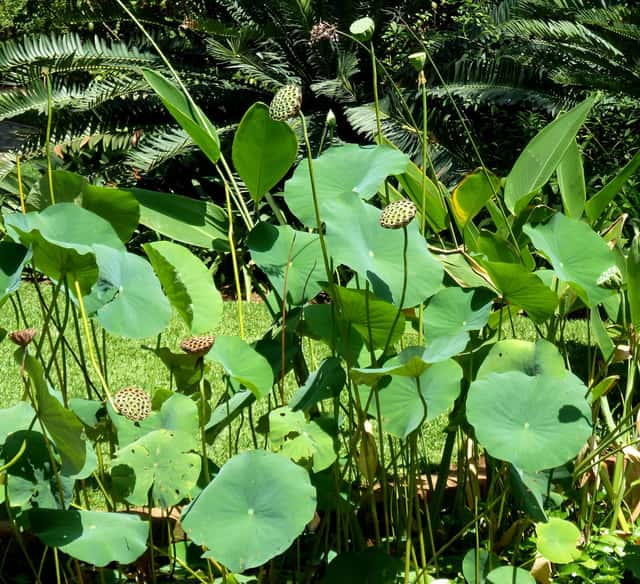
American lotus (Nelumbo lutea) is a perennial aquatic plant native to North America, Mexico, Central America and the Caribbean, growing in lakes, swamps and floodplains. Its roots and rhizome anchor in the mud, and the round leaves, 33 to 43 cm across, rise above the water on stalks that can exceed 1.5 m; the plant stands 0.8–1.8 m above the surface. In summer it opens large flowers, 18 to 28 cm wide, creamy white to pale yellow (lutea means "yellow" in Latin); each flower lasts about three days, opening in the morning and closing in the afternoon. It leaves a woody, shower-head-shaped seed pod with very long-lived seeds. Seeds and rhizomes are edible and were a food of Native American peoples. It spreads by long rhizomes and can take over a whole pond. It is a close relative of the sacred lotus (Nelumbo nucifera), with which it forms hybrids.
How to Propagate American lotus?
Rhizome division
The growing tip snaps easily: handle with care.
- 1 In early spring, lift the rhizome gently from the mud.
- 2 Cut pieces with at least one bud or growing tip.
- 3 Lay the piece on the surface of a wide pot of heavy soil, weighing it down with a stone, without burying the tip.
- 4 Cover with a few centimetres of water and deepen gradually as leaves grow.
Materials needed:
Sowing seed
Without scarifying, the hard coat can stop germination for years.
- 1 File the pointed end of the seed until the pale inner layer shows.
- 2 Soak in warm water, changing it daily, until it sprouts.
- 3 Plant the seedling in heavy soil under a few centimetres of water.
Materials needed:
How Big Does American lotus Grow?
TLDR: American lotus can reach up to 1.8m tall with Fast growth rate.
Max height
1.8m
Spread
1.2m
Growth rate
Fast
Foliage
Deciduous
Plant Uses
Ornamental
Great for decoration
Edible
Can be consumed
Culinary Uses
- Seeds (raw or cooked)
- Cooked rhizome
- Cooked young leaves
Is your plant showing symptoms?
Click on the symptom to discover possible causes:
What Diseases Commonly Affect American lotus?
TLDR: American lotus is susceptible to 2 known diseases. Monitor regularly for early detection.
Aphids
Aphids are small, soft-bodied, pear-shaped insects (1/16 to 1/8 inch long) that feed by sucking nutrient-rich sap from plants. They reproduce rapidly and can quickly weaken plants, causing distorted growth and transmitting plant viruses. Aphids come in various colors including green, black, red, yellow, brown, and gray. They secrete honeydew, a sticky substance that attracts ants and encourages sooty mold growth.
Leaf Spot
Leaf spot is a common fungal disease caused by various pathogens including Alternaria, Ascochyta, Colletotrichum, Septoria, and Venturia. It primarily affects leaves, causing discolored spots that can lead to premature leaf drop if left untreated.
Fun Facts
Its seeds are nicknamed alligator corn.
Native American peoples ate the seeds and rhizomes and helped spread the plant.
Each flower lasts about three days, opening in the morning and closing in the afternoon.
Frequently asked questions
How deep should the water be for American lotus?
Why is my lotus not blooming?
Is American lotus toxic?
Can it survive cold winters?
Compare with similar plants
| Attribute | Difficulty | Light | Watering | Pet Safe |
|---|---|---|---|---|
| Dark Fieldcap | Medium | Low light | 2d | ⚠️ |
| Azalea | Medium | Partial shade | 3d | ⚠️ |
| Muriel's Bamboo | Medium | Partial shade | 3d | ✓ |
| Bougainvillea | Medium | Direct sun | 7d | ⚠️ |




