Pontederiaceae
Anchored Water Hyacinth: Full Sun Plant
Pontederia azurea
A freshwater aquatic plant that requires full sun and a rich, muddy substrate for rooting. It needs permanent water (pond, tank, or large aquarium). It grows very quickly and can become invasive, requiring control and periodic removal of excess growth. Sensitive to cold: prefers tropical to subtropical climates.
Every 1 days
Direct sun
15° - 35°C
70% - 100%
Categories
What is Anchored Water Hyacinth?
Anchored Water Hyacinth (Pontederia azurea) is a medium-care plant from the Pontederiaceae family. The anchored water hyacinth (Pontederia azurea, syn. Eichhornia azurea) is a perennial aquatic plant in the Pontederiaceae family, native to Central and South America, including Brazil. Unlike the floating water hyacinth, this species roots in the bottom mud and sends out stems that stretch to the s...
Anchored Water Hyacinth grows up to 50cm, spread of 150cm, watering every 1 days, 15°C – 35°C, 70–100% humidity. It is not suitable for indoor environments and safe for pets.
Unlike many popular species, Anchored Water Hyacinth is safe to keep around pets.
How to Care for Anchored Water Hyacinth?
TLDR: Anchored Water Hyacinth needs Direct sun, watering every 1 days, and temperatures between 15-35°C with 70-100% humidity.
How Often Should You Water Anchored Water Hyacinth?
As an aquatic plant, it must always remain in water. Keep the water level stable and clean; never let the substrate dry out. In cultivation, replace part of the water to prevent excessive nutrient buildup.
How Much Light Does Anchored Water Hyacinth Need?
Requires full sun to bloom and maintain compact growth. In shade, the plant becomes leggy and produces few flowers. Ideal for open, well-lit ponds and tanks.
What Is the Best Soil for Anchored Water Hyacinth?
Roots in muddy, clayey substrate rich in organic matter at the bottom of the water body. In cultivation, use aquatic pots with heavy substrate submerged under the water surface.
What Pot Should You Use for Anchored Water Hyacinth?
Grow in a wide aquatic pot without holes, using heavy substrate, submerged in a pond or tank. Shallow and wide containers favor rooting and make it easier to control propagation.
What Is Anchored Water Hyacinth and Where Does It Come From?
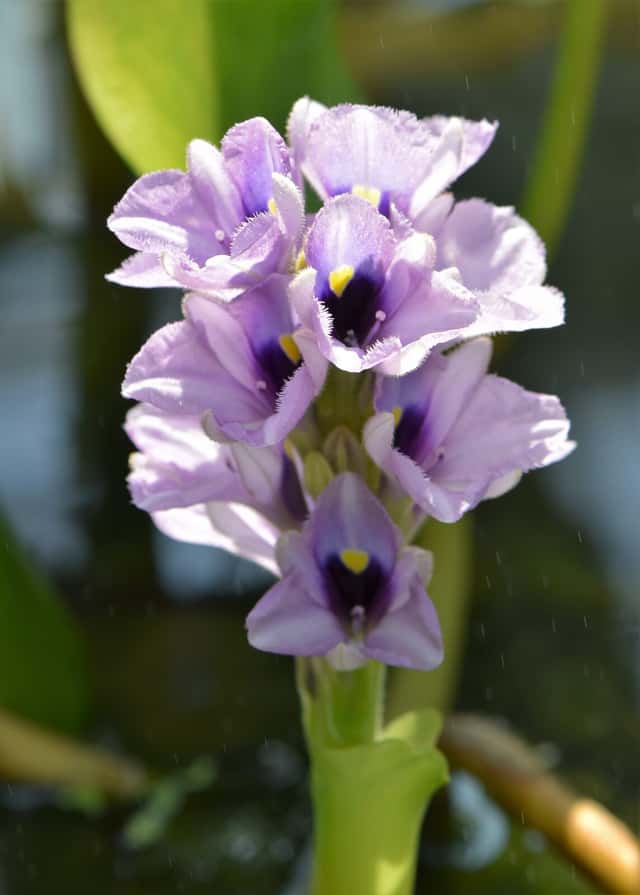
The anchored water hyacinth (Pontederia azurea, syn. Eichhornia azurea) is a perennial aquatic plant in the Pontederiaceae family, native to Central and South America, including Brazil. Unlike the floating water hyacinth, this species roots in the bottom mud and sends out stems that stretch to the surface. It has round, shiny green leaves about 10 cm wide and showy bluish-purple flowers with yellow markings. It grows vigorously in still or slow-moving waters.
How to Propagate Anchored Water Hyacinth?
Stolon division
The plant multiplies on its own very quickly; separate only what is necessary and dispose of excess responsibly to avoid dispersal into natural waterways.
- 1 Select a healthy stem with nodes that are already producing roots or shoots.
- 2 Cut a segment between two nodes using clean scissors.
- 3 Plant the segment in muddy substrate inside an aquatic pot.
- 4 Submerge the pot in warm, well-lit water until established.
Materials needed:
How Big Does Anchored Water Hyacinth Grow?
TLDR: Anchored Water Hyacinth can reach up to 50cm tall with Fast growth rate.
Max height
50cm
Spread
1.5m
Growth rate
Fast
Foliage
Evergreen
Plant Uses
Ornamental
Great for decoration
Is your plant showing symptoms?
Click on the symptom to discover possible causes:
What Diseases Commonly Affect Anchored Water Hyacinth?
TLDR: Anchored Water Hyacinth is susceptible to 2 known diseases. Monitor regularly for early detection.
Aphids
Aphids are small, soft-bodied, pear-shaped insects (1/16 to 1/8 inch long) that feed by sucking nutrient-rich sap from plants. They reproduce rapidly and can quickly weaken plants, causing distorted growth and transmitting plant viruses. Aphids come in various colors including green, black, red, yellow, brown, and gray. They secrete honeydew, a sticky substance that attracts ants and encourages sooty mold growth.
Root Rot
Root rot is a serious fungal disease that affects the root system of plants, causing them to decay and die. It is primarily caused by overwatering, poor drainage, or soil-borne fungi such as Pythium, Phytophthora, Rhizoctonia, and Fusarium. The disease thrives in waterlogged conditions where roots are deprived of oxygen, making them susceptible to fungal infection.
Meaning & Symbolism
Associated with the serene beauty of ponds and still waters; due to its vigorous growth, it also evokes expansion and resilience.
Compare with similar plants
| Attribute | Difficulty | Light | Watering | Pet Safe |
|---|---|---|---|---|
| Dark Fieldcap | Medium | Low light | 2d | ⚠️ |
| Azalea | Medium | Partial shade | 3d | ⚠️ |
| Muriel's Bamboo | Medium | Partial shade | 3d | ✓ |
| Bougainvillea | Medium | Direct sun | 7d | ⚠️ |




