Ranunculaceae
Anemone (Windflower)
Anemone
Plant anemones in full sun to partial shade in fertile, well-drained soil that stays lightly moist. Soak poppy anemone tubers for a few hours before planting them about 5-8 cm deep; Japanese anemones are bought as plants and left to form clumps. Water when the top layer of soil starts to dry, never leave the roots in soggy soil, and cut back flowered stems after blooming. In cold regions protect autumn-planted tubers over winter or lift them and replant in spring.
Every 5 days
Bright indirect
° - °C
% - %
Categories
What is Anemone?
Anemone (Anemone) is a medium-care plant from the Ranunculaceae family. Anemone is a genus of perennial flowering plants in the buttercup family (Ranunculaceae), native to temperate and subtropical regions of every continent except Australia, New Zealand and Antarctica. Gardeners mainly grow three groups. The poppy anemone (Anemone coronaria) from the Mediterranean grow...
Anemone grows up to 1.5m, spread of 80cm, watering every 5 days. It is not suitable for indoor environments and not safe for pets.
Without precautions, ingestion can cause irritation in pets. Keep out of reach of cats and dogs.
How to Care for Anemone?
TLDR: Anemone needs Bright indirect, watering every 5 days, and temperatures between 15-30°C with 40-70% humidity.
How Often Should You Water Anemone?
Keep the soil evenly moist during growth and flowering, watering roughly every 4-6 days in dry weather and letting the top layer dry slightly in between. Water at the base, not over the leaves, to limit mildew and grey mould. Tubers rot quickly in waterlogged ground, so cut back watering once the foliage of spring anemones yellows and the plant goes dormant.
How Much Light Does Anemone Need?
Most anemones flower best with at least 6 hours of sun a day. In hot climates give them light afternoon shade; Japanese anemones and Grecian windflowers also do well in dappled shade under trees. Too little light gives long, weak stems and few flowers.
What Is the Best Soil for Anemone?
Use loose, fertile soil rich in organic matter that drains freely: dig in compost or well-rotted manure before planting and add grit or sand to heavy clay, or plant in raised beds. In pots, a peat-free multipurpose compost with extra grit works well. Good drainage matters more than soil type.
What Pot Should You Use for Anemone?
A pot at least 20-30 cm wide with drainage holes, such as terracotta, filled with gritty, well-drained compost. Poppy anemones and Grecian windflowers suit pots and troughs; tall Japanese anemones are better in the ground.
What Is Anemone and Where Does It Come From?
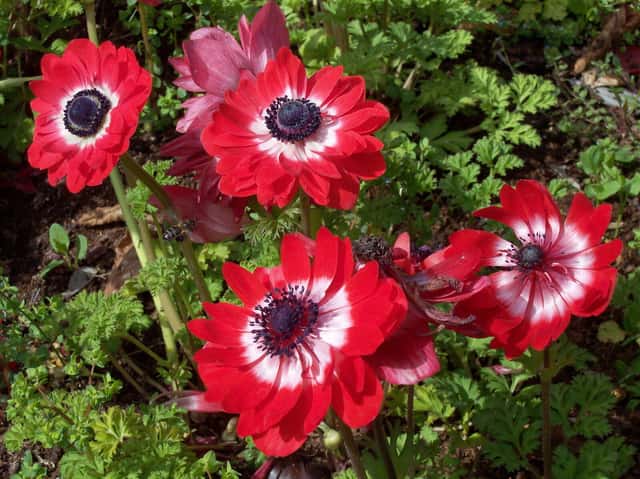
Anemone is a genus of perennial flowering plants in the buttercup family (Ranunculaceae), native to temperate and subtropical regions of every continent except Australia, New Zealand and Antarctica. Gardeners mainly grow three groups. The poppy anemone (Anemone coronaria) from the Mediterranean grows from small tubers, reaches 20-40 cm and opens bowl-shaped flowers 3-10 cm wide in red, pink, purple, blue or white, often with a dark centre, from late winter to spring; it is also a popular cut flower. The Grecian windflower (A. blanda) forms low carpets of daisy-like blue, pink or white flowers in early spring. Japanese anemones (A. x hybrida and A. hupehensis) are tall clumps of 60-150 cm with pink or white flowers on wiry stems from late summer to autumn. Some botanists now place the Grecian and Japanese anemones in the related genera Anemonoides and Eriocapitella, but in gardens they are still sold as anemones. All parts of the plant are poisonous.
How to Propagate Anemone?
Planting and dividing tubers
Do not soak for too long or the tubers may rot. In cold areas plant in spring or keep autumn plantings in a cold frame.
- 1 Soak dry tubers in room-temperature water for 2-4 hours until they swell
- 2 Plant them about 5-8 cm deep and 10-15 cm apart in well-drained soil
- 3 Water once and then keep the soil only slightly moist until shoots appear
- 4 After several years, lift crowded tubers when dormant and break them into pieces that each have a bud
Materials needed:
Division of clumps
Japanese anemones resent disturbance and may take a season to settle. Small root pieces left in the ground often grow into new plants.
- 1 Dig up an established clump of Japanese anemone in early spring or autumn
- 2 Split it into sections, each with roots and several shoots
- 3 Replant at the same depth in prepared soil
- 4 Water well and keep moist until new growth starts
Materials needed:
Sowing seed
Fresh seed germinates best. Seedlings of named varieties may not look like the parent plant.
- 1 Sow fresh seed on the surface of moist seed compost
- 2 Cover very lightly and keep in a cool, shaded spot
- 3 Prick out seedlings into small pots when they have true leaves
- 4 Plant out the following season
Materials needed:
How Big Does Anemone Grow?
TLDR: Anemone can reach up to 1.5m tall with Medium growth rate.
Max height
1.5m
Spread
80cm
Growth rate
Medium
Foliage
Deciduous
Warning: Toxic Plant
This plant can be toxic if ingested. Keep out of reach of:
Plant Uses
Ornamental
Great for decoration
Is your plant showing symptoms?
Click on the symptom to discover possible causes:
What Diseases Commonly Affect Anemone?
TLDR: Anemone is susceptible to 11 known diseases. Monitor regularly for early detection.
Root Rot
Root rot is a serious fungal disease that affects the root system of plants, causing them to decay and die. It is primarily caused by overwatering, poor drainage, or soil-borne fungi such as Pythium, Phytophthora, Rhizoctonia, and Fusarium. The disease thrives in waterlogged conditions where roots are deprived of oxygen, making them susceptible to fungal infection.
Powdery Mildew
Powdery mildew is a common fungal disease caused by various fungi species including Erysiphe, Podosphaera, Oïdium, and Leveillula. It affects over 10,000 plant species worldwide. The disease thrives in warm, dry climates with high humidity and appears as a distinctive white powdery coating on plant surfaces.
Downy Mildew
Downy mildew is a fungal-like disease caused by oomycetes (water molds) that thrives in cool, wet conditions. It affects a wide range of plants, causing yellowing leaves with fuzzy white-gray growth underneath, leading to defoliation and reduced yields if left untreated.
Rust
Rust is a common fungal disease caused by fungi in the order Pucciniales that affects a wide variety of plants. The disease gets its name from the characteristic orange, yellow, or reddish-brown pustules that appear on leaves, resembling metal rust. This obligate fungal parasite requires living plants to survive and can cause significant economic losses in agricultural crops.
Meaning & Symbolism
Called the "daughter of the wind" in Greek, the anemone stands for anticipation and fragile, fleeting love. In Greek myth the red anemone sprang from the blood of Adonis, mourned by Aphrodite; in Victorian flower language it meant forsaken love.
Fun Facts
The name anemone comes from Greek and is often translated as daughter of the wind, hence the common name windflower.
Anemone coronaria was chosen as the national flower of Israel in 2013.
What look like petals on an anemone are in fact sepals; the flowers have no true petals.
Despite catalogue names, there are no truly blue anemones: the blue ones are bluish violet.
Frequently asked questions
Should I soak anemone tubers before planting?
How deep do I plant anemones?
Are anemones toxic to cats and dogs?
When do anemones flower?
Why are my anemone tubers rotting?
Compare with similar plants
| Attribute | Difficulty | Light | Watering | Pet Safe |
|---|---|---|---|---|
| Dark Fieldcap | Medium | Low light | 2d | ⚠️ |
| Azalea | Medium | Partial shade | 3d | ⚠️ |
| Muriel's Bamboo | Medium | Partial shade | 3d | ✓ |
| Bougainvillea | Medium | Direct sun | 7d | ⚠️ |
Choose & Compare
Sources & References
- Anemone - Wikipedia
- Anemone coronaria - Wikipedia
- Anemone - NC State Extension Gardener Plant Toolbox
- How to plant anemone de Caen corms - Gardeners' World
- Anemone coronaria (poppy anemone) - Chicago Botanic Garden Plant Finder
- Anemone x hybrida (Japanese anemone) - RHS Plants
- Anemone Diseases: Signs, Causes and Solutions - Dutch Bulbs




