Araceae
Anubias: Best for Low Light
Anubias barteri
An undemanding aquarium plant suitable for beginners. It should not be planted in the substrate but rather attached to decorations (lava rock, driftwood). It tolerates a wide range of water temperatures, hardness, and pH levels, requiring only moderate fertilization and a gentle water current around the rhizome.
Every 1 days
Low light
22° - 28°C
80% - 100%
Categories
What is Anubias?
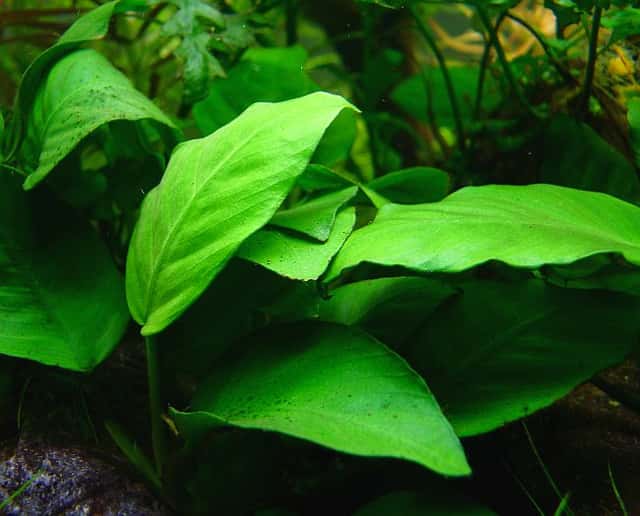
Anubias (Anubias barteri) is a easy-care plant from the Araceae family. Anubias barteri is an exceptionally hardy aquatic plant native to West Africa, belonging to the Araceae family. It is characterized by tough, dark green leaves growing from a creeping rhizome and its ability to grow attached to rocks, driftwood, or roots instead of rooting in the substrate. It grows...
Anubias grows up to 40cm, spread of 30cm, watering every 1 days, 22°C – 28°C, 80–100% humidity. It is suitable for indoor environments and not safe for pets.
Unlike many tropical plants, Anubias tolerates watering mistakes. Best for beginners. Without precautions, ingestion can cause irritation in pets. Keep out of reach of cats and dogs. Without adequate drainage, root rot can develop within 7 days.
How to Care for Anubias?
TLDR: Anubias needs Low light, watering every 1 days, and temperatures between 22-28°C with 80-100% humidity.
How Often Should You Water Anubias?
As an aquatic plant, it must be permanently submerged in water or grown in very high humidity within a paludarium. A gentle water flow around the rhizome helps prevent rot by keeping it oxygenated.
How Much Light Does Anubias Need?
It thrives in low to medium lighting for 8–10 hours a day. Strong direct light will not speed up growth but instead encourages algae to form on its slow-growing leaves, so it is best avoided.
What Is the Best Soil for Anubias?
The rhizome must never be buried in substrate or sand—this is the most common cause of rot. While the roots can grow down into the bottom, the rhizome itself must always remain exposed and visible.
What Pot Should You Use for Anubias?
It thrives best when attached to lava rock or driftwood using fishing line or specialized aquarium glue until it secures itself with its own roots.
Care Schedule
Fertilize
Every 30 days
What Is Anubias and Where Does It Come From?
Anubias barteri is an exceptionally hardy aquatic plant native to West Africa, belonging to the Araceae family. It is characterized by tough, dark green leaves growing from a creeping rhizome and its ability to grow attached to rocks, driftwood, or roots instead of rooting in the substrate. It grows very slowly—producing a new leaf approximately once every 2 to 3 months—and tolerates low lighting, making it one of the most popular and resilient plants in the aquarium hobby.
How to Propagate Anubias?
Rhizome Division
- Never bury the rhizome in sand or substrate, otherwise it will begin to rot.
- Maintain a gentle water flow around the new plant until it establishes itself.
- 1 Selecting a healthy rhizome
Find a firm, green rhizome with at least 3 to 5 leaves, free of soft or translucent spots.
- 2 Cutting
Using sharp, disinfected scissors, cut a section of the rhizome that includes both roots and leaves.
- 3 Securing
Attach the new section to a new surface using fishing line or glue, ensuring the rhizome remains outside the substrate.
Materials needed:
How Big Does Anubias Grow?
TLDR: Anubias can reach up to 40cm tall with Slow growth rate.
Max height
40cm
Spread
30cm
Growth rate
Slow
Foliage
Evergreen
Warning: Toxic Plant
This plant can be toxic if ingested. Keep out of reach of:
Plant Uses
Ornamental
Great for decoration
Is your plant showing symptoms?
Click on the symptom to discover possible causes:
What Diseases Commonly Affect Anubias?
TLDR: Anubias is susceptible to 3 known diseases. Monitor regularly for early detection.
Root Rot
Root rot is a serious fungal disease that affects the root system of plants, causing them to decay and die. It is primarily caused by overwatering, poor drainage, or soil-borne fungi such as Pythium, Phytophthora, Rhizoctonia, and Fusarium. The disease thrives in waterlogged conditions where roots are deprived of oxygen, making them susceptible to fungal infection.
Leaf Spot
Leaf spot is a common fungal disease caused by various pathogens including Alternaria, Ascochyta, Colletotrichum, Septoria, and Venturia. It primarily affects leaves, causing discolored spots that can lead to premature leaf drop if left untreated.
Nutrient Deficiency
Nutrient deficiency occurs when a plant cannot access one or more essential mineral elements in sufficient quantities for healthy growth. Plants require 17 essential nutrients: macronutrients (N, P, K, Ca, Mg, S) and micronutrients (Fe, Zn, Mn, Cu, B, Mo, Cl). Each plays a unique role in metabolism, structure, and reproduction. Deficiencies arise from depleted soils, incorrect pH blocking uptake, poor watering practices leaching nutrients, root damage, or imbalanced fertilization. Understanding whether a nutrient is mobile or immobile determines where symptoms first appear: mobile nutrients (N, P, K, Mg) show symptoms on older leaves first, while immobile nutrients (Ca, Fe, Zn, Cu, B) show symptoms on new growth first.
Meaning & Symbolism
In the aquarium hobby, it symbolizes endurance and stability due to its incredible resilience and ability to survive even in challenging conditions.
Compare with similar plants
| Attribute | Difficulty | Light | Watering | Pet Safe |
|---|---|---|---|---|
| Field Maple | Easy | Bright indirect | 14d | ✓ |
| Silver Birch | Easy | Direct sun | 14d | ✓ |
| Common Blanketflower | Easy | Direct sun | 10d | ✓ |
| Cushion Bush | Easy | Direct sun | 14d | ✓ |





