Acanthaceae
Aphelandra
Aphelandra
A tropical plant that wants steady conditions: bright indirect light, evenly moist (never soggy) soil, warmth between 15 and 27 C and fairly high humidity. Feed every two weeks from spring to late summer, cut off faded flower spikes and prune back after flowering to keep it bushy. It does not like drafts, cold or drying out, which make it drop its lower leaves.
Every 5 days
Partial shade
15° - 27°C
50% - 70%
Categories
What is Aphelandra?
Aphelandra (Aphelandra) is a medium-care plant from the Acanthaceae family. Aphelandra is a genus of about 200 evergreen shrubs in the acanthus family (Acanthaceae), native to tropical forests of Central and South America. In the wild many reach 1-2 m, but the ones grown at home stay compact. The best known is Aphelandra squarrosa, the zebra plant from Brazil's Atlantic For...
Aphelandra grows up to 60cm, spread of 60cm, watering every 5 days, 15°C – 27°C, 50–70% humidity. It is suitable for indoor environments and safe for pets.
Unlike many popular species, Aphelandra is safe to keep around pets. Without adequate drainage, root rot can develop within 10 days.
How to Care for Aphelandra?
TLDR: Aphelandra needs Partial shade, watering every 5 days, and temperatures between 15-27°C with 50-70% humidity.
How Often Should You Water Aphelandra?
Keep the soil lightly and evenly moist during spring and summer, watering when the top 2-3 cm feel dry, usually every 4-6 days. Small, frequent waterings work better than occasional soakings. In winter let the surface dry a little more between waterings. Use room-temperature filtered or rain water if your tap water is hard, and always empty the saucer: both drought and waterlogging make the lower leaves yellow and fall.
How Much Light Does Aphelandra Need?
Give it plenty of bright but indirect light, such as near an east window or a couple of metres from a south or west window. Gentle morning sun is fine, but strong midday sun scorches the leaves. Good light for about three months is what triggers the flower spikes; in a dim spot it will keep its leaves but rarely bloom.
What Is the Best Soil for Aphelandra?
Use a rich, peat- or coir-based potting mix that holds moisture but drains well, such as African violet mix, or regular potting soil with added perlite. A slightly acidic substrate (pH around 5.6-6.0) is ideal. Make sure the pot has drainage holes.
What Pot Should You Use for Aphelandra?
A plastic or glazed pot with drainage holes, only slightly larger than the root ball; Aphelandra flowers better when a little pot-bound and plastic helps keep moisture even.
Care Schedule
Fertilize
Every 14 days
Misting
Every 3 days
Repot
Every 730 days
What Is Aphelandra and Where Does It Come From?
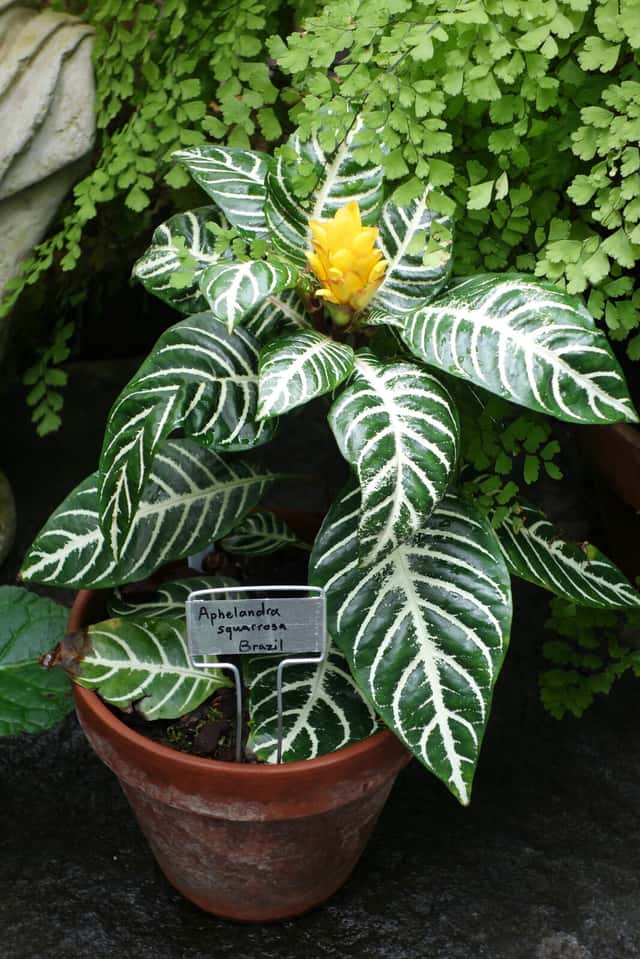
Aphelandra is a genus of about 200 evergreen shrubs in the acanthus family (Acanthaceae), native to tropical forests of Central and South America. In the wild many reach 1-2 m, but the ones grown at home stay compact. The best known is Aphelandra squarrosa, the zebra plant from Brazil's Atlantic Forest: glossy dark green leaves with bold white or cream veins and, in late summer or autumn, a cone-shaped spike of golden-yellow bracts that stays colourful for several weeks while the small tubular flowers last only days. Other cultivated species, such as A. aurantiaca and A. sinclairiana, carry orange, scarlet or coral-pink spikes. Grown as houseplants they reach about 30-60 cm, grow slowly and are prized for both foliage and flowers.
How to Propagate Aphelandra?
Stem tip cuttings
Bottom heat and high humidity greatly improve rooting. Spring cuttings taken after flowering root best. Keep the mix moist but not wet.
- 1 Cut a healthy shoot tip 10-15 cm long with at least two pairs of leaves, just below a node.
- 2 Remove the lowest leaves and dip the cut end in rooting hormone.
- 3 Insert it in a moist mix of peat or coir and perlite.
- 4 Cover with a clear bag or propagator and keep at 21-24 C in bright indirect light.
- 5 Pot it on once new leaves appear.
Materials needed:
Air layering
Useful for rejuvenating an old plant that has lost its lower leaves. Keep the moss moist the whole time.
- 1 Choose a tall, leggy stem and make a small upward cut or remove a thin ring of bark below a node.
- 2 Wrap the wound with moist sphagnum moss.
- 3 Cover the moss with plastic film and tie both ends.
- 4 When roots are visible through the film, cut the stem below them and pot it up.
Materials needed:
How Big Does Aphelandra Grow?
TLDR: Aphelandra can reach up to 60cm tall with Slow growth rate.
Max height
60cm
Spread
60cm
Growth rate
Slow
Foliage
Evergreen
Plant Uses
Ornamental
Great for decoration
Is your plant showing symptoms?
Click on the symptom to discover possible causes:
What Diseases Commonly Affect Aphelandra?
TLDR: Aphelandra is susceptible to 10 known diseases. Monitor regularly for early detection.
Root Rot
Root rot is a serious fungal disease that affects the root system of plants, causing them to decay and die. It is primarily caused by overwatering, poor drainage, or soil-borne fungi such as Pythium, Phytophthora, Rhizoctonia, and Fusarium. The disease thrives in waterlogged conditions where roots are deprived of oxygen, making them susceptible to fungal infection.
Gray Mold (Botrytis Blight)
Gray mold, caused by the fungus Botrytis cinerea, is one of the most common fungal diseases in plants. It affects over 200 plant species, including ornamentals, vegetables, fruits, and houseplants. The disease thrives in cool, humid conditions with poor air circulation, causing grayish spots and soft rot on infected tissues.
Leaf Spot
Leaf spot is a common fungal disease caused by various pathogens including Alternaria, Ascochyta, Colletotrichum, Septoria, and Venturia. It primarily affects leaves, causing discolored spots that can lead to premature leaf drop if left untreated.
Whiteflies
Whiteflies are small, soft-bodied, winged insects closely related to aphids and mealybugs. They are moth-like in appearance, about 1/16 inch long, triangular in shape, and gray-white in color. These sap-sucking pests feed on plant tissue, causing yellowing, stunted growth, and wilting. They also excrete honeydew, which attracts ants and promotes sooty mold growth. Whiteflies can transmit serious plant viruses.
Meaning & Symbolism
Tropical exuberance and vitality: the bold striped leaves and glowing golden flower spikes make Aphelandra a symbol of energy, warmth and cheerful contrast.
Fun Facts
The genus name comes from Greek apheles (simple) and aner, andros (male), referring to the single-chambered anthers of its flowers.
The colourful part of the flower spike is made of bracts, which stay bright for weeks while each true flower lasts only a few days.
Wild Aphelandra flowers are pollinated mainly by hummingbirds, which is why they are tubular and brightly coloured.
Frequently asked questions
How often should I water an Aphelandra?
Why is my Aphelandra dropping its leaves?
How do I make my zebra plant bloom again?
Is Aphelandra toxic to cats and dogs?
Compare with similar plants
| Attribute | Difficulty | Light | Watering | Pet Safe |
|---|---|---|---|---|
| Dark Fieldcap | Medium | Low light | 2d | ⚠️ |
| Azalea | Medium | Partial shade | 3d | ⚠️ |
| Muriel's Bamboo | Medium | Partial shade | 3d | ✓ |
| Bougainvillea | Medium | Direct sun | 7d | ⚠️ |
Choose & Compare
Sources & References
- Aphelandra - Wikipedia
- Aphelandra squarrosa - Wikipedia
- How to Plant, Grow and Care for Zebra Plant - Epic Gardening
- Zebra Plant (Aphelandra squarrosa) Plant Care - Healthy Houseplants
- Aphelandra squarrosa - UK Houseplants
- Aphelandra squarrosa (Zebra Plant) - World of Plants
- Zebra Plant - ASPCA Toxic and Non-Toxic Plants




