Iridaceae
Apostle Plant: Ground Cover Plant
Neomarica gracilis
The apostle plant thrives in bright indirect light or partial shade, in rich, well-draining soil kept evenly moist. It tolerates warm, humid conditions well but benefits from a cooler spell in winter to trigger the next round of blooms. Easy to grow indoors or in shaded garden beds, it makes a low-maintenance, long-lived houseplant or landscape accent.
Every 7 days
Partial shade
10° - 27°C
40% - 50%
Categories
What is Apostle Plant?
Apostle Plant (Neomarica gracilis) is a easy-care plant from the Iridaceae family. Neomarica gracilis, commonly called the apostle plant or walking iris, is a rhizomatous perennial in the Iridaceae family, native to Brazil. Its nickname comes from an unusual habit: after flowering, small plantlets form at the tips of the flower stalks, which arch over under their own weight until...
Apostle Plant grows up to 75cm, spread of 40cm, watering every 7 days, 10°C – 27°C, 40–50% humidity. It is suitable for indoor environments and not safe for pets.
Unlike many tropical plants, Apostle Plant tolerates watering mistakes. Best for beginners. Without precautions, ingestion can cause irritation in pets. Keep out of reach of cats and dogs. Without adequate drainage, root rot can develop within 14 days.
How to Care for Apostle Plant?
TLDR: Apostle Plant needs Partial shade, watering every 7 days, and temperatures between 10-27°C with 40-50% humidity.
How Often Should You Water Apostle Plant?
Keep the soil consistently moist but never soggy — water once the top inch starts to dry out. Cut back watering in winter while the plant rests, since waterlogged soil during cool weather quickly leads to root rot.
How Much Light Does Apostle Plant Need?
Give it bright, indirect light or dappled shade. Harsh midday sun scorches the thin leaves, while too little light suppresses flowering — an east- or west-facing window, or a partly shaded patio spot, works best.
What Is the Best Soil for Apostle Plant?
Plant in rich, organic, well-draining soil with a pH between 5.5 and 7. A mix of potting soil, coarse sand or perlite, and organic matter like peat or compost mimics its natural forest-floor habitat.
What Pot Should You Use for Apostle Plant?
Choose a terracotta or unglazed ceramic pot with good drainage holes, which helps excess moisture evaporate and lowers the risk of root rot. The plant actually flowers best when slightly pot-bound, so avoid oversized containers.
Care Schedule
Fertilize
Every 14 days
What Is Apostle Plant and Where Does It Come From?
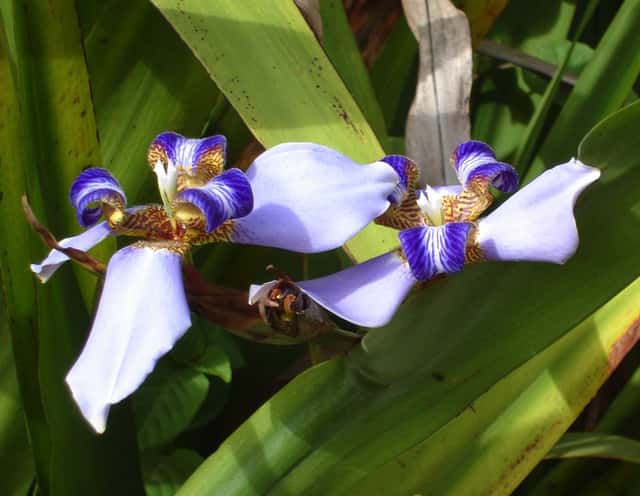
Neomarica gracilis, commonly called the apostle plant or walking iris, is a rhizomatous perennial in the Iridaceae family, native to Brazil. Its nickname comes from an unusual habit: after flowering, small plantlets form at the tips of the flower stalks, which arch over under their own weight until they touch the soil and take root, letting the plant "walk" outward from the parent clump. The sword-shaped, fan-arranged leaves are evergreen, and the striking flowers — white outer petals with violet, blue, and brown markings on the inner segments — bloom in succession through spring and summer, though each individual flower lasts only a single day.
How to Propagate Apostle Plant?
Clump division
Divide in spring at the start of the growing season so the plant has time to establish before winter.
- 1 Lift the clump from its pot or bed, keeping as many roots intact as possible
- 2 Separate the rhizomes into sections, each with at least one fan of leaves and healthy roots
- 3 Replant each section at its original depth in rich, well-draining soil
- 4 Keep the soil moist until new growth appears
Materials needed:
Flower-stalk plantlets
You can also snip off a plantlet before it roots and press it directly into moist potting mix to root it separately.
- 1 Wait for small plantlets to form at the tip of spent flower stalks
- 2 Let the stalk arch down naturally until the plantlet touches soil or a nearby pot
- 3 Once the plantlet has rooted on its own, cut the stalk connecting it to the parent plant
- 4 Transplant the newly rooted plantlet into its own pot if needed
Materials needed:
How Big Does Apostle Plant Grow?
TLDR: Apostle Plant can reach up to 75cm tall with Medium growth rate.
Max height
75cm
Spread
40cm
Growth rate
Medium
Foliage
Evergreen
Warning: Toxic Plant
This plant can be toxic if ingested. Keep out of reach of:
Plant Uses
Ornamental
Great for decoration
Ground Cover
Soil coverage
Is your plant showing symptoms?
Click on the symptom to discover possible causes:
What Diseases Commonly Affect Apostle Plant?
TLDR: Apostle Plant is susceptible to 6 known diseases. Monitor regularly for early detection.
Root Rot
Root rot is a serious fungal disease that affects the root system of plants, causing them to decay and die. It is primarily caused by overwatering, poor drainage, or soil-borne fungi such as Pythium, Phytophthora, Rhizoctonia, and Fusarium. The disease thrives in waterlogged conditions where roots are deprived of oxygen, making them susceptible to fungal infection.
Leaf Spot
Leaf spot is a common fungal disease caused by various pathogens including Alternaria, Ascochyta, Colletotrichum, Septoria, and Venturia. It primarily affects leaves, causing discolored spots that can lead to premature leaf drop if left untreated.
Spider Mites
Spider mites are tiny arachnids (less than 1/20 inch long) related to spiders and ticks that feed on plant sap. They thrive in hot, dry conditions and can cause significant damage to ornamental and vegetable plants. During severe infestations, crop losses can reach 14% or higher as these pests disrupt vital plant processes including photosynthesis, carbon dioxide absorption, and transpiration.
Aphids
Aphids are small, soft-bodied, pear-shaped insects (1/16 to 1/8 inch long) that feed by sucking nutrient-rich sap from plants. They reproduce rapidly and can quickly weaken plants, causing distorted growth and transmitting plant viruses. Aphids come in various colors including green, black, red, yellow, brown, and gray. They secrete honeydew, a sticky substance that attracts ants and encourages sooty mold growth.
Meaning & Symbolism
Because it produces new plantlets that "walk" across the ground on arching stems, the walking iris is often seen as a symbol of renewal, generosity, and sharing — every rooted plantlet is effectively a gift to pass along. Its other common name, apostle plant, comes from folklore claiming the plant withholds its blooms until it has grown twelve leaves in its fan, one for each apostle.
Compare with similar plants
| Attribute | Difficulty | Light | Watering | Pet Safe |
|---|---|---|---|---|
| Field Maple | Easy | Bright indirect | 14d | ✓ |
| Silver Birch | Easy | Direct sun | 14d | ✓ |
| Common Blanketflower | Easy | Direct sun | 10d | ✓ |
| Cushion Bush | Easy | Direct sun | 14d | ✓ |





