Casuarinaceae
Casuarina: Full Sun Plant
Casuarina equisetifolia
A hardy tree for full sun, adapted to sandy, poor, and saline soils; requires regular watering only during the establishment phase and then becomes highly drought-tolerant; should not be grown in pots long-term due to its size and vigorous root system.
Every 14 days
Direct sun
5° - 38°C
30% - 70%
Categories
What is Casuarina?
Casuarina (Casuarina equisetifolia) is a easy-care plant from the Casuarinaceae family. Casuarina equisetifolia is a fast-growing tree native to Australia, Southeast Asia, and the Pacific Islands, now widely naturalized in tropical and subtropical coastal regions worldwide. Despite its conifer-like appearance, it is an angiosperm: its thin, jointed, horsetail-like branches replace true...
Casuarina grows up to 40.0m, spread of 1000cm, watering every 14 days, 5°C – 38°C, 30–70% humidity. It is not suitable for indoor environments and safe for pets.
Unlike many tropical plants, Casuarina tolerates watering mistakes. Best for beginners. Unlike many popular species, Casuarina is safe to keep around pets.
How to Care for Casuarina?
TLDR: Casuarina needs Direct sun, watering every 14 days, and temperatures between 5-38°C with 30-70% humidity.
How Often Should You Water Casuarina?
Water newly planted seedlings frequently until they show clear signs of growth (usually 6 to 12 months). Once established, the tree tolerates long periods of drought and only needs extra water during very prolonged dry spells; avoid waterlogging, as poorly drained soil promotes root rot.
How Much Light Does Casuarina Need?
Needs direct full sun (minimum of 6 hours daily) to grow vigorously and maintain a dense canopy; in partial shade, it grows sparsely and more slowly, and does not tolerate dense shade.
What Is the Best Soil for Casuarina?
Thrives best in sandy, light, and well-drained soils, but is extremely adaptable to poor, compacted, rocky, and saline soils, with a pH from slightly acidic to alkaline (5.5 to 8.5). The only factor it does not tolerate is prolonged waterlogging.
What Pot Should You Use for Casuarina?
Not recommended for permanent pot cultivation: its tall stature and aggressive, extensive root system quickly outgrow the capacity of any container. It can be kept young for a few years in a large, deep pot as a temporary stage before definitive planting in the ground, or as a bonsai with regular root pruning.
Care Schedule
Fertilize
Every 60 days
What Is Casuarina and Where Does It Come From?
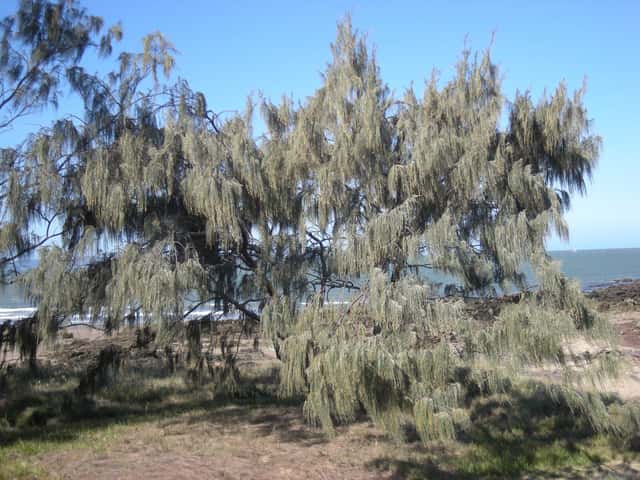
Casuarina equisetifolia is a fast-growing tree native to Australia, Southeast Asia, and the Pacific Islands, now widely naturalized in tropical and subtropical coastal regions worldwide. Despite its conifer-like appearance, it is an angiosperm: its thin, jointed, horsetail-like branches replace true leaves (which are reduced to scales) and perform photosynthesis, drastically reducing water loss through evapotranspiration. It can reach 15 to 40 meters in height, with a straight trunk and rough, fissured grayish to brownish bark. Its roots form a symbiosis with Frankia bacteria, fixing atmospheric nitrogen and improving poor soils. It is extremely tolerant of salinity, strong winds, and sandy soils, making it one of the most used species globally for dune stabilization and coastal erosion control.
How to Propagate Casuarina?
Seed Sowing
- Use fresh seeds: viability drops quickly after a few months of storage.
- Avoid waterlogging the substrate to prevent fungal growth.
- 1 Seed Collection
Harvest mature woody fruits and let them dry in the sun until they release the small winged seeds.
- 2 Substrate Preparation
Use a light mixture of sand and potting soil in germination trays.
- 3 Sowing
Sow superficially and cover with a thin layer of sand, maintaining constant moisture until germination, which occurs faster above 25°C.
Materials needed:
Cuttings
- Less common method than seed sowing, with more variable success rates.
- Maintain high humidity around the cutting until rooting.
- 1 Taking the Cutting
Cut healthy, semi-hardwood branches without flowers in late spring or summer.
- 2 Hormone Application
Dip the base of the cutting in powdered or gel rooting hormone.
- 3 Planting
Plant in well-drained sandy substrate and keep in a humid, shaded environment until rooting.
Materials needed:
How Big Does Casuarina Grow?
TLDR: Casuarina can reach up to 40.0m tall with Fast growth rate.
Max height
40.0m
Spread
10.0m
Growth rate
Fast
Foliage
Evergreen
Plant Uses
Ornamental
Great for decoration
Medicinal
Medicinal properties
Medicinal Uses
- Bark traditionally used as an astringent in the treatment of diarrhea and dysentery
- Decoction of bark and roots popularly used for stomach ache, toothache, and headache
- Bark and leaf extracts studied for anti-inflammatory and hypoglycemic properties
Is your plant showing symptoms?
Click on the symptom to discover possible causes:
What Diseases Commonly Affect Casuarina?
TLDR: Casuarina is susceptible to 5 known diseases. Monitor regularly for early detection.
Bacterial Wilt
Bacterial wilt is a fatal vascular disease caused by bacteria (Erwinia tracheiphila, Ralstonia solanacearum, Xanthomonas spp.) that infects the water-conducting tissue of plants. The bacteria multiply and block the flow of water and nutrients, causing rapid wilting and plant death within 1-2 weeks.
Root Rot
Root rot is a serious fungal disease that affects the root system of plants, causing them to decay and die. It is primarily caused by overwatering, poor drainage, or soil-borne fungi such as Pythium, Phytophthora, Rhizoctonia, and Fusarium. The disease thrives in waterlogged conditions where roots are deprived of oxygen, making them susceptible to fungal infection.
Canker
Canker is a disease caused by various fungi and bacteria that create necrotic, sunken areas on bark of branches, stems, and trunks. Pathogens enter through wounds and natural openings, especially when plants are stressed. Canker can gradually weaken or kill branches by disrupting water and nutrient flow.
Dieback (Dead Wood)
This is an environmental condition where the woody parts of the plant dry out and die. It is often caused by extreme frost, prolonged water deficiency, or physical damage. Since it is non-infectious, it does not spread to other plants, but the weakened sections can provide an entry point for fungal pathogens.
Meaning & Symbolism
Symbol of resilience, adaptation, and protection against the elements; traditionally planted as a windbreak and coastal protection barrier.
Compare with similar plants
| Attribute | Difficulty | Light | Watering | Pet Safe |
|---|---|---|---|---|
| Field Maple | Easy | Bright indirect | 14d | ✓ |
| Silver Birch | Easy | Direct sun | 14d | ✓ |
| Common Blanketflower | Easy | Direct sun | 10d | ✓ |
| Cushion Bush | Easy | Direct sun | 14d | ✓ |
Choose & Compare
Sources & References
- Casuarina equisetifolia: Complete care, cultivation and characteristics guide
- Casuarina equisetifolia - Bugwoodwiki
- Casuarina - Casuarina equisetifolia - Jardineiro.net
- Características y cultivo del árbol casuarina - Agromática
- Casuarina equisetifolia in Ayurveda - Uses, Benefits, Traditional Medicine
- Casuarina equisetifolia Casuarinaceae - World Agroforestry species database





