Aizoaceae
Baby toes: Low Water Needs
Fenestraria rhopalophylla
Requires several hours of intense sunlight daily and very sparse watering using the "soak and dry" method, allowing the substrate to dry out completely between waterings (approximately every 10-14 days). It is extremely sensitive to excess moisture, requiring a very porous mineral mix such as a succulent or cactus soil.
Every 14 days
Bright indirect
10° - 35°C
10% - 30%
Categories
What is Baby toes?
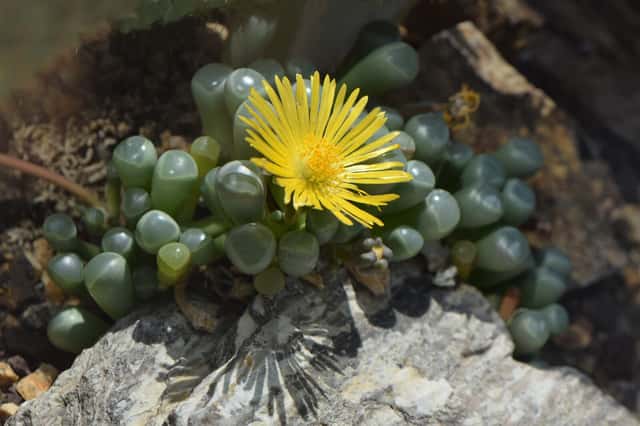
Baby toes (Fenestraria rhopalophylla) is a medium-care plant from the Aizoaceae family. Fenestraria rhopalophylla, known as baby toes or window plant, is a succulent from the Aizoaceae family native to the deserts of Namibia and South Africa. Its cylindrical, fleshy leaves grow in tight clusters and feature translucent tips or "windows" that allow light to pass through to the interior,...
Baby toes grows up to 10cm, spread of 20cm, watering every 14 days, 10°C – 35°C, 10–30% humidity. It is suitable for indoor environments and safe for pets.
Unlike many popular species, Baby toes is safe to keep around pets. Without adequate drainage, root rot can develop within 28 days.
How to Care for Baby toes?
TLDR: Baby toes needs Bright indirect, watering every 14 days, and temperatures between 10-35°C with 10-30% humidity.
How Often Should You Water Baby toes?
Water only when the substrate is completely dry, every 10-14 days during the growing season, and reduce watering even further in fall and winter. Avoid wetting the tops of the leaves or leaving standing water, as this promotes rot.
How Much Light Does Baby toes Need?
Place the plant in a very bright location with several hours of direct or filtered sunlight per day (ideally near a south-facing window). If the leaves stretch or lose their compact shape, it is a sign of insufficient light.
What Is the Best Soil for Baby toes?
Use a very porous, mineral-based succulent or cactus mix with plenty of coarse sand or perlite; avoid organic-rich substrates that retain moisture.
What Pot Should You Use for Baby toes?
Terracotta pot with large drainage holes to prevent waterlogging and root rot.
Care Schedule
Fertilize
Every 60 days
Rotate
Every 15 days
Repot
Every 730 days
What Is Baby toes and Where Does It Come From?
Fenestraria rhopalophylla, known as baby toes or window plant, is a succulent from the Aizoaceae family native to the deserts of Namibia and South Africa. Its cylindrical, fleshy leaves grow in tight clusters and feature translucent tips or "windows" that allow light to pass through to the interior, enabling photosynthesis while most of the leaf remains buried in the sand to protect against extreme heat and dehydration. It blooms in summer and fall with small white or yellow daisy-like flowers.
How to Propagate Baby toes?
Division
- Use sterilized tools to prevent fungal infections.
- 1 Extraction
Carefully remove the plant from the pot during repotting.
- 2 Separation
Gently separate the leaf clusters, ensuring each section has its own roots.
- 3 Planting
Plant each section in a mineral succulent substrate and wait a few days before watering.
Materials needed:
Sowing seeds
- Requires constant temperatures of about 20°C (68°F) to germinate.
- 1 Preparation
Scatter the seeds over a mixture of fine sand and sterile substrate.
- 2 Moisture
Maintain constant humidity with a fine mister and cover with clear plastic.
Materials needed:
How Big Does Baby toes Grow?
TLDR: Baby toes can reach up to 10cm tall with Slow growth rate.
Max height
10cm
Spread
20cm
Growth rate
Slow
Foliage
Evergreen
Plant Uses
Ornamental
Great for decoration
Is your plant showing symptoms?
Click on the symptom to discover possible causes:
What Diseases Commonly Affect Baby toes?
TLDR: Baby toes is susceptible to 4 known diseases. Monitor regularly for early detection.
Root Rot
Root rot is a serious fungal disease that affects the root system of plants, causing them to decay and die. It is primarily caused by overwatering, poor drainage, or soil-borne fungi such as Pythium, Phytophthora, Rhizoctonia, and Fusarium. The disease thrives in waterlogged conditions where roots are deprived of oxygen, making them susceptible to fungal infection.
Mealybugs
Mealybugs are small, soft-bodied insects covered with a white, waxy, cottony material. They are common pests of houseplants and outdoor plants in mild climates. These sap-sucking insects feed on plant tissue, causing damage, stunted growth, and can lead to plant death if left untreated. They produce sticky honeydew which attracts sooty mold.
Scale Insects
Scale insects are small sap-sucking pests that appear as brown, shell-like bumps on plant stems and leaves. There are over 25 species, divided into armored (hard) and unarmored (soft) scales. They feed by piercing plant tissue and extracting sap, which weakens the plant and can lead to yellowing, stunted growth, and even death if left untreated. They also excrete honeydew, which attracts ants and promotes sooty mold growth.
Aphids
Aphids are small, soft-bodied, pear-shaped insects (1/16 to 1/8 inch long) that feed by sucking nutrient-rich sap from plants. They reproduce rapidly and can quickly weaken plants, causing distorted growth and transmitting plant viruses. Aphids come in various colors including green, black, red, yellow, brown, and gray. They secrete honeydew, a sticky substance that attracts ants and encourages sooty mold growth.
Meaning & Symbolism
Represents adaptability and the ability to find light and thrive even in the most adverse conditions.
Compare with similar plants
| Attribute | Difficulty | Light | Watering | Pet Safe |
|---|---|---|---|---|
| Dark Fieldcap | Medium | Low light | 2d | ⚠️ |
| Azalea | Medium | Partial shade | 3d | ⚠️ |
| Muriel's Bamboo | Medium | Partial shade | 3d | ✓ |
| Bougainvillea | Medium | Direct sun | 7d | ⚠️ |




