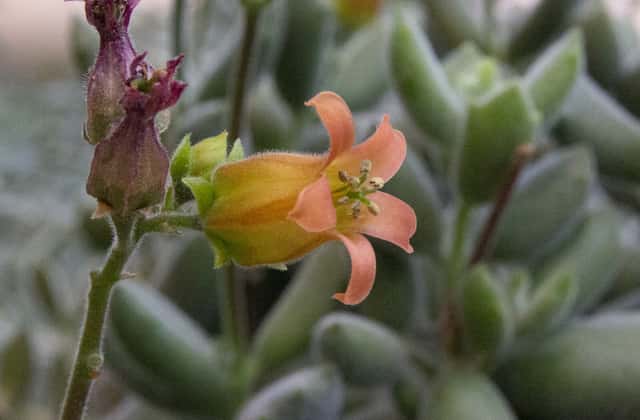
Crassulaceae
Bear's Paw: Perfect Plant for Beginners
Cotyledon tomentosa
Bear's Paw is an extremely drought-tolerant succulent ideal for indoor and outdoor cultivation. It thrives in bright, direct sunlight for at least 6 hours daily. Water deeply using the soak-and-dry method, allowing soil to dry completely between waterings (every 10-14 days). The plant prefers well-draining soil and tolerates low humidity environments typical of indoor homes.
Every 12 days
Bright indirect
2° - 27°C
20% - 50%
Categories
What is Bear's Paw?
Bear's Paw (Cotyledon tomentosa) is a easy-care plant from the Crassulaceae family. Cotyledon tomentosa, commonly known as Bear's Paw or Bear Paw Succulent, is a compact succulent native to South Africa in the Crassulaceae family. It is instantly recognizable by its thick, velvety green leaves with distinctive reddish, teeth-like projections along the edges that resemble a bear's p...
Bear's Paw grows up to 75cm, spread of 60cm, watering every 12 days, 2°C – 27°C, 20–50% humidity. It is suitable for indoor environments and not safe for pets.
Unlike many tropical plants, Bear's Paw tolerates watering mistakes. Best for beginners. Without precautions, ingestion can cause irritation in pets. Keep out of reach of cats and dogs. Without adequate drainage, root rot can develop within 24 days.
How to Care for Bear's Paw?
TLDR: Bear's Paw needs Bright indirect, watering every 12 days, and temperatures between 2-27°C with 20-50% humidity.
How Often Should You Water Bear's Paw?
Water thoroughly every 10-14 days during the growing season, allowing the soil to dry completely between waterings. Reduce watering frequency to every 2-3 weeks during winter dormancy. Overwatering is the leading cause of root rot; err on the side of underwatering. Use a pot with drainage holes and well-draining soil.
How Much Light Does Bear's Paw Need?
Position in bright, direct sunlight for 6+ hours daily. South or west-facing windows are ideal for northern hemisphere locations. Insufficient light causes leaves to lose vibrant coloring and become pale green. The characteristic reddish leaf margins intensify with increased light exposure.
What Is the Best Soil for Bear's Paw?
Use a well-draining succulent or cactus soil mix. Alternatively, amend standard potting soil with perlite and coarse sand. Target soil pH between 5.5-6.5. Proper drainage is critical to prevent root rot and fungal issues.
What Pot Should You Use for Bear's Paw?
Terra cotta or ceramic pot with drainage holes. Repot every 2-3 years into a container 1-2 cm larger than the previous one.
Care Schedule
Fertilize
Every 45 days
Rotate
Every 30 days
Repot
Every 1095 days
What Is Bear's Paw and Where Does It Come From?
Cotyledon tomentosa, commonly known as Bear's Paw or Bear Paw Succulent, is a compact succulent native to South Africa in the Crassulaceae family. It is instantly recognizable by its thick, velvety green leaves with distinctive reddish, teeth-like projections along the edges that resemble a bear's paw - hence its common name. This popular houseplant is prized for its unique appearance, ease of care, and suitability for indoor cultivation.
How Big Does Bear's Paw Grow?
TLDR: Bear's Paw can reach up to 75cm tall with Medium growth rate.
Max height
75cm
Spread
60cm
Growth rate
Medium
Foliage
Evergreen
Warning: Toxic Plant
This plant can be toxic if ingested. Keep out of reach of:
Plant Uses
Ornamental
Great for decoration
Is your plant showing symptoms?
Click on the symptom to discover possible causes:
What Diseases Commonly Affect Bear's Paw?
TLDR: Bear's Paw is susceptible to 6 known diseases. Monitor regularly for early detection.
Root Rot
Root rot is a serious fungal disease that affects the root system of plants, causing them to decay and die. It is primarily caused by overwatering, poor drainage, or soil-borne fungi such as Pythium, Phytophthora, Rhizoctonia, and Fusarium. The disease thrives in waterlogged conditions where roots are deprived of oxygen, making them susceptible to fungal infection.
Mealybugs
Mealybugs are small, soft-bodied insects covered with a white, waxy, cottony material. They are common pests of houseplants and outdoor plants in mild climates. These sap-sucking insects feed on plant tissue, causing damage, stunted growth, and can lead to plant death if left untreated. They produce sticky honeydew which attracts sooty mold.
Spider Mites
Spider mites are tiny arachnids (less than 1/20 inch long) related to spiders and ticks that feed on plant sap. They thrive in hot, dry conditions and can cause significant damage to ornamental and vegetable plants. During severe infestations, crop losses can reach 14% or higher as these pests disrupt vital plant processes including photosynthesis, carbon dioxide absorption, and transpiration.
Scale Insects
Scale insects are small sap-sucking pests that appear as brown, shell-like bumps on plant stems and leaves. There are over 25 species, divided into armored (hard) and unarmored (soft) scales. They feed by piercing plant tissue and extracting sap, which weakens the plant and can lead to yellowing, stunted growth, and even death if left untreated. They also excrete honeydew, which attracts ants and promotes sooty mold growth.
Meaning & Symbolism
Resilience, natural beauty, and whimsical charm
Compare with similar plants
| Attribute | Difficulty | Light | Watering | Pet Safe |
|---|---|---|---|---|
| Field Maple | Easy | Bright indirect | 14d | ✓ |
| Silver Birch | Easy | Direct sun | 14d | ✓ |
| Common Blanketflower | Easy | Direct sun | 10d | ✓ |
| Cushion Bush | Easy | Direct sun | 14d | ✓ |





