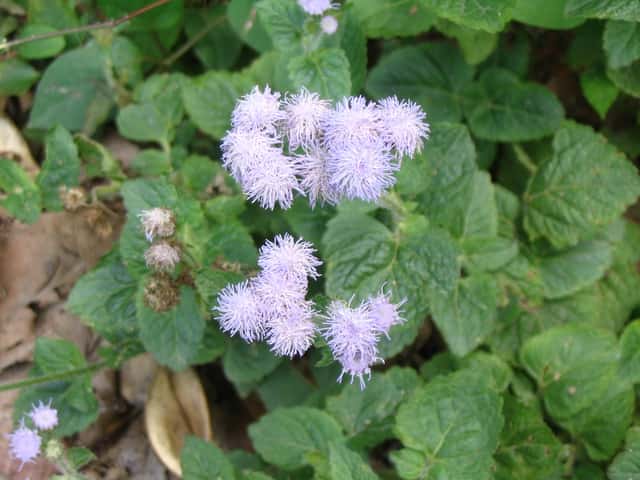
Asteraceae
Billygoat Weed (Ageratum conyzoides)
Ageratum conyzoides
Grow billygoat weed in full sun to partial shade in organically rich, well-draining soil, watering regularly to keep the substrate lightly moist. It is a tough, low-maintenance plant that self-seeds readily.
Every 4 days
Bright indirect
15° - 32°C
40% - 70%
Categories
What is Billygoat Weed?
Billygoat Weed (Ageratum conyzoides) is a easy-care plant from the Asteraceae family. Billygoat weed (Ageratum conyzoides) is a fast-growing annual herb in the daisy family (Asteraceae), native to tropical America and now naturalized throughout tropical and subtropical regions worldwide. It has softly hairy stems and oval, serrated leaves with a distinctive musky scent when crushed....
Billygoat Weed grows up to 90cm, spread of 40cm, watering every 4 days, 15°C – 32°C, 40–70% humidity. It is not suitable for indoor environments and not safe for pets.
Unlike many tropical plants, Billygoat Weed tolerates watering mistakes. Best for beginners. Without precautions, ingestion can cause irritation in pets. Keep out of reach of cats and dogs.
How to Care for Billygoat Weed?
TLDR: Billygoat Weed needs Bright indirect, watering every 4 days, and temperatures between 15-32°C with 40-70% humidity.
How Often Should You Water Billygoat Weed?
Water when the top inch of soil feels dry; avoid soggy conditions, which encourage root rot.
How Much Light Does Billygoat Weed Need?
Prefers full sun to part shade — at least 4-6 hours of direct light daily promotes fuller flowering.
What Is the Best Soil for Billygoat Weed?
Adapts to most soils but performs best in organically rich, well-draining soil with a pH of 6.0-7.0.
What Pot Should You Use for Billygoat Weed?
A container with drainage holes and light potting mix, or a sunny, well-drained garden bed.
Care Schedule
Fertilize
Every 21 days
What Is Billygoat Weed and Where Does It Come From?
Billygoat weed (Ageratum conyzoides) is a fast-growing annual herb in the daisy family (Asteraceae), native to tropical America and now naturalized throughout tropical and subtropical regions worldwide. It has softly hairy stems and oval, serrated leaves with a distinctive musky scent when crushed. Small blue-lavender to white flower heads cluster in terminal clusters, attracting bees and butterflies. Common in gardens, roadsides, and disturbed ground, it is regarded by many growers as a weed but is also widely valued in traditional medicine.
How to Propagate Billygoat Weed?
Seed propagation
Seeds germinate readily even in poor soil; the plant self-seeds easily in tropical climates.
- 1 Collect mature seed from dried flower heads
- 2 Sow directly in the ground or in trays with light, moist potting mix
- 3 Keep in indirect light until germination
- 4 Transplant seedlings once they have 3-4 true leaves
Materials needed:
Stem cutting
Use clean tools; keep the substrate consistently moist but never waterlogged.
- 1 Cut an 8-10 cm cutting from a healthy, non-flowering stem
- 2 Remove leaves from the lower half of the cutting
- 3 Insert into moist, well-draining substrate
- 4 Keep shaded and moist until rooted
Materials needed:
How Big Does Billygoat Weed Grow?
TLDR: Billygoat Weed can reach up to 90cm tall with Fast growth rate.
Max height
90cm
Spread
40cm
Growth rate
Fast
Foliage
Deciduous
Warning: Toxic Plant
This plant can be toxic if ingested. Keep out of reach of:
Plant Uses
Medicinal
Medicinal properties
Ornamental
Great for decoration
Aromatic
Pleasant fragrance
Medicinal Uses
- Traditional infusion of the flower-free aerial parts for joint pain and rheumatism (short-term use only)
- Folk use as an anti-inflammatory and mild analgesic
- Topical use for wound healing
- Caution: contains hepatotoxic pyrrolizidine alkaloids concentrated in the flowers — medicinal use should exclude flowers, be limited to a few weeks, and be avoided by people with liver conditions, pregnant women, and children
Is your plant showing symptoms?
Click on the symptom to discover possible causes:
What Diseases Commonly Affect Billygoat Weed?
TLDR: Billygoat Weed is susceptible to 6 known diseases. Monitor regularly for early detection.
Powdery Mildew
Powdery mildew is a common fungal disease caused by various fungi species including Erysiphe, Podosphaera, Oïdium, and Leveillula. It affects over 10,000 plant species worldwide. The disease thrives in warm, dry climates with high humidity and appears as a distinctive white powdery coating on plant surfaces.
Aphids
Aphids are small, soft-bodied, pear-shaped insects (1/16 to 1/8 inch long) that feed by sucking nutrient-rich sap from plants. They reproduce rapidly and can quickly weaken plants, causing distorted growth and transmitting plant viruses. Aphids come in various colors including green, black, red, yellow, brown, and gray. They secrete honeydew, a sticky substance that attracts ants and encourages sooty mold growth.
Whiteflies
Whiteflies are small, soft-bodied, winged insects closely related to aphids and mealybugs. They are moth-like in appearance, about 1/16 inch long, triangular in shape, and gray-white in color. These sap-sucking pests feed on plant tissue, causing yellowing, stunted growth, and wilting. They also excrete honeydew, which attracts ants and promotes sooty mold growth. Whiteflies can transmit serious plant viruses.
Spider Mites
Spider mites are tiny arachnids (less than 1/20 inch long) related to spiders and ticks that feed on plant sap. They thrive in hot, dry conditions and can cause significant damage to ornamental and vegetable plants. During severe infestations, crop losses can reach 14% or higher as these pests disrupt vital plant processes including photosynthesis, carbon dioxide absorption, and transpiration.
Meaning & Symbolism
In folk tradition it is associated with resilience and healing, long used in home remedies for pain and inflammation.
Fun Facts
Despite being considered an invasive weed in over 30 tropical and subtropical countries, it remains a staple of traditional medicine in many of those same regions.
Its crushed leaves release a musky, goat-like scent, which inspired common names like "billygoat weed" and "goatweed".
It likely spread from tropical America to Africa and Asia centuries ago and has since become one of the most widespread tropical weeds in the world.
Frequently asked questions
Is billygoat weed toxic?
How often should I water billygoat weed?
What is the easiest way to propagate it?
Does it attract pests or diseases?
Can I grow it in a pot?
Compare with similar plants
| Attribute | Difficulty | Light | Watering | Pet Safe |
|---|---|---|---|---|
| Field Maple | Easy | Bright indirect | 14d | ✓ |
| Silver Birch | Easy | Direct sun | 14d | ✓ |
| Common Blanketflower | Easy | Direct sun | 10d | ✓ |
| Cushion Bush | Easy | Direct sun | 14d | ✓ |





