Solanaceae
Black Nightshade: Complete Care Guide and Uses
Solanum nigrum
Extremely low-maintenance and adaptable plant. Thrives in full sun with moderate watering. Tolerates a wide range of soils. Highly toxic — keep away from children and pets at all times.
Every 7 days
Direct sun
5° - 35°C
40% - 70%
Categories
What is Black Nightshade?
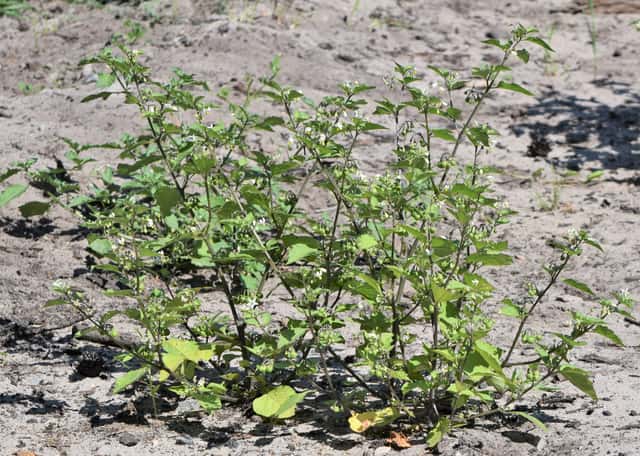
Black Nightshade (Solanum nigrum) is a easy-care plant from the Solanaceae family. Black nightshade (Solanum nigrum) is a fast-growing cosmopolitan herbaceous weed in the Solanaceae family. Found worldwide in disturbed soils, roadsides, and gardens, it produces small white star-shaped flowers with yellow anthers and clusters of berries that ripen from green to shiny black. All gre...
Black Nightshade grows up to 1.2m, spread of 60cm, watering every 7 days, 5°C – 35°C, 40–70% humidity. It is not suitable for indoor environments and not safe for pets.
Unlike many tropical plants, Black Nightshade tolerates watering mistakes. Best for beginners. Without precautions, ingestion can cause irritation in pets. Keep out of reach of cats and dogs.
How to Care for Black Nightshade?
TLDR: Black Nightshade needs Direct sun, watering every 7 days, and temperatures between 5-35°C with 40-70% humidity.
How Often Should You Water Black Nightshade?
Water every 7 days, keeping the soil slightly moist but never waterlogged. Reduce frequency during rainy seasons. Ensure good drainage to prevent root rot.
How Much Light Does Black Nightshade Need?
Requires full sun (6-8 hours daily) for best growth and fruiting. Tolerates partial shade but produces fewer flowers and berries. Avoid dense shade.
What Is the Best Soil for Black Nightshade?
Adapts to sandy, loamy, or clay soils rich in organic matter. Ensure good drainage. Ideal pH between 5.5 and 7.5. Grows even in compacted or poor soils.
What Pot Should You Use for Black Nightshade?
Clay or terracotta pot with drainage hole, or direct ground planting.
Care Schedule
Fertilize
Every 60 days
What Is Black Nightshade and Where Does It Come From?
Black nightshade (Solanum nigrum) is a fast-growing cosmopolitan herbaceous weed in the Solanaceae family. Found worldwide in disturbed soils, roadsides, and gardens, it produces small white star-shaped flowers with yellow anthers and clusters of berries that ripen from green to shiny black. All green parts and unripe berries contain solanine, a toxic glycoalkaloid; ripe berries are consumed cautiously in some traditional cultures.
How to Propagate Black Nightshade?
Direct seeding
Seeds germinate best at 20-30°C. No pre-soaking required. Direct outdoor sowing after last frost is highly effective.
- 1 Collect seeds from fully ripe black berries and rinse them
- 2 Sow directly in moist potting mix or directly in the ground
- 3 Cover lightly with a thin layer of soil (0.5 cm)
- 4 Keep in indirect light until germination occurs
- 5 Transplant seedlings when they develop 2-3 true leaves
Materials needed:
How Big Does Black Nightshade Grow?
TLDR: Black Nightshade can reach up to 1.2m tall with Fast growth rate.
Max height
1.2m
Spread
60cm
Growth rate
Fast
Foliage
Deciduous
Warning: Toxic Plant
This plant can be toxic if ingested. Keep out of reach of:
Plant Uses
Medicinal
Medicinal properties
Edible
Can be consumed
Medicinal Uses
- Traditional external use for skin inflammation, boils, and minor burns (leaf poultice)
- Leaf infusion used in washes for skin conditions
- Research suggests anti-inflammatory and antitumor properties in extracts
Culinary Uses
- Ripe berries eaten fresh or made into jam in some African and Asian traditions
- Young leaves cooked as a leafy vegetable in parts of Africa, India, and Southeast Asia
- Ripe berries used in traditional preserves and sauces
Is your plant showing symptoms?
Click on the symptom to discover possible causes:
What Diseases Commonly Affect Black Nightshade?
TLDR: Black Nightshade is susceptible to 7 known diseases. Monitor regularly for early detection.
Root Rot
Root rot is a serious fungal disease that affects the root system of plants, causing them to decay and die. It is primarily caused by overwatering, poor drainage, or soil-borne fungi such as Pythium, Phytophthora, Rhizoctonia, and Fusarium. The disease thrives in waterlogged conditions where roots are deprived of oxygen, making them susceptible to fungal infection.
Powdery Mildew
Powdery mildew is a common fungal disease caused by various fungi species including Erysiphe, Podosphaera, Oïdium, and Leveillula. It affects over 10,000 plant species worldwide. The disease thrives in warm, dry climates with high humidity and appears as a distinctive white powdery coating on plant surfaces.
Fusarium Wilt
Fusarium wilt is a serious fungal disease caused by the soil-borne fungus Fusarium oxysporum. The fungus invades roots and blocks the water-conducting vessels (xylem) of the plant, causing progressive wilting and eventual death. Host-specific forms of the pathogen exist that attack different plant species.
Spider Mites
Spider mites are tiny arachnids (less than 1/20 inch long) related to spiders and ticks that feed on plant sap. They thrive in hot, dry conditions and can cause significant damage to ornamental and vegetable plants. During severe infestations, crop losses can reach 14% or higher as these pests disrupt vital plant processes including photosynthesis, carbon dioxide absorption, and transpiration.
Meaning & Symbolism
In European folklore, nightshade plants were associated with witchcraft, death, and protection. Used in traditional medicine across Africa, Asia, and Europe for centuries.
Fun Facts
The solanine in black nightshade is the same alkaloid that makes green potatoes toxic
It is classified as an invasive weed in over 40 countries yet is cultivated as a vegetable crop in parts of Africa and Asia
The plant has been used in traditional medicine for over 2,000 years across Ayurvedic, Chinese, and European herbal systems
Frequently asked questions
Is black nightshade poisonous?
How do I care for black nightshade?
Can black nightshade berries be eaten?
What diseases affect black nightshade?
Compare with similar plants
| Attribute | Difficulty | Light | Watering | Pet Safe |
|---|---|---|---|---|
| Field Maple | Easy | Bright indirect | 14d | ✓ |
| Silver Birch | Easy | Direct sun | 14d | ✓ |
| Common Blanketflower | Easy | Direct sun | 10d | ✓ |
| Cushion Bush | Easy | Direct sun | 14d | ✓ |





