Asteraceae
Blue Marguerite: Pet-Safe Plant
Felicia amelloides
A plant of moderate ease: it requires full sun, well-drained soil, and regular but moderate watering. It is very sensitive to waterlogging and humid heat, conditions that promote root rot and reduce flowering. It can easily become sparse and woody, so it benefits from light pruning and regular pinching.
Every 7 days
Bright indirect
5° - 32°C
30% - 50%
Categories
What is Blue Marguerite?
Blue Marguerite (Felicia amelloides) is a medium-care plant from the Asteraceae family. Felicia amelloides is an evergreen perennial (sometimes biennial) plant belonging to the Asteraceae family, native to the southern coast of South Africa, where it grows on sandy dunes and rocky slopes. It forms a small, bushy shrub 50-100 cm tall, with opposite, oval leaves that are rough to the tou...
Blue Marguerite grows up to 1.0m, spread of 60cm, watering every 7 days, 5°C – 32°C, 30–50% humidity. It is suitable for indoor environments and safe for pets.
Unlike many popular species, Blue Marguerite is safe to keep around pets. Without adequate drainage, root rot can develop within 14 days.
How to Care for Blue Marguerite?
TLDR: Blue Marguerite needs Bright indirect, watering every 7 days, and temperatures between 5-32°C with 30-50% humidity.
How Often Should You Water Blue Marguerite?
Water approximately once a week during the growing season, allowing the soil surface to dry slightly between waterings; reduce drastically in winter. Always avoid standing water in the saucer.
How Much Light Does Blue Marguerite Need?
Requires full sun for at least 6 hours a day; in shaded positions, flowering significantly decreases, and the plant tends to become leggy.
What Is the Best Soil for Blue Marguerite?
Prefers a poor to moderately fertile but perfectly draining substrate (suitable for calcareous, sandy, or loamy soils); in pots, use a peat-free mix with ample drainage at the bottom.
What Pot Should You Use for Blue Marguerite?
Prefer terracotta pots with large drainage holes, which promote the evaporation of excess moisture and reduce the risk of root rot, to which this species is particularly susceptible.
Care Schedule
Fertilize
Every 30 days
Rotate
Every 14 days
Repot
Every 365 days
What Is Blue Marguerite and Where Does It Come From?
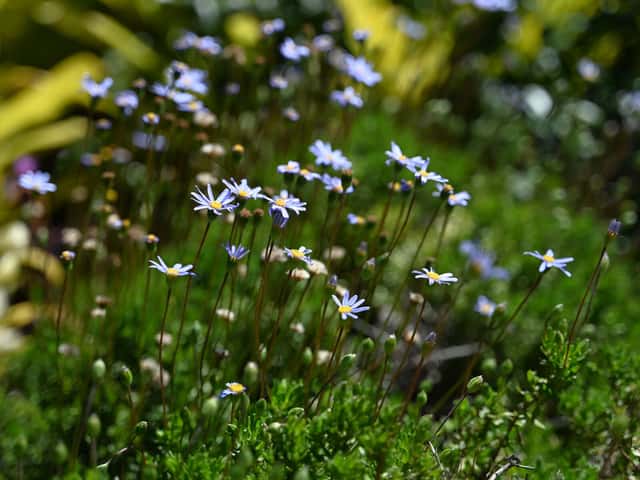
Felicia amelloides is an evergreen perennial (sometimes biennial) plant belonging to the Asteraceae family, native to the southern coast of South Africa, where it grows on sandy dunes and rocky slopes. It forms a small, bushy shrub 50-100 cm tall, with opposite, oval leaves that are rough to the touch due to their covering of fine hairs. From late spring until autumn, it produces numerous daisy-like flower heads, about 3 cm wide, with sky-blue ray florets and a bright yellow center.
How to Propagate Blue Marguerite?
How Big Does Blue Marguerite Grow?
TLDR: Blue Marguerite can reach up to 1.0m tall with Medium growth rate.
Max height
1.0m
Spread
60cm
Growth rate
Medium
Foliage
Evergreen
Plant Uses
Ornamental
Great for decoration
Is your plant showing symptoms?
Click on the symptom to discover possible causes:
What Diseases Commonly Affect Blue Marguerite?
TLDR: Blue Marguerite is susceptible to 6 known diseases. Monitor regularly for early detection.
Root Rot
Root rot is a serious fungal disease that affects the root system of plants, causing them to decay and die. It is primarily caused by overwatering, poor drainage, or soil-borne fungi such as Pythium, Phytophthora, Rhizoctonia, and Fusarium. The disease thrives in waterlogged conditions where roots are deprived of oxygen, making them susceptible to fungal infection.
Overwatering
Overwatering occurs when plants receive too much water, depriving roots of oxygen and causing root rot. This environmental stress is one of the most common causes of houseplant death, as waterlogged soil prevents roots from breathing and functioning properly.
Aphids
Aphids are small, soft-bodied, pear-shaped insects (1/16 to 1/8 inch long) that feed by sucking nutrient-rich sap from plants. They reproduce rapidly and can quickly weaken plants, causing distorted growth and transmitting plant viruses. Aphids come in various colors including green, black, red, yellow, brown, and gray. They secrete honeydew, a sticky substance that attracts ants and encourages sooty mold growth.
Spider Mites
Spider mites are tiny arachnids (less than 1/20 inch long) related to spiders and ticks that feed on plant sap. They thrive in hot, dry conditions and can cause significant damage to ornamental and vegetable plants. During severe infestations, crop losses can reach 14% or higher as these pests disrupt vital plant processes including photosynthesis, carbon dioxide absorption, and transpiration.
Meaning & Symbolism
Like many daisy-like flowering Asteraceae, Felicia amelloides is associated with innocence and simplicity; the blue color of its petals also evokes serenity, trust, and clear skies, making it a symbolic gift of tranquility.
Compare with similar plants
| Attribute | Difficulty | Light | Watering | Pet Safe |
|---|---|---|---|---|
| Dark Fieldcap | Medium | Low light | 2d | ⚠️ |
| Azalea | Medium | Partial shade | 3d | ⚠️ |
| Muriel's Bamboo | Medium | Partial shade | 3d | ✓ |
| Bougainvillea | Medium | Direct sun | 7d | ⚠️ |




