Asteraceae
Blue globe thistle: Full Sun Plant
Echinops bannaticus
Blue globe thistle is easy to care for and drought-tolerant once established. Plant in full sun and well-drained, lean to normal soil—avoid nutrient-rich or damp ground which results in weaker, floppy growth. It is very hardy and requires minimal maintenance except for removing spent flower heads to prolong blooming and limit self-seeding.
Every 14 days
Direct sun
-37° - 38°C
20% - 50%
Categories
What is Blue globe thistle?
Blue globe thistle (Echinops bannaticus) is a easy-care plant from the Asteraceae family. Blue globe thistle (Echinops bannaticus) is a tall, architectural perennial in the Asteraceae family, originally from southeastern Europe, including the Banat region of Romania. It forms upright stems with prickly, grayish-green lobed foliage and ends in perfectly round, steel-blue flower heads that...
Blue globe thistle grows up to 1.5m, spread of 50cm, watering every 14 days, -37°C – 38°C, 20–50% humidity. It is not suitable for indoor environments and safe for pets.
Unlike many tropical plants, Blue globe thistle tolerates watering mistakes. Best for beginners. Unlike many popular species, Blue globe thistle is safe to keep around pets.
How to Care for Blue globe thistle?
TLDR: Blue globe thistle needs Direct sun, watering every 14 days, and temperatures between -37-38°C with 20-50% humidity.
How Often Should You Water Blue globe thistle?
Water sparingly. Thanks to its deep taproot, blue globe thistle is very drought-tolerant and only needs watering during prolonged dry spells, especially during its establishment year. Avoid waterlogged soil—too much moisture around the roots increases the risk of root rot.
How Much Light Does Blue globe thistle Need?
Place in full sun, at least 6–8 hours of direct sunlight per day. With too little light, the stems become weak and flowering will be sparse.
What Is the Best Soil for Blue globe thistle?
Prefers well-drained, lean to normal, and ideally lime-rich soil. Heavy, nutrient-rich, or moisture-retentive soil should be avoided or improved with sand or gravel for better drainage; otherwise, the plant risks becoming overgrown and drooping.
What Pot Should You Use for Blue globe thistle?
Best grown directly in flower beds or gravel gardens due to its deep taproot, which makes it sensitive to transplanting. If a pot is used, it requires a large and deep container with plenty of drainage holes and a permeable soil mix.
What Is Blue globe thistle and Where Does It Come From?
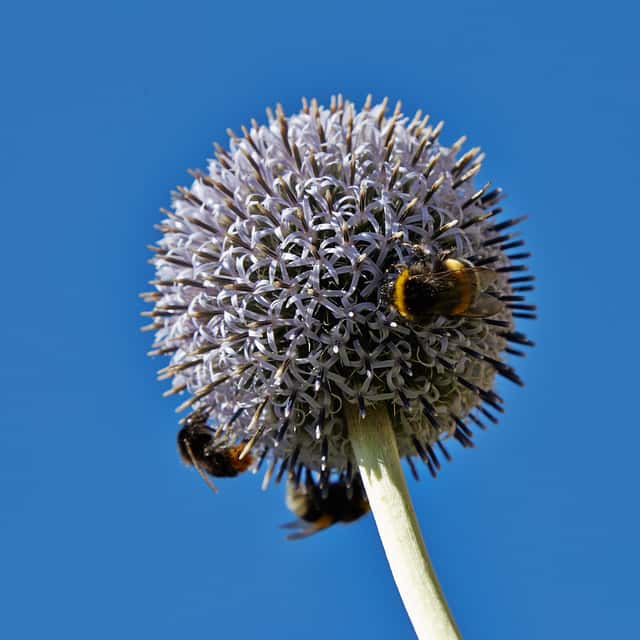
Blue globe thistle (Echinops bannaticus) is a tall, architectural perennial in the Asteraceae family, originally from southeastern Europe, including the Banat region of Romania. It forms upright stems with prickly, grayish-green lobed foliage and ends in perfectly round, steel-blue flower heads that attract bees, bumblebees, and butterflies during July–August. The plant grows about 120–150 cm tall with a deep taproot system that makes it very drought-tolerant.
How to Propagate Blue globe thistle?
Root cuttings/division
The plant has a deep taproot and does not tolerate division well—divide only when necessary and be prepared for a low success rate.
- 1 Gently dig up an established plant (at least 3 years old) in spring or fall.
- 2 Cut root pieces with at least one bud each using a clean, sharp tool.
- 3 Plant the root pieces directly into well-drained soil at the new site.
- 4 Keep the soil slightly moist until new shoots appear.
Materials needed:
Seed sowing
Seeds benefit from cold stratification before sowing for more even germination.
- 1 Collect or buy mature seeds in the fall.
- 2 Cold stratify the seeds (refrigerator) for 4–6 weeks, or sow directly outdoors in the fall.
- 3 Sow seeds thinly in well-drained seed starting soil during the spring.
- 4 Transplant the seedlings 40–50 cm apart when they are large enough.
Materials needed:
How Big Does Blue globe thistle Grow?
TLDR: Blue globe thistle can reach up to 1.5m tall with Medium growth rate.
Max height
1.5m
Spread
50cm
Growth rate
Medium
Foliage
Deciduous
Plant Uses
Ornamental
Great for decoration
Is your plant showing symptoms?
Click on the symptom to discover possible causes:
What Diseases Commonly Affect Blue globe thistle?
TLDR: Blue globe thistle is susceptible to 6 known diseases. Monitor regularly for early detection.
Aphids
Aphids are small, soft-bodied, pear-shaped insects (1/16 to 1/8 inch long) that feed by sucking nutrient-rich sap from plants. They reproduce rapidly and can quickly weaken plants, causing distorted growth and transmitting plant viruses. Aphids come in various colors including green, black, red, yellow, brown, and gray. They secrete honeydew, a sticky substance that attracts ants and encourages sooty mold growth.
Leafminers
Leafminers are the larvae of various insects including flies, moths, sawflies, and beetles that tunnel between leaf surfaces, creating distinctive serpentine trails or blotchy patches. While primarily cosmetic, severe infestations can weaken plants by reducing photosynthesis capacity and making them susceptible to secondary infections.
Thrips
Thrips are tiny cigar-shaped insects (1/25-inch long) that damage plants by sucking plant juices and scraping at fruits, flowers, and leaves. With over 6,000 species and rapid reproduction (lifecycle as short as 14 days), they can quickly infest plants and transmit viruses like tomato spotted wilt virus.
Root Rot
Root rot is a serious fungal disease that affects the root system of plants, causing them to decay and die. It is primarily caused by overwatering, poor drainage, or soil-borne fungi such as Pythium, Phytophthora, Rhizoctonia, and Fusarium. The disease thrives in waterlogged conditions where roots are deprived of oxygen, making them susceptible to fungal infection.
Compare with similar plants
| Attribute | Difficulty | Light | Watering | Pet Safe |
|---|---|---|---|---|
| Field Maple | Easy | Bright indirect | 14d | ✓ |
| Silver Birch | Easy | Direct sun | 14d | ✓ |
| Common Blanketflower | Easy | Direct sun | 10d | ✓ |
| Cushion Bush | Easy | Direct sun | 14d | ✓ |





