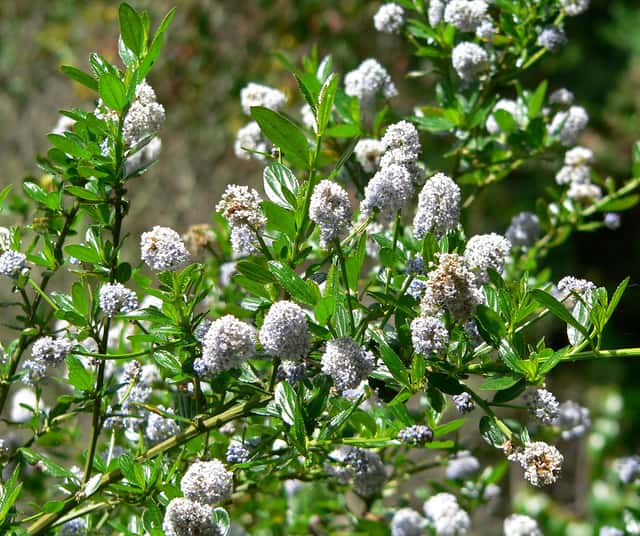
Rhamnaceae
Ceanothus thyrsiflorus - Blueblossom Care Guide
Ceanothus thyrsiflorus
Grow in full sun with sharply draining soil; water regularly the first year to establish roots, then rely mostly on natural rainfall. Avoid summer irrigation once established to prevent root rot.
Every 14 days
Direct sun
-10° - 35°C
% - %
Categories
What is Blueblossom?
Blueblossom (Ceanothus thyrsiflorus) is a medium-care plant from the Rhamnaceae family. Ceanothus thyrsiflorus, known as blueblossom, is an evergreen shrub or small tree native to the coastal ranges of California and Oregon. Valued for its dense clusters of powder-blue to deep-blue flowers that bloom in spring, it belongs to the buckthorn family (Rhamnaceae) and thrives in Mediterranea...
Blueblossom grows up to 3.0m, spread of 300cm, watering every 14 days, -10°C – 35°C. It is not suitable for indoor environments and safe for pets.
Unlike many popular species, Blueblossom is safe to keep around pets.
How to Care for Blueblossom?
TLDR: Blueblossom needs Direct sun, watering every 14 days, and temperatures between -10-35°C with 40-70% humidity.
How Often Should You Water Blueblossom?
Water deeply but infrequently. Once established, blueblossom is drought tolerant and resents wet feet, especially in summer.
How Much Light Does Blueblossom Need?
Plant in full sun for the best flowering; it tolerates light afternoon shade in hot inland climates.
What Is the Best Soil for Blueblossom?
Use well-draining, slightly acidic to neutral soil. Sandy or gravelly soils mimic its native habitat and reduce root rot risk.
What Pot Should You Use for Blueblossom?
Best grown in the ground; if potted, use an unglazed terracotta container with excellent drainage holes.
What Is Blueblossom and Where Does It Come From?
Ceanothus thyrsiflorus, known as blueblossom, is an evergreen shrub or small tree native to the coastal ranges of California and Oregon. Valued for its dense clusters of powder-blue to deep-blue flowers that bloom in spring, it belongs to the buckthorn family (Rhamnaceae) and thrives in Mediterranean-climate gardens.
How to Propagate Blueblossom?
Semi-hardwood stem cutting
Use sterile, sharp tools and avoid overwatering, as cuttings are prone to rot.
- 1 Take a 10-15 cm semi-hardwood cutting from a healthy side shoot in summer
- 2 Strip the lower leaves and dip the cut end in rooting hormone
- 3 Insert into a well-draining mix of sand and perlite
- 4 Keep evenly moist and in bright, indirect light until roots form
Materials needed:
Seed propagation
Germination is naturally triggered by fire in the wild; hot water and cold stratification mimic this process.
- 1 Soak seeds in hot water for 24 hours to break down the hard seed coat
- 2 Cold-stratify seeds in moist sand in the refrigerator for 1-3 months
- 3 Sow in well-draining seed-starting mix
- 4 Keep lightly moist until germination
Materials needed:
How Big Does Blueblossom Grow?
TLDR: Blueblossom can reach up to 3.0m tall with Fast growth rate.
Max height
3.0m
Spread
3.0m
Growth rate
Fast
Foliage
Evergreen
Plant Uses
Ornamental
Great for decoration
Ground Cover
Soil coverage
Is your plant showing symptoms?
Click on the symptom to discover possible causes:
What Diseases Commonly Affect Blueblossom?
TLDR: Blueblossom is susceptible to 8 known diseases. Monitor regularly for early detection.
Powdery Mildew
Powdery mildew is a common fungal disease caused by various fungi species including Erysiphe, Podosphaera, Oïdium, and Leveillula. It affects over 10,000 plant species worldwide. The disease thrives in warm, dry climates with high humidity and appears as a distinctive white powdery coating on plant surfaces.
Phytophthora Root Rot
Disease caused by fungus-like organisms (oomycetes) that live in soil and can survive for years. It affects roots, stem, and crown of plants, being especially severe in waterlogged or poorly drained soils. It is the second most common cause of root rot in trees and shrubs.
Root Rot
Root rot is a serious fungal disease that affects the root system of plants, causing them to decay and die. It is primarily caused by overwatering, poor drainage, or soil-borne fungi such as Pythium, Phytophthora, Rhizoctonia, and Fusarium. The disease thrives in waterlogged conditions where roots are deprived of oxygen, making them susceptible to fungal infection.
Aphids
Aphids are small, soft-bodied, pear-shaped insects (1/16 to 1/8 inch long) that feed by sucking nutrient-rich sap from plants. They reproduce rapidly and can quickly weaken plants, causing distorted growth and transmitting plant viruses. Aphids come in various colors including green, black, red, yellow, brown, and gray. They secrete honeydew, a sticky substance that attracts ants and encourages sooty mold growth.
Meaning & Symbolism
In California native gardening circles, blueblossom is often associated with resilience and the arrival of spring along the Pacific coast.
Fun Facts
Blueblossom is a California native shrub in the buckthorn family, and one of the few Ceanothus species with true blue flowers.
Its seeds germinate more readily after exposure to fire or hot water, an adaptation to the wildfire-prone chaparral of California.
Bees and other pollinators are strongly attracted to its fragrant flower clusters.
Frequently asked questions
Is blueblossom toxic to pets?
How often should I water blueblossom?
Why are the leaves on my blueblossom turning yellow?
Does blueblossom need pruning?
Compare with similar plants
| Attribute | Difficulty | Light | Watering | Pet Safe |
|---|---|---|---|---|
| Dark Fieldcap | Medium | Low light | 2d | ⚠️ |
| Azalea | Medium | Partial shade | 3d | ⚠️ |
| Muriel's Bamboo | Medium | Partial shade | 3d | ✓ |
| Bougainvillea | Medium | Direct sun | 7d | ⚠️ |




