Orchidaceae
Cymbidium Orchid (Boat Orchid) Care Guide
Cymbidium hybridum
Give Cymbidium hybrids bright, indirect light (a lightly shaded south or east window, or filtered outdoor sun in summer), keep the bark-based mix evenly moist but never soggy, and provide a noticeable day-to-night temperature drop in autumn to trigger flower spikes. Feed regularly during active growth, repot only every 2-3 years, and expect a long-lasting bloom display from winter into spring.
Every 6 days
Bright indirect
14° - 29°C
40% - 60%
Categories
What is Boat Orchid?
Boat Orchid (Cymbidium hybridum) is a medium-care plant from the Orchidaceae family. Cymbidium hybridum refers to the vast group of cultivated Cymbidium hybrids (Orchidaceae) bred over more than a century from wild Asian and Australian species. These evergreen, terrestrial-to-epiphytic orchids form clumps of pseudobulbs topped with long, strap-shaped leaves, and in late winter to sp...
Boat Orchid grows up to 75cm, watering every 6 days, 14°C – 29°C, 40–60% humidity. It is suitable for indoor environments and safe for pets.
Unlike many popular species, Boat Orchid is safe to keep around pets. Without adequate drainage, root rot can develop within 12 days.
How to Care for Boat Orchid?
TLDR: Boat Orchid needs Bright indirect, watering every 6 days, and temperatures between 14-29°C with 40-60% humidity.
How Often Should You Water Boat Orchid?
Water thoroughly whenever the top of the bark mix begins to dry, letting excess water drain away completely; keep the medium evenly moist (never waterlogged or bone-dry) during active growth from spring to early fall, and reduce frequency in winter. Use room-temperature rainwater, distilled water, or filtered water -- Cymbidiums are sensitive to salt and chlorine buildup.
How Much Light Does Boat Orchid Need?
Provide bright, indirect light -- an east-facing window or a south/west window softened with a sheer curtain is ideal. Golden-green leaves signal good light; dark green leaves mean too little light and poor flowering; reddish or yellowish leaves mean too much sun. Outdoors, give morning sun with afternoon shade.
What Is the Best Soil for Boat Orchid?
Grow in a coarse, well-draining orchid bark mix (fine-to-medium fir bark with perlite, and often a little peat or sphagnum) rather than regular potting soil. The medium should hold some moisture yet drain freely and allow air to reach the roots; refresh it every 2-3 years as the bark breaks down.
What Pot Should You Use for Boat Orchid?
Use a clay or terracotta pot with ample drainage holes -- Cymbidiums bloom best when slightly root/pot-bound, so choose a container only one size larger than the current root mass rather than sizing for future growth.
Care Schedule
Fertilize
Every 14 days
Repot
Every 900 days
What Is Boat Orchid and Where Does It Come From?
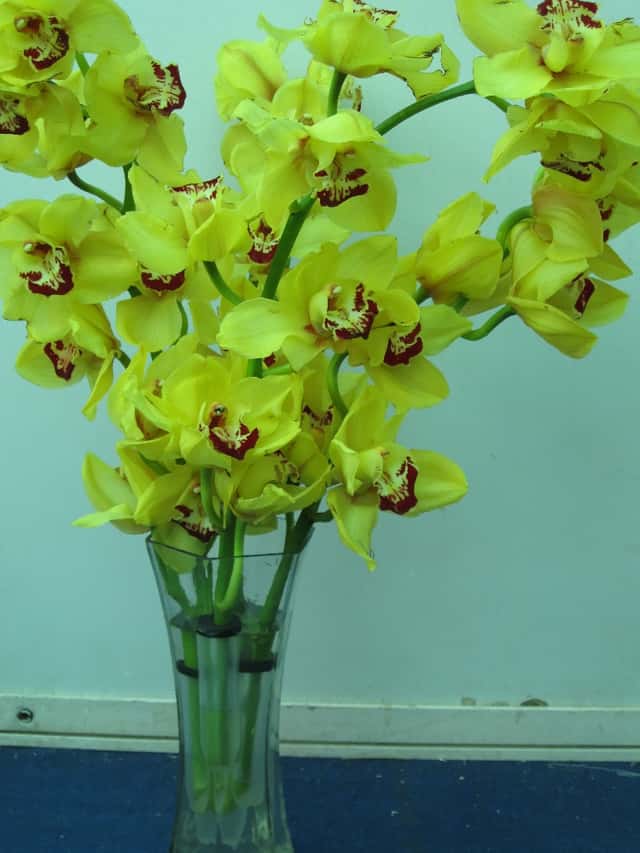
Cymbidium hybridum refers to the vast group of cultivated Cymbidium hybrids (Orchidaceae) bred over more than a century from wild Asian and Australian species. These evergreen, terrestrial-to-epiphytic orchids form clumps of pseudobulbs topped with long, strap-shaped leaves, and in late winter to spring they send up sturdy arching spikes carrying a dozen or more long-lasting, waxy flowers. Modern hybrids range from miniature to large-flowered types, in shades of white, green, yellow, pink, red, cream and near-brown, often with a contrasting spotted lip. Prized as houseplants, patio specimens in mild climates, and cut flowers, boat orchids reward growers with cool nights and bright light with months of bloom.
How to Propagate Boat Orchid?
Division
Always use sterilized cutting tools between plants to avoid spreading viruses such as Cymbidium mosaic virus; divisions may take a year or more to bloom again.
- 1 Wait until the plant has finished flowering and has at least 6-8 healthy pseudobulbs before dividing
- 2 Remove the plant from its pot and gently wash or shake excess mix from the roots
- 3 Using a sterilized knife, cut through the rhizome so each division has at least 3-5 pseudobulbs with roots attached
- 4 Trim away any dead, mushy, or rotten roots and dust cut surfaces with cinnamon or a fungicide
- 5 Pot each division into fresh, coarse orchid bark mix sized to just cover the roots
- 6 Keep newly divided plants in bright, indirect light and water sparingly until new roots establish
Materials needed:
How Big Does Boat Orchid Grow?
TLDR: Boat Orchid can reach up to 75cm tall with Slow growth rate.
Max height
75cm
Growth rate
Slow
Foliage
Evergreen
Plant Uses
Ornamental
Great for decoration
Is your plant showing symptoms?
Click on the symptom to discover possible causes:
What Diseases Commonly Affect Boat Orchid?
TLDR: Boat Orchid is susceptible to 11 known diseases. Monitor regularly for early detection.
Root Rot
Root rot is a serious fungal disease that affects the root system of plants, causing them to decay and die. It is primarily caused by overwatering, poor drainage, or soil-borne fungi such as Pythium, Phytophthora, Rhizoctonia, and Fusarium. The disease thrives in waterlogged conditions where roots are deprived of oxygen, making them susceptible to fungal infection.
Leaf Spot
Leaf spot is a common fungal disease caused by various pathogens including Alternaria, Ascochyta, Colletotrichum, Septoria, and Venturia. It primarily affects leaves, causing discolored spots that can lead to premature leaf drop if left untreated.
Mosaic Virus
Mosaic virus is a group of plant viruses that cause mottled, patchy patterns on leaves and can affect a wide variety of plants. The virus creates characteristic yellow, white, and green mosaic patterns, often accompanied by stunted growth and deformed plant parts. This highly contagious disease spreads rapidly through insect vectors and contaminated tools.
Phytophthora Blight
Devastating fungal disease caused by Phytophthora species (primarily P. capsici and P. infestans), famously responsible for the Irish Potato Famine in the 1840s. Affects all plant parts including roots, stems, leaves, and fruits in warm, wet conditions. The pathogen is technically an oomycete (water mold) that thrives in saturated soils and can survive in soil for 5+ years.
Meaning & Symbolism
The Cymbidium symbolizes nobility, refinement, virtue and valued friendship; Confucius praised it as an emblem of the moral, cultivated gentleman, and in many cultures giving a Cymbidium bloom is considered an honor.
Fun Facts
Cymbidium hybrids have been bred since the late 1800s by crossing wild species from the Himalayas, China, Japan and Australia.
A single Cymbidium flower spike can carry a dozen or more blooms that each last 6-10 weeks, making it one of the longest-lasting cut flowers.
In Chinese culture, Confucius so admired the Cymbidium's fragrance that he called it the "King of Fragrant Plants."
Cymbidium leaf color responds visibly to light: golden-green means happy, dark green means too shady, reddish means too much sun.
Frequently asked questions
How often should I water my Cymbidium orchid?
Why won't my Cymbidium orchid bloom?
Is the Cymbidium orchid toxic to cats and dogs?
How do I get my Cymbidium orchid to rebloom?
Compare with similar plants
| Attribute | Difficulty | Light | Watering | Pet Safe |
|---|---|---|---|---|
| Dark Fieldcap | Medium | Low light | 2d | ⚠️ |
| Azalea | Medium | Partial shade | 3d | ⚠️ |
| Muriel's Bamboo | Medium | Partial shade | 3d | ✓ |
| Bougainvillea | Medium | Direct sun | 7d | ⚠️ |
Choose & Compare
Sources & References
- Cymbidium Orchid Care Guide - Pro Tips You Need To Know!
- Cymbidium Care Sheet - Carter and Holmes Orchids
- Common Cymbidium Orchid Diseases: Prevention and Treatment
- Cymbidium Orchid Plants: How to Grow, Care and Get Cymbidiums to Bloom
- The Toxicity Of Cymbidium Orchids
- CYMBIDIUMS: Fertilizer Program
- Origin and symbolism of Cymbidium




