Arecaceae
Bottle palm: Pet-Safe Plant
Hyophorbe lagenicaulis
A resilient tropical palm when provided with the right conditions: bright light, moderate watering without waterlogging, and well-draining soil. It is sensitive to cold and excessive root moisture; the most common cause of loss in cultivation is overwatering or poor drainage rather than pests.
Every 10 days
Bright indirect
15° - 35°C
50% - 80%
Categories
What is Bottle palm?
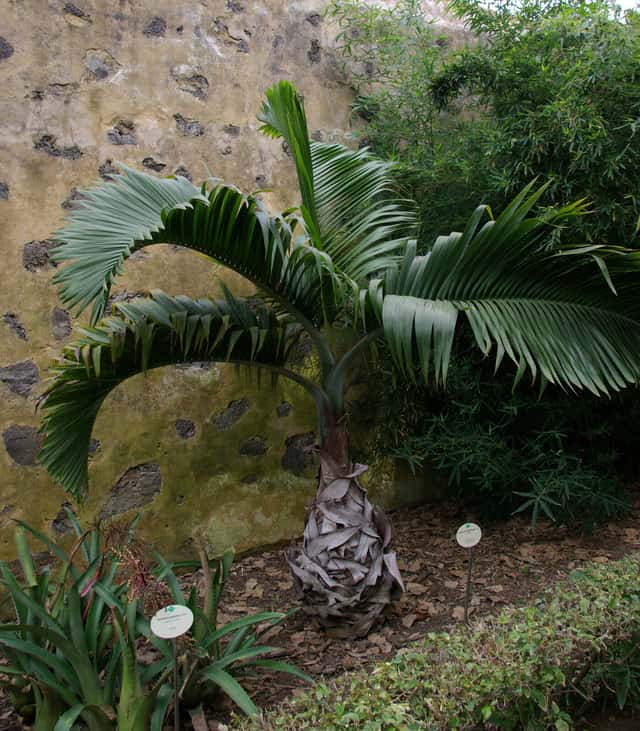
Bottle palm (Hyophorbe lagenicaulis) is a medium-care plant from the Arecaceae family. The bottle palm (Hyophorbe lagenicaulis) is a solitary palm from the Arecaceae family, endemic to Round Island in the Mascarene Islands (Mauritius). It is famous for its smooth, grayish trunk, which is swollen in a bottle shape at the base and tapers toward the crown, supporting a small canopy of 4...
Bottle palm grows up to 5.0m, spread of 250cm, watering every 10 days, 15°C – 35°C, 50–80% humidity. It is suitable for indoor environments and safe for pets.
Unlike many popular species, Bottle palm is safe to keep around pets. Without adequate drainage, root rot can develop within 20 days.
How to Care for Bottle palm?
TLDR: Bottle palm needs Bright indirect, watering every 10 days, and temperatures between 15-35°C with 50-80% humidity.
How Often Should You Water Bottle palm?
Water moderately, allowing the top few inches of soil to dry out between waterings. Increase frequency during warm periods of active growth and reduce it in winter. Avoid waterlogging: excess water at the roots is the primary cause of trunk rot.
How Much Light Does Bottle palm Need?
Prefers bright light or full sun once established; young specimens benefit from filtered light or partial shade to avoid stress. Indoors, place it in the brightest spot available, near a south-facing window.
What Is the Best Soil for Bottle palm?
Requires a well-draining substrate, slightly acidic to neutral (pH 6-7.5); it tolerates sandy, loamy, or even saline soils. For potted plants, mix palm soil with perlite or coarse sand to ensure optimal drainage.
What Pot Should You Use for Bottle palm?
Use a wide, heavy, and well-draining pot (terracotta or ceramic) to provide stability for the swollen trunk, which can become top-heavy with age. Ensure it has large drainage holes.
Care Schedule
Fertilize
Every 90 days
Misting
Every 7 days
Rotate
Every 15 days
Repot
Every 1095 days
What Is Bottle palm and Where Does It Come From?
The bottle palm (Hyophorbe lagenicaulis) is a solitary palm from the Arecaceae family, endemic to Round Island in the Mascarene Islands (Mauritius). It is famous for its smooth, grayish trunk, which is swollen in a bottle shape at the base and tapers toward the crown, supporting a small canopy of 4 to 8 deep green pinnate leaves (young plants often show reddish or orange tones). A slow-growing species, fewer than 10 adult specimens remain in the wild, making it critically endangered, although its ornamental cultivation is widespread in tropical and subtropical climates worldwide.
How to Propagate Bottle palm?
Seed
Fresh seeds germinate best (up to 75% at 30°C). Avoid letting the substrate dry out during germination.
- 1 Collection
Collect ripe fruits (turning from green to black) and remove all the fleshy pulp surrounding the seed.
- 2 Soaking
Submerge the clean seeds in warm water for 24-48 hours to encourage germination.
- 3 Sowing
Sow in a light, well-draining substrate, maintaining a warm temperature of 25-30°C and good light levels.
- 4 Waiting and transplanting
Germination is slow (44-180 days); transplant the seedling into an individual pot once the first leaf emerges.
Materials needed:
How Big Does Bottle palm Grow?
TLDR: Bottle palm can reach up to 5.0m tall with Slow growth rate.
Max height
5.0m
Spread
2.5m
Growth rate
Slow
Foliage
Evergreen
Plant Uses
Ornamental
Great for decoration
Air Purifying
Improves air quality
Medicinal Uses
- No documented traditional medicinal use.
- Preliminary phytochemical studies detected antioxidant and alpha-glucosidase inhibitory activity (potential anti-diabetic) in leaf extracts, though no therapeutic use has been established.
Culinary Uses
- No culinary use for humans.
- Historically, its fruits were used as pig feed in Mauritius, which is the origin of the genus name Hyophorbe ('pig forage').
Is your plant showing symptoms?
Click on the symptom to discover possible causes:
What Diseases Commonly Affect Bottle palm?
TLDR: Bottle palm is susceptible to 5 known diseases. Monitor regularly for early detection.
Root Rot
Root rot is a serious fungal disease that affects the root system of plants, causing them to decay and die. It is primarily caused by overwatering, poor drainage, or soil-borne fungi such as Pythium, Phytophthora, Rhizoctonia, and Fusarium. The disease thrives in waterlogged conditions where roots are deprived of oxygen, making them susceptible to fungal infection.
Potassium Deficiency
Potassium deficiency is a nutritional disorder that affects a plant's ability to regulate stomatal opening and closing, resulting in characteristic leaf edge burn. Potassium is a mobile nutrient, so symptoms first appear on older, lower leaves.
Spider Mites
Spider mites are tiny arachnids (less than 1/20 inch long) related to spiders and ticks that feed on plant sap. They thrive in hot, dry conditions and can cause significant damage to ornamental and vegetable plants. During severe infestations, crop losses can reach 14% or higher as these pests disrupt vital plant processes including photosynthesis, carbon dioxide absorption, and transpiration.
Scale Insects
Scale insects are small sap-sucking pests that appear as brown, shell-like bumps on plant stems and leaves. There are over 25 species, divided into armored (hard) and unarmored (soft) scales. They feed by piercing plant tissue and extracting sap, which weakens the plant and can lead to yellowing, stunted growth, and even death if left untreated. They also excrete honeydew, which attracts ants and promotes sooty mold growth.
Meaning & Symbolism
Represents resilience and uniqueness due to its distinctive shape and its origin on a remote island.
Compare with similar plants
| Attribute | Difficulty | Light | Watering | Pet Safe |
|---|---|---|---|---|
| Dark Fieldcap | Medium | Low light | 2d | ⚠️ |
| Azalea | Medium | Partial shade | 3d | ⚠️ |
| Muriel's Bamboo | Medium | Partial shade | 3d | ✓ |
| Bougainvillea | Medium | Direct sun | 7d | ⚠️ |
Choose & Compare
Sources & References
- Hyophorbe lagenicaulis (Bottle Palm) - Gardenia.net
- Hyophorbe lagenicaulis - Palmpedia
- Hyophorbe lagenicaulis - Wikipedia
- Antioxidant activity, alpha-glucosidase inhibition and phytochemical profiling of Hyophorbe lagenicaulis leaf extracts
- Hyophorbe lagenicaulis (HFBLA) Pests - EPPO Global Database




