Fabaceae
Jatoba: Edible Plant
Hymenaea courbaril
A large tree intended for outdoor cultivation, not suitable for indoors. Plant in a full sun location with deep, well-drained soil. During the first few years, water regularly to establish the sapling; once established, the tree is quite drought-tolerant. It grows at a moderate pace and requires little maintenance. Fruits begin to appear only 8 to 10 years after planting.
Every 10 days
Bright indirect
-3° - 35°C
60% - 90%
Categories
What is Jatoba?
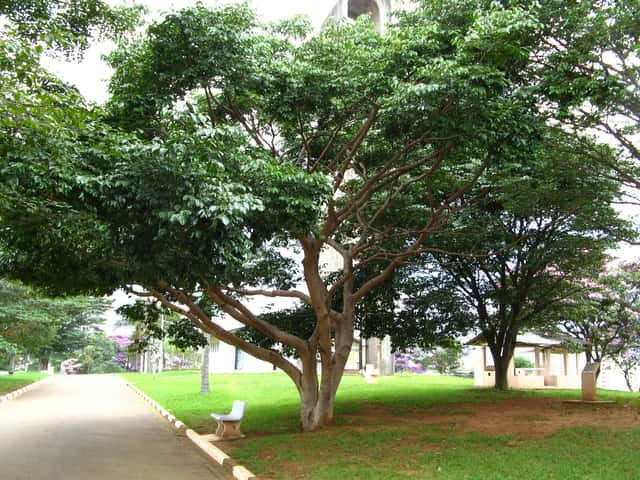
Jatoba (Hymenaea courbaril) is a medium-care plant from the Fabaceae family. The jatoba is a tree native to Brazil and other tropical regions of the Americas, found in the Amazon, Cerrado, Atlantic Forest, Caatinga, and Pantanal. When cultivated, it typically reaches 26 to 50 feet in height, with a wide and dense canopy. The leaves are bifoliate, leathery, and sickle-shaped....
Jatoba grows up to 15.0m, spread of 1500cm, watering every 10 days, -3°C – 35°C, 60–90% humidity. It is not suitable for indoor environments and safe for pets.
Unlike many popular species, Jatoba is safe to keep around pets.
How to Care for Jatoba?
TLDR: Jatoba needs Bright indirect, watering every 10 days, and temperatures between -3-35°C with 60-90% humidity.
How Often Should You Water Jatoba?
Water regularly during the first few years to establish the sapling. Once established, it can withstand 3 to 5 months without rain. Avoid waterlogging the soil.
How Much Light Does Jatoba Need?
Young saplings can tolerate about 50% shade initially. Mature trees require full sun to grow well and bloom.
What Is the Best Soil for Jatoba?
Prefers deep, well-drained soils rich in organic matter, ranging from sandy to clay-loam, with a pH between 4.5 and 7.0.
What Pot Should You Use for Jatoba?
Not recommended for pots due to its large size. For saplings, use deep and large nursery bags or pots with good drainage holes until permanent planting in the ground.
Care Schedule
Fertilize
Every 60 days
What Is Jatoba and Where Does It Come From?
The jatoba is a tree native to Brazil and other tropical regions of the Americas, found in the Amazon, Cerrado, Atlantic Forest, Caatinga, and Pantanal. When cultivated, it typically reaches 26 to 50 feet in height, with a wide and dense canopy. The leaves are bifoliate, leathery, and sickle-shaped. The flowers are white to cream-colored and appear between September and November. The fruits are woody pods containing a mealy, sweet pulp surrounding the seeds. The wood is dense and highly valued, and its resin is known as copal.
How to Propagate Jatoba?
Sowing
- The seeds have a hard coat and require scarification to germinate well.
- Young saplings tolerate partial shade in the beginning.
- 1 Scarification
Sand or rub the seed coat against a rough surface until worn down, or soak in warm water.
- 2 Sowing
Plant the seed in well-drained substrate in a deep bag or pot, and keep slightly moist.
- 3 Germination
Germination usually takes 2 to 8 weeks. Afterwards, transplant the sapling to its permanent location.
Materials needed:
How Big Does Jatoba Grow?
TLDR: Jatoba can reach up to 15.0m tall with Medium growth rate.
Max height
15.0m
Spread
15.0m
Growth rate
Medium
Foliage
Evergreen
Plant Uses
Ornamental
Great for decoration
Edible
Can be consumed
Medicinal
Medicinal properties
Medicinal Uses
- Traditional use for respiratory issues such as coughs, bronchitis, and asthma
- Popular use as an anti-inflammatory and antifungal agent
- Traditional use of bark infusion as an energy tonic
- Traditional use for urinary problems and mouth ulcers
Culinary Uses
- Mealy pulp of the pod consumed fresh
- Pulp used in drinks and ice creams
- Jatoba flour used in cakes and breads
Is your plant showing symptoms?
Click on the symptom to discover possible causes:
Meaning & Symbolism
A tree symbolizing longevity and resilience in Brazilian flora, whose fossil resin, copal, was used in rituals and varnishes.
Compare with similar plants
| Attribute | Difficulty | Light | Watering | Pet Safe |
|---|---|---|---|---|
| Dark Fieldcap | Medium | Low light | 2d | ⚠️ |
| Azalea | Medium | Partial shade | 3d | ⚠️ |
| Muriel's Bamboo | Medium | Partial shade | 3d | ✓ |
| Bougainvillea | Medium | Direct sun | 7d | ⚠️ |




