Podocarpaceae
Podocarpus elongatus (Breede River Yellowwood) Care Guide
Podocarpus elongatus
A slow-growing, drought-tolerant evergreen once established, the Breede River yellowwood thrives in full sun to light shade with well-draining sandy soil. Water regularly during the first year to establish a strong root system, then reduce frequency as the plant matures. It tolerates light frost and coastal conditions, and needs minimal feeding or pruning to maintain its naturally rounded form.
Every 10 days
Bright indirect
-1° - 35°C
% - %
Categories
What is Breede River Yellowwood?
Breede River Yellowwood (Podocarpus elongatus) is a medium-care plant from the Podocarpaceae family. Podocarpus elongatus, commonly known as the Breede River yellowwood, is an evergreen conifer native to the Western Cape of South Africa, where it grows along the Breede River valley and into the Cederberg mountains. Unlike its taller yellowwood relatives, it typically forms a broad, multi-stemmed, r...
Breede River Yellowwood grows up to 20.0m, spread of 1200cm, watering every 10 days, -1°C – 35°C. It is not suitable for indoor environments and not safe for pets.
Without precautions, ingestion can cause irritation in pets. Keep out of reach of cats and dogs.
How to Care for Breede River Yellowwood?
TLDR: Breede River Yellowwood needs Bright indirect, watering every 10 days, and temperatures between -1-35°C with 40-70% humidity.
How Often Should You Water Breede River Yellowwood?
Water deeply and regularly during the first growing season to help roots establish, letting the topsoil dry out slightly between waterings. Once established, this species is fairly drought-tolerant, but avoid letting the soil become waterlogged, as poor drainage can lead to root rot.
How Much Light Does Breede River Yellowwood Need?
Provide full sun to semi-shade, ideally morning sun with some afternoon protection in very hot climates. It adapts well to a range of light conditions but produces its densest, most compact growth in brighter positions.
What Is the Best Soil for Breede River Yellowwood?
Plant in deep, sandy, well-draining soil similar to its native riverine habitat. It tolerates a range of well-drained soils but dislikes heavy, waterlogged clay.
What Pot Should You Use for Breede River Yellowwood?
Best planted directly in the ground where it has room to spread; if grown in a container while young, choose a large, deep pot with generous drainage holes and a sandy, well-draining mix.
What Is Breede River Yellowwood and Where Does It Come From?
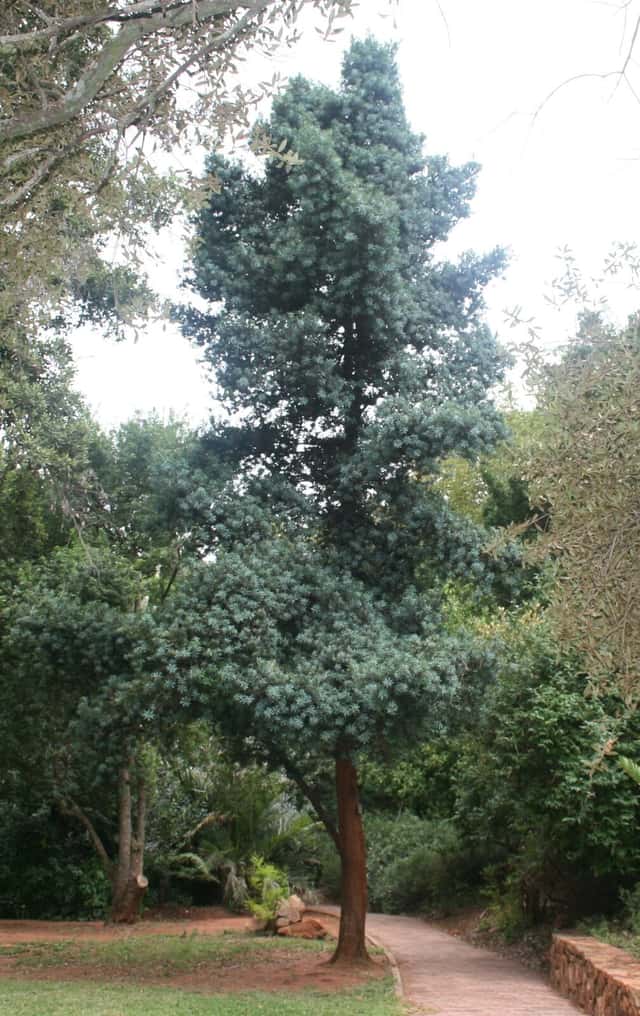
Podocarpus elongatus, commonly known as the Breede River yellowwood, is an evergreen conifer native to the Western Cape of South Africa, where it grows along the Breede River valley and into the Cederberg mountains. Unlike its taller yellowwood relatives, it typically forms a broad, multi-stemmed, rounded shrub or small tree with elongated grey-blue needle-like leaves, though in sheltered, well-watered ravines it can reach up to 20 m. It is the only South African yellowwood able to resprout from its roots and trunk after fire or flood damage, making it exceptionally resilient in its native fynbos habitat.
How to Propagate Breede River Yellowwood?
Seed Propagation
Fresh seed germinates far better than stored seed, so sow as soon as possible after harvesting.
- 1 Collect fresh seed as soon as it ripens in late summer to autumn
- 2 Sow immediately in deep trays (about 10 cm) filled with well-draining, sandy medium
- 3 Keep the medium consistently moist and place trays in a shaded position
- 4 Transplant seedlings once they are large enough to handle
Materials needed:
Tip Cuttings
Cuttings can be slow and difficult to root, and young rooted plants are notoriously tricky to transplant successfully, so disturb roots as little as possible.
- 1 Take semi-hardwood tip cuttings in spring
- 2 Dip cut ends in rooting hormone
- 3 Insert cuttings into a well-draining propagation mix under mist or high humidity
- 4 Keep consistently moist and warm until roots form
Materials needed:
How Big Does Breede River Yellowwood Grow?
TLDR: Breede River Yellowwood can reach up to 20.0m tall with Slow growth rate.
Max height
20.0m
Spread
12.0m
Growth rate
Slow
Foliage
Evergreen
Warning: Toxic Plant
This plant can be toxic if ingested. Keep out of reach of:
Plant Uses
Ornamental
Great for decoration
Is your plant showing symptoms?
Click on the symptom to discover possible causes:
What Diseases Commonly Affect Breede River Yellowwood?
TLDR: Breede River Yellowwood is susceptible to 4 known diseases. Monitor regularly for early detection.
Root Rot
Root rot is a serious fungal disease that affects the root system of plants, causing them to decay and die. It is primarily caused by overwatering, poor drainage, or soil-borne fungi such as Pythium, Phytophthora, Rhizoctonia, and Fusarium. The disease thrives in waterlogged conditions where roots are deprived of oxygen, making them susceptible to fungal infection.
Spider Mites
Spider mites are tiny arachnids (less than 1/20 inch long) related to spiders and ticks that feed on plant sap. They thrive in hot, dry conditions and can cause significant damage to ornamental and vegetable plants. During severe infestations, crop losses can reach 14% or higher as these pests disrupt vital plant processes including photosynthesis, carbon dioxide absorption, and transpiration.
Scale Insects
Scale insects are small sap-sucking pests that appear as brown, shell-like bumps on plant stems and leaves. There are over 25 species, divided into armored (hard) and unarmored (soft) scales. They feed by piercing plant tissue and extracting sap, which weakens the plant and can lead to yellowing, stunted growth, and even death if left untreated. They also excrete honeydew, which attracts ants and promotes sooty mold growth.
Sooty Mold
Sooty mold is a fungal disease that develops on surfaces coated with honeydew, a sticky sweet substance secreted by sap-sucking insects like aphids, scale insects, and whiteflies. While it does not directly infect plant tissue, it reduces photosynthetic capacity by blocking sunlight and diminishes the plant's aesthetic appearance.
Meaning & Symbolism
In its native fynbos, the Breede River yellowwood is a symbol of resilience and renewal — one of the few conifers able to resprout from burnt or flood-damaged roots and trunks, embodying survival and regeneration after disturbance.
Fun Facts
It is the only South African yellowwood able to resprout from its roots and trunk after fire or flooding, a rare trait among conifers.
In the wild it often grows as a broad, multi-stemmed, rounded shrub as wide as it is tall, resembling a hut rather than a typical tree.
Its range is restricted almost entirely to the Breede River valley in the Western Cape, extending north to the Cedarberg mountains.
The fleshy seed-bearing structures it produces attract birds, which help disperse its seeds.
Frequently asked questions
How much sun does Podocarpus elongatus need?
Is Podocarpus elongatus toxic to pets?
How fast does the Breede River yellowwood grow?
How do you propagate Podocarpus elongatus?
Does Podocarpus elongatus tolerate drought?
Compare with similar plants
| Attribute | Difficulty | Light | Watering | Pet Safe |
|---|---|---|---|---|
| Dark Fieldcap | Medium | Low light | 2d | ⚠️ |
| Azalea | Medium | Partial shade | 3d | ⚠️ |
| Muriel's Bamboo | Medium | Partial shade | 3d | ✓ |
| Bougainvillea | Medium | Direct sun | 7d | ⚠️ |




