Bromeliaceae
Bulbous Air Plant (Tillandsia bulbosa)
Tillandsia bulbosa
A humid-climate air plant: bright indirect light, misting every 2-3 days or a weekly soak in soft water, then a thorough dry. It likes humidity above 60% and 15-28 °C. Its weak spot is the bulb: water trapped there rots the plant.
Every 7 days
Partial shade
15° - 28°C
60% - %
Categories
What is Bulbous Air Plant?
Bulbous Air Plant (Tillandsia bulbosa) is a medium-care plant from the Bromeliaceae family. Tillandsia bulbosa is an epiphytic air plant from the humid tropics of the Americas, from southern Mexico and Central America through the Caribbean to northern South America and Brazil. It forms a small rosette 7-22 cm tall: the leaf bases swell into a pseudobulb, from which thin, dark green, twisti...
Bulbous Air Plant grows up to 22cm, watering every 7 days, 15°C – 28°C. It is suitable for indoor environments and safe for pets.
Unlike many popular species, Bulbous Air Plant is safe to keep around pets. Without adequate drainage, root rot can develop within 14 days.
How to Care for Bulbous Air Plant?
TLDR: Bulbous Air Plant needs Partial shade, watering every 7 days, and temperatures between 15-28°C with 60-70% humidity.
How Often Should You Water Bulbous Air Plant?
Mist every 2-3 days or soak for about 20 minutes once a week. Use rain, filtered or soft water. Afterwards, shake it, turn it upside down and let it dry completely somewhere airy: water trapped in the bulb causes rot.
How Much Light Does Bulbous Air Plant Need?
Bright indirect light or light shade, near an east window. Avoid strong midday sun, which scorches the leaves.
What Is the Best Soil for Bulbous Air Plant?
It needs no soil: grow it mounted on bark, a branch, cork or a holder. Never bury the bulb in potting mix, which holds water and rots the base.
What Pot Should You Use for Bulbous Air Plant?
No pot needed. Mount it on cork, a branch or bark, or set it loose in an open, airy glass globe. Avoid closed containers, which keep the bulb wet.
Care Schedule
Fertilize
Every 14 days
Misting
Every 3 days
What Is Bulbous Air Plant and Where Does It Come From?
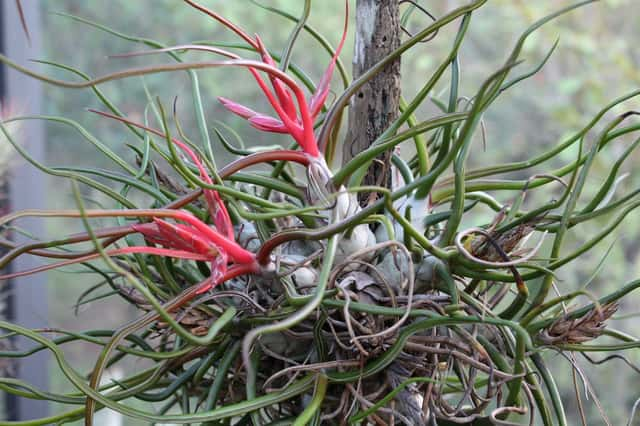
Tillandsia bulbosa is an epiphytic air plant from the humid tropics of the Americas, from southern Mexico and Central America through the Caribbean to northern South America and Brazil. It forms a small rosette 7-22 cm tall: the leaf bases swell into a pseudobulb, from which thin, dark green, twisting leaves spread like tentacles. At bloom the upper leaves turn red and a spike of bright red bracts appears, carrying tubular blue-violet flowers. In the wild it grows on trees and shelters ants, which nest between the leaf bases; at home, the ants are not needed. After flowering it produces pups at the base.
How to Propagate Bulbous Air Plant?
Pup division
If you leave the pups on, they form an attractive clump. Each rosette flowers only once, so pups keep the plant going.
- 1 Wait for the plant to flower: pups appear at the base afterwards
- 2 Let the pup grow to about a third of the mother plant's size
- 3 Separate it gently by twisting, or cut it off at the base with a clean knife
- 4 Mount the pup on an airy holder and care for it like an adult
Materials needed:
How Big Does Bulbous Air Plant Grow?
TLDR: Bulbous Air Plant can reach up to 22cm tall with Medium growth rate.
Max height
22cm
Foliage
Evergreen
Plant Uses
Ornamental
Great for decoration
Is your plant showing symptoms?
Click on the symptom to discover possible causes:
What Diseases Commonly Affect Bulbous Air Plant?
TLDR: Bulbous Air Plant is susceptible to 6 known diseases. Monitor regularly for early detection.
Crown Rot
Crown rot is a serious fungal disease that attacks the crown (base) of the plant where the stem meets the soil. It is caused by various fungal pathogens including Phytophthora, Fusarium, and Rhizoctonia. The disease thrives in waterlogged conditions and can quickly spread to kill the entire plant if not addressed promptly.
Underwatering
Underwatering or drought stress is a physiological disorder that occurs when the amount of water a plant loses through transpiration exceeds the amount its roots can absorb from the soil. This leads to cellular dehydration and various visible symptoms that can compromise plant health and productivity.
Low Humidity Stress
Low humidity stress occurs when indoor air becomes too dry, causing plants to lose moisture faster than they can absorb it through their roots. This is especially common during winter heating periods, near radiators and heating vents, or in air-conditioned spaces. Tropical plants are particularly susceptible to low humidity damage.
Poor Air Circulation
Poor air circulation is an environmental stress condition that occurs when plants lack adequate airflow around their foliage and stems. Stagnant air creates a microenvironment that promotes moisture buildup, depletes available CO2, and weakens plant defenses against fungal diseases and pests. This is especially common with densely packed indoor plants or plants placed in corners with limited ventilation.
Fun Facts
In the wild, ants nest inside the hollow bulb formed by its leaf bases.
Each rosette flowers only once, then leaves pups behind.
There are a dozen or so named cultivars, such as 'Hyde's Silver' and 'Royal Sceptre'.
Frequently asked questions
How often should I water it?
Why has the base gone soft and dark?
Is it toxic to pets?
Does it need soil?
Compare with similar plants
| Attribute | Difficulty | Light | Watering | Pet Safe |
|---|---|---|---|---|
| Dark Fieldcap | Medium | Low light | 2d | ⚠️ |
| Azalea | Medium | Partial shade | 3d | ⚠️ |
| Muriel's Bamboo | Medium | Partial shade | 3d | ✓ |
| Bougainvillea | Medium | Direct sun | 7d | ⚠️ |