Orchidaceae
Cambria orchid: Perfect Indoor Houseplant
Vuylstekeara
Cambria hybrids require cool-to-intermediate temperatures (approx. 12-28°C), a bright spot protected from direct sunlight, and an evenly moist, bark-based medium that never sits in water. They thrive best with high humidity (55-80%) and good air circulation; they require a short, cooler, and drier rest period in autumn and winter to encourage reblooming.
Every 7 days
Partial shade
12° - 28°C
55% - 80%
Categories
What is Cambria orchid?
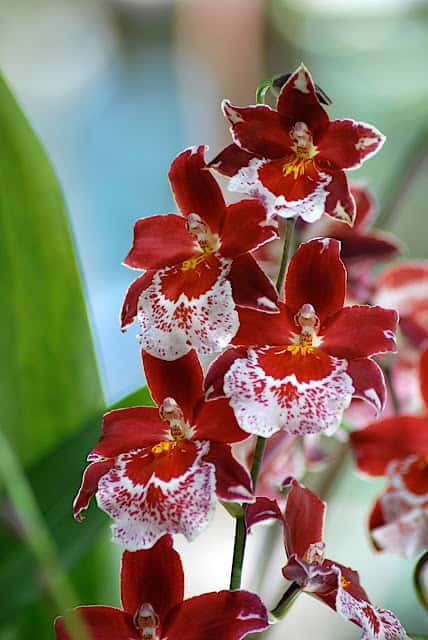
Cambria orchid (Vuylstekeara) is a medium-care plant from the Orchidaceae family. Vuylstekeara is an artificially created orchid nothogenus (a cross between Cochlioda × Miltonia × Odontoglossum), most commonly known in the trade as "Cambria," primarily through the popular cultivar Vuylstekeara Cambria 'Plush'. This hybrid combines the best traits of its parent species: it offers...
Cambria orchid grows up to 45cm, spread of 35cm, watering every 7 days, 12°C – 28°C, 55–80% humidity. It is suitable for indoor environments and safe for pets.
Unlike many popular species, Cambria orchid is safe to keep around pets. Without adequate drainage, root rot can develop within 14 days.
How to Care for Cambria orchid?
TLDR: Cambria orchid needs Partial shade, watering every 7 days, and temperatures between 12-28°C with 55-80% humidity.
How Often Should You Water Cambria orchid?
Allow the top third of the bark medium to dry out before watering, then water thoroughly with room-temperature, lime-free water, allowing the excess to drain away completely. Keep the medium evenly moist during the flowering period, and reduce watering during the rest period in autumn and winter.
How Much Light Does Cambria orchid Need?
Choose a bright location free from direct sunlight, ideally near an east or south-east facing window; it is advisable to provide light shading from March to September to prevent the leaves from scorching.
What Is the Best Soil for Cambria orchid?
A fine-grade (3-9 mm) pine bark-based orchid mix is recommended, combined with sphagnum moss, coconut fiber, or perlite if necessary; due to the fine roots, opaque pots and well-ventilated, perforated planting containers are suggested.
What Pot Should You Use for Cambria orchid?
An opaque (not glass or transparent plastic), well-ventilated orchid pot with perforated walls is recommended to protect the sensitive roots from light and ensure rapid drainage.
Care Schedule
Fertilize
Every 30 days
Rotate
Every 14 days
Repot
Every 1095 days
What Is Cambria orchid and Where Does It Come From?
Vuylstekeara is an artificially created orchid nothogenus (a cross between Cochlioda × Miltonia × Odontoglossum), most commonly known in the trade as "Cambria," primarily through the popular cultivar Vuylstekeara Cambria 'Plush'. This hybrid combines the best traits of its parent species: it offers long-lasting, colorful inflorescences and is relatively easy to maintain, making it a frequent recommendation for beginner orchid enthusiasts. Ribbon-like leaves grow from its fleshy pseudobulbs, and its flowers appear with contrastingly patterned petals in a wide range of colors from yellow to burgundy.
How to Propagate Cambria orchid?
Separation of basal shoots (division)
The separated section must have at least one viable, dormant bud at the base of the pseudobulb, otherwise it will not sprout. Flowering may be significantly delayed after division, sometimes for 1-2 years.
- 1 Select a healthy plant with at least 3-4 pseudobulbs
- 2 Using a sterilized knife, separate the oldest, leafless pseudobulbs (at least 2-3 in a group) from the younger section
- 3 Allow the cut surfaces to dry for a few hours to prevent rot
- 4 Plant the separated section into fresh bark-based medium in an opaque pot
- 5 Water only lightly and infrequently until new roots appear, while maintaining high humidity
Materials needed:
How Big Does Cambria orchid Grow?
TLDR: Cambria orchid can reach up to 45cm tall with Slow growth rate.
Max height
45cm
Spread
35cm
Growth rate
Slow
Foliage
Evergreen
Plant Uses
Ornamental
Great for decoration
Is your plant showing symptoms?
Click on the symptom to discover possible causes:
What Diseases Commonly Affect Cambria orchid?
TLDR: Cambria orchid is susceptible to 9 known diseases. Monitor regularly for early detection.
Root Rot
Root rot is a serious fungal disease that affects the root system of plants, causing them to decay and die. It is primarily caused by overwatering, poor drainage, or soil-borne fungi such as Pythium, Phytophthora, Rhizoctonia, and Fusarium. The disease thrives in waterlogged conditions where roots are deprived of oxygen, making them susceptible to fungal infection.
Spider Mites
Spider mites are tiny arachnids (less than 1/20 inch long) related to spiders and ticks that feed on plant sap. They thrive in hot, dry conditions and can cause significant damage to ornamental and vegetable plants. During severe infestations, crop losses can reach 14% or higher as these pests disrupt vital plant processes including photosynthesis, carbon dioxide absorption, and transpiration.
Scale Insects
Scale insects are small sap-sucking pests that appear as brown, shell-like bumps on plant stems and leaves. There are over 25 species, divided into armored (hard) and unarmored (soft) scales. They feed by piercing plant tissue and extracting sap, which weakens the plant and can lead to yellowing, stunted growth, and even death if left untreated. They also excrete honeydew, which attracts ants and promotes sooty mold growth.
Mealybugs
Mealybugs are small, soft-bodied insects covered with a white, waxy, cottony material. They are common pests of houseplants and outdoor plants in mild climates. These sap-sucking insects feed on plant tissue, causing damage, stunted growth, and can lead to plant death if left untreated. They produce sticky honeydew which attracts sooty mold.
Meaning & Symbolism
Orchids generally symbolize rare beauty, elegance, and refinement; due to its colorful and long-lasting blooms, the Cambria hybrid is a common gift for those whose individuality and taste we consider exceptional.
Compare with similar plants
| Attribute | Difficulty | Light | Watering | Pet Safe |
|---|---|---|---|---|
| Dark Fieldcap | Medium | Low light | 2d | ⚠️ |
| Azalea | Medium | Partial shade | 3d | ⚠️ |
| Muriel's Bamboo | Medium | Partial shade | 3d | ✓ |
| Bougainvillea | Medium | Direct sun | 7d | ⚠️ |




