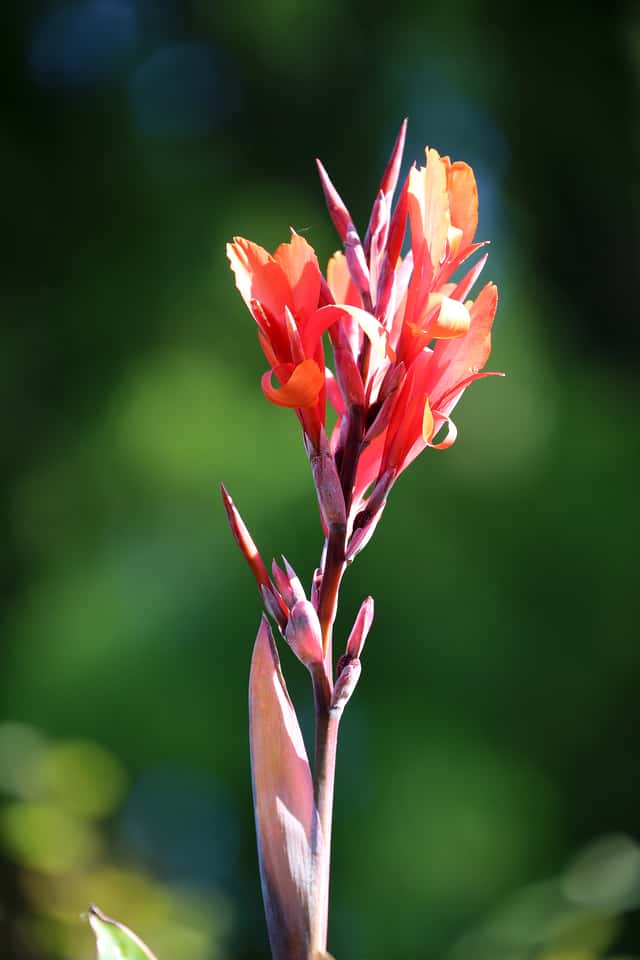
Cannaceae
Canna lily: Edible Plant
Canna × hybrida
Canna lilies require full sun (at least 6 hours of direct light daily), nutrient-rich, well-draining soil, and consistently moist soil levels for lush foliage and blooming. It is recommended to divide the rhizomes every 3–5 years, fertilize the soil in early spring, and regularly deadhead spent flowers. In temperate climates, rhizomes must be dug up before the first frost and stored in a frost-free, dry place.
Every 4 days
Direct sun
7° - 35°C
50% - 80%
Categories
What is Canna lily?
Canna lily (Canna × hybrida) is a medium-care plant from the Cannaceae family. Canna × hybrida, commonly known as the Canna lily, is a spectacular perennial ornamental plant with a tropical feel, popular for its large, paddle-shaped leaves reminiscent of banana plants and its vibrant, exotic flowers. This hybrid group is extremely diverse: flowers can be red, orange, yellow, p...
Canna lily grows up to 2.4m, spread of 180cm, watering every 4 days, 7°C – 35°C, 50–80% humidity. It is suitable for indoor environments and safe for pets.
Unlike many popular species, Canna lily is safe to keep around pets. Without adequate drainage, root rot can develop within 8 days.
How to Care for Canna lily?
TLDR: Canna lily needs Direct sun, watering every 4 days, and temperatures between 7-35°C with 50-80% humidity.
How Often Should You Water Canna lily?
During the growing season, keep the soil consistently and evenly moist—water deeply 1–2 times per week—but avoid standing water and waterlogged soil, as this promotes root and rhizome rot.
How Much Light Does Canna lily Need?
Requires as much direct sunlight as possible (ideally more than 6 hours a day); in shadier spots, the foliage remains a lusher green, but flowering will be sparse and the stems may become leggy.
What Is the Best Soil for Canna lily?
Use loose, well-draining soil rich in humus and organic matter, with a neutral to slightly acidic pH (approx. 6.0–7.0); avoid permanently wet, compacted soils.
What Pot Should You Use for Canna lily?
A large pot or planter at least 30–40 cm in diameter with good drainage is recommended to stabilize the tall stems and provide enough space for the expanding rhizomes.
Care Schedule
Fertilize
Every 14 days
Repot
Every 1460 days
What Is Canna lily and Where Does It Come From?
Canna × hybrida, commonly known as the Canna lily, is a spectacular perennial ornamental plant with a tropical feel, popular for its large, paddle-shaped leaves reminiscent of banana plants and its vibrant, exotic flowers. This hybrid group is extremely diverse: flowers can be red, orange, yellow, pink, or white, often with spotted or bicolor patterns, while the foliage ranges from green and burgundy to variegated stripes. A rhizomatous, fast-spreading plant, it grows 240–240 cm (2–8 feet) tall and blooms from summer to fall. It requires a sunny, warm location and nutrient-rich, well-draining soil; its cold hardiness is limited (down to USDA zones 7–10), so in colder climates, the rhizomes must be lifted for winter.
How to Propagate Canna lily?
Rhizome division
- Allow the cut surfaces to dry for a day before planting to prevent rot.
- Ensure soil temperature reaches approximately 18°C (65°F) before planting.
- 1 Lifting
In spring, before new growth starts, lift the rhizomes from the ground or from winter storage.
- 2 Cutting
Cut the rhizome with a sharp, sterilized knife so that each piece has at least one or two healthy eyes/buds.
- 3 Drying
Allow the cut surfaces to dry for a day before planting to prevent rot.
- 4 Planting
Plant the pieces 10–15 cm deep in nutrient-rich, well-draining soil in a sunny location.
Materials needed:
How Big Does Canna lily Grow?
TLDR: Canna lily can reach up to 2.4m tall with Fast growth rate.
Max height
2.4m
Spread
1.8m
Growth rate
Fast
Foliage
Deciduous
Plant Uses
Ornamental
Great for decoration
Edible
Can be consumed
Culinary Uses
- The rhizomes are rich in starch and can be eaten when cooked
- Young shoots can be used as a vegetable
Is your plant showing symptoms?
Click on the symptom to discover possible causes:
What Diseases Commonly Affect Canna lily?
TLDR: Canna lily is susceptible to 7 known diseases. Monitor regularly for early detection.
Root Rot
Root rot is a serious fungal disease that affects the root system of plants, causing them to decay and die. It is primarily caused by overwatering, poor drainage, or soil-borne fungi such as Pythium, Phytophthora, Rhizoctonia, and Fusarium. The disease thrives in waterlogged conditions where roots are deprived of oxygen, making them susceptible to fungal infection.
Rust
Rust is a common fungal disease caused by fungi in the order Pucciniales that affects a wide variety of plants. The disease gets its name from the characteristic orange, yellow, or reddish-brown pustules that appear on leaves, resembling metal rust. This obligate fungal parasite requires living plants to survive and can cause significant economic losses in agricultural crops.
Gray Mold (Botrytis Blight)
Gray mold, caused by the fungus Botrytis cinerea, is one of the most common fungal diseases in plants. It affects over 200 plant species, including ornamentals, vegetables, fruits, and houseplants. The disease thrives in cool, humid conditions with poor air circulation, causing grayish spots and soft rot on infected tissues.
Mosaic Virus
Mosaic virus is a group of plant viruses that cause mottled, patchy patterns on leaves and can affect a wide variety of plants. The virus creates characteristic yellow, white, and green mosaic patterns, often accompanied by stunted growth and deformed plant parts. This highly contagious disease spreads rapidly through insect vectors and contaminated tools.
Meaning & Symbolism
A symbol of confidence, passion, and tropical splendor; in some cultures, they are planted in gardens as symbols of protection and hospitality.
Compare with similar plants
| Attribute | Difficulty | Light | Watering | Pet Safe |
|---|---|---|---|---|
| Dark Fieldcap | Medium | Low light | 2d | ⚠️ |
| Azalea | Medium | Partial shade | 3d | ⚠️ |
| Muriel's Bamboo | Medium | Partial shade | 3d | ✓ |
| Bougainvillea | Medium | Direct sun | 7d | ⚠️ |




