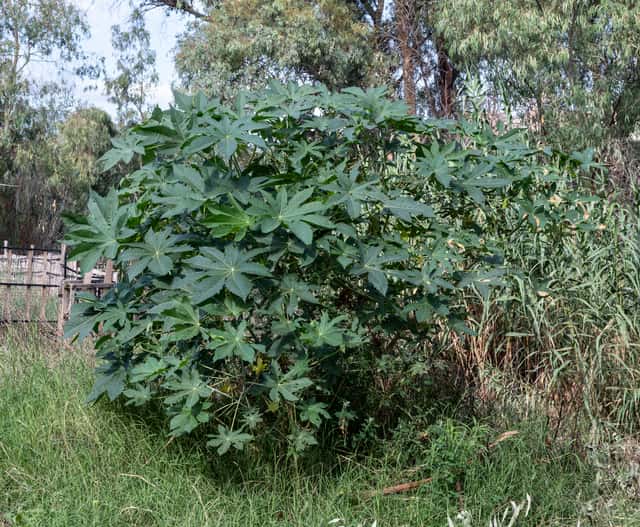
Euphorbiaceae
Castor Bean: The Ultra-Fast Tropical Shrub
Ricinus communis
Plant in full sun with well-draining soil. Water every 7 days, allowing the topsoil to dry slightly between waterings. Fertilize monthly during the growing season. Remove spent flower spikes to limit toxic seed production. Protect from frost.
Every 7 days
Direct sun
15° - 35°C
40% - 70%
Categories
What is Castor Bean?
Castor Bean (Ricinus communis) is a easy-care plant from the Euphorbiaceae family. Castor bean (Ricinus communis) is a fast-growing tropical shrub in the Euphorbiaceae family, native to northeastern Africa. Its giant palmate leaves can reach 60 cm across in deep green or bronzy-red varieties. WARNING: all parts are toxic, and the seeds contain ricin, one of the most lethal natural...
Castor Bean grows up to 3.0m, spread of 150cm, watering every 7 days, 15°C – 35°C, 40–70% humidity. It is not suitable for indoor environments and not safe for pets.
Unlike many tropical plants, Castor Bean tolerates watering mistakes. Best for beginners. Without precautions, ingestion can cause irritation in pets. Keep out of reach of cats and dogs.
How to Care for Castor Bean?
TLDR: Castor Bean needs Direct sun, watering every 7 days, and temperatures between 15-35°C with 40-70% humidity.
How Often Should You Water Castor Bean?
Water deeply every 7 days. Avoid waterlogged soil — castor bean tolerates short dry spells but not root rot. Reduce watering in winter or cooler periods.
How Much Light Does Castor Bean Need?
Requires full direct sun — at least 6 hours daily. Insufficient light causes leggy growth and reduced ornamental impact. This plant truly thrives in hot, sunny positions.
What Is the Best Soil for Castor Bean?
Use rich, well-draining soil: loam mixed with sand and organic compost. Ideal pH 5.5–7.0. Avoid heavy clay soils that stay wet.
What Pot Should You Use for Castor Bean?
Large terracotta pot or directly in garden soil. Not suitable for indoors due to size and extreme toxicity.
Care Schedule
Fertilize
Every 30 days
What Is Castor Bean and Where Does It Come From?
Castor bean (Ricinus communis) is a fast-growing tropical shrub in the Euphorbiaceae family, native to northeastern Africa. Its giant palmate leaves can reach 60 cm across in deep green or bronzy-red varieties. WARNING: all parts are toxic, and the seeds contain ricin, one of the most lethal natural toxins known. Widely grown as a dramatic ornamental and commercially cultivated for castor oil, used across medicine and industry.
How to Propagate Castor Bean?
Direct Sowing
Always wear gloves when handling seeds — ricin in the seed coat can cause skin irritation. Sow after all frost risk has passed.
- 1 Soak seeds in warm water for 24 hours to soften the seed coat
- 2 Sow directly in the final location 2-3 cm deep, or in large pots
- 3 Keep soil moist until germination (7-14 days)
- 4 Thin to one plant per cluster after emergence
Materials needed:
How Big Does Castor Bean Grow?
TLDR: Castor Bean can reach up to 3.0m tall with Fast growth rate.
Max height
3.0m
Spread
1.5m
Growth rate
Fast
Foliage
Semi-evergreen
Warning: Toxic Plant
This plant can be toxic if ingested. Keep out of reach of:
Plant Uses
Ornamental
Great for decoration
Medicinal
Medicinal properties
Medicinal Uses
- Castor oil: laxative, hair moisturizer, topical anti-inflammatory, industrial lubricant
Is your plant showing symptoms?
Click on the symptom to discover possible causes:
What Diseases Commonly Affect Castor Bean?
TLDR: Castor Bean is susceptible to 10 known diseases. Monitor regularly for early detection.
Root Rot
Root rot is a serious fungal disease that affects the root system of plants, causing them to decay and die. It is primarily caused by overwatering, poor drainage, or soil-borne fungi such as Pythium, Phytophthora, Rhizoctonia, and Fusarium. The disease thrives in waterlogged conditions where roots are deprived of oxygen, making them susceptible to fungal infection.
Gray Mold (Botrytis Blight)
Gray mold, caused by the fungus Botrytis cinerea, is a widespread necrotrophic pathogen affecting over 1,400 plant species. It thrives in cool, humid conditions and attacks weakened or aging plant tissues, causing soft rot and characteristic gray fuzzy growth.
Fusarium Wilt
Fusarium wilt is a serious fungal disease caused by the soil-borne fungus Fusarium oxysporum. The fungus invades roots and blocks the water-conducting vessels (xylem) of the plant, causing progressive wilting and eventual death. Host-specific forms of the pathogen exist that attack different plant species.
Leaf Spot
Leaf spot is a common fungal disease caused by various pathogens including Alternaria, Ascochyta, Colletotrichum, Septoria, and Venturia. It primarily affects leaves, causing discolored spots that can lead to premature leaf drop if left untreated.
Meaning & Symbolism
Symbolizes danger and lethal power due to ricin; yet also healing and purification through its castor oil, used in folk medicine for centuries.
Fun Facts
Castor bean can grow 3 meters tall in a single growing season
Ricin in the seeds is roughly 6,000 times more toxic than cyanide
Castor oil was used as aircraft engine lubricant in World War I
It is considered an invasive species in many parts of the world outside its native range
Frequently asked questions
Can castor bean be grown in a pot?
Is castor bean toxic to pets?
How often should I fertilize castor bean?
When does castor bean flower?
Does castor bean die in winter?
Compare with similar plants
| Attribute | Difficulty | Light | Watering | Pet Safe |
|---|---|---|---|---|
| Field Maple | Easy | Bright indirect | 14d | ✓ |
| Silver Birch | Easy | Direct sun | 14d | ✓ |
| Common Blanketflower | Easy | Direct sun | 10d | ✓ |
| Cushion Bush | Easy | Direct sun | 14d | ✓ |





