Rubiaceae
Warszewiczia (Chaconia / Wild Poinsettia) Care Guide
Warszewiczia
Grow in full sun to light shade in warm, humid, frost-free conditions (USDA zones 9-11). Keep soil consistently moist but well-drained and rich in organic matter; avoid waterlogging, which quickly leads to root rot. Fertilize twice a year and prune lightly after flowering to maintain shape. Young plants can be container-grown but eventually need garden space as they mature into a small tree.
Every 6 days
Bright indirect
18° - 32°C
60% - 85%
Categories
What is Chaconia?
Chaconia (Warszewiczia) is a medium-care plant from the Rubiaceae family. Warszewiczia is a genus of evergreen tropical trees and shrubs in the Rubiaceae (coffee) family, native to Central America, the Caribbean, and northern South America. Its best-known and most widely cultivated species, W. coccinea -- the chaconia or wild poinsettia -- is the national flower of Trinid...
Chaconia grows up to 8.0m, watering every 6 days, 18°C – 32°C, 60–85% humidity. It is suitable for indoor environments and safe for pets.
Unlike many popular species, Chaconia is safe to keep around pets. Without adequate drainage, root rot can develop within 12 days.
How to Care for Chaconia?
TLDR: Chaconia needs Bright indirect, watering every 6 days, and temperatures between 18-32°C with 60-85% humidity.
How Often Should You Water Chaconia?
Water regularly to keep the soil evenly moist, letting only the top layer dry slightly between waterings. Reduce frequency for potted specimens and ensure excellent drainage -- soggy roots are the plant's main weakness.
How Much Light Does Chaconia Need?
Provide full sun to partial shade. Best flowering and compact growth occur with at least a few hours of direct sun daily; deep shade causes leaf drop and leggy growth.
What Is the Best Soil for Chaconia?
Use a fertile, humus-rich soil that retains moisture yet drains well -- a loamy mix enriched with compost and organic matter works best.
What Pot Should You Use for Chaconia?
Large, well-draining terracotta or plastic pot with generous drainage holes; upgrade to a half-barrel or plant in-ground once the plant exceeds 1.5 m.
Care Schedule
Fertilize
Every 180 days
Repot
Every 365 days
What Is Chaconia and Where Does It Come From?
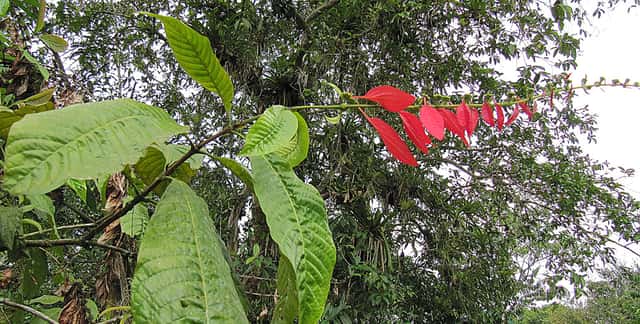
Warszewiczia is a genus of evergreen tropical trees and shrubs in the Rubiaceae (coffee) family, native to Central America, the Caribbean, and northern South America. Its best-known and most widely cultivated species, W. coccinea -- the chaconia or wild poinsettia -- is the national flower of Trinidad and Tobago. The plant is prized for its striking flower clusters: long, upright spikes bearing dozens of small, inconspicuous yellow flowers, each subtended by one flame-red, enlarged sepal (bract) that gives the inflorescence its brilliant color. It grows as a large shrub or small tree, typically 4-8 m tall in cultivation (up to 12 m in the wild), with big, glossy, leathery leaves.
How to Propagate Chaconia?
Seed propagation
Germination rates are naturally low, so sow more seed than you need. Fresh seed germinates far better than stored seed.
- 1 Sow fresh seed on the surface of a moist nursery bed or seed tray
- 2 Water gently to settle seeds without burying them
- 3 Keep warm and consistently moist in bright, indirect light
- 4 Pot up seedlings individually once they reach 4-5 cm tall
- 5 Grow on for 6-7 months before planting out
Materials needed:
Stem cutting
Use sharp, clean tools and maintain high humidity around the cutting; bottom heat speeds rooting.
- 1 Take a semi-hardwood cutting 15-20 cm long from a healthy stem
- 2 Remove the lower leaves and dip the cut end in rooting hormone
- 3 Insert into a moist, well-draining propagation mix
- 4 Cover with a clear bag or propagator lid to keep humidity high
- 5 Keep warm and in bright, indirect light until roots form
Materials needed:
How Big Does Chaconia Grow?
TLDR: Chaconia can reach up to 8.0m tall with Medium growth rate.
Max height
8.0m
Growth rate
Medium
Foliage
Evergreen
Plant Uses
Ornamental
Great for decoration
Medicinal
Medicinal properties
Medicinal Uses
- Bark and wood used in traditional folk medicine in parts of its native range
Is your plant showing symptoms?
Click on the symptom to discover possible causes:
What Diseases Commonly Affect Chaconia?
TLDR: Chaconia is susceptible to 3 known diseases. Monitor regularly for early detection.
Root Rot
Root rot is a serious fungal disease that affects the root system of plants, causing them to decay and die. It is primarily caused by overwatering, poor drainage, or soil-borne fungi such as Pythium, Phytophthora, Rhizoctonia, and Fusarium. The disease thrives in waterlogged conditions where roots are deprived of oxygen, making them susceptible to fungal infection.
Overwatering
Overwatering occurs when plants receive too much water, depriving roots of oxygen and causing root rot. This environmental stress is one of the most common causes of houseplant death, as waterlogged soil prevents roots from breathing and functioning properly.
Low Light Stress
Low light stress, also known as etiolation, occurs when plants do not receive adequate light for proper growth and development. This leads to abnormal growth patterns characterized by elongated stems, pale leaves, and weakened overall structure as the plant attempts to reach toward available light sources.
Meaning & Symbolism
As the national flower of Trinidad and Tobago, the chaconia (W. coccinea) symbolizes national pride, independence, and unity; its blooming season historically coincides with the islands' independence celebrations.
Fun Facts
The chaconia's true flowers are small and yellow -- the brilliant red "petals" everyone notices are actually enlarged bracts (modified sepals).
It is the national flower of Trinidad and Tobago, chosen partly because its wild blooming season lines up with the country's August independence celebrations.
A double-bracted cultivar called 'David Auyong' exists -- every plant of this form descends from a single wild specimen found along a Trinidad roadside in 1957.
The genus is named after Polish plant collector Jozef Warszewicz, who explored Central America in the 19th century.
Frequently asked questions
Is Warszewiczia the same as chaconia?
How much light does it need?
Is it toxic to pets?
Why are the leaves dropping?
Can it be grown indoors?
Compare with similar plants
| Attribute | Difficulty | Light | Watering | Pet Safe |
|---|---|---|---|---|
| Dark Fieldcap | Medium | Low light | 2d | ⚠️ |
| Azalea | Medium | Partial shade | 3d | ⚠️ |
| Muriel's Bamboo | Medium | Partial shade | 3d | ✓ |
| Bougainvillea | Medium | Direct sun | 7d | ⚠️ |