Commelinaceae
Callisia navicularis (Chain Plant) Care Guide
Callisia navicularis
Give this plant bright light, well-draining sandy soil, and let it dry out between waterings. It is a hardy, low-maintenance succulent-type groundcover, sensitive mainly to overwatering and cold.
Every 10 days
Bright indirect
15° - 29°C
30% - 60%
Categories
What is Chain Plant?
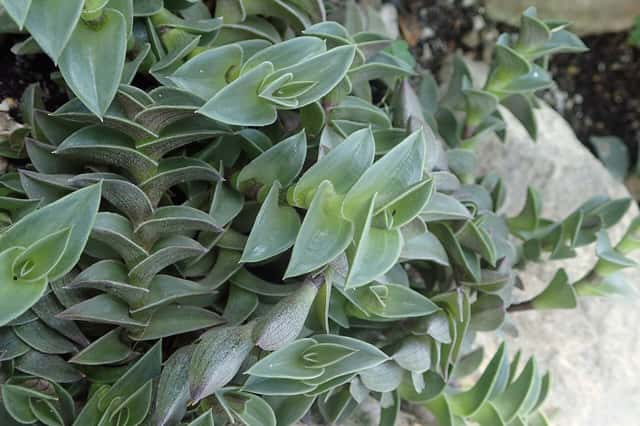
Chain Plant (Callisia navicularis) is a easy-care plant from the Commelinaceae family. Callisia navicularis, commonly known as the Chain Plant, is a low-growing succulent-like perennial in the spiderwort family (Commelinaceae), native to Mexico. Its small, boat-shaped (navicular) leaves are densely arranged along creeping stems, forming tight mats or trailing chains that cascade attra...
Chain Plant grows up to 10cm, spread of 60cm, watering every 10 days, 15°C – 29°C, 30–60% humidity. It is suitable for indoor environments and not safe for pets.
Unlike many tropical plants, Chain Plant tolerates watering mistakes. Best for beginners. Without precautions, ingestion can cause irritation in pets. Keep out of reach of cats and dogs. Without adequate drainage, root rot can develop within 20 days.
How to Care for Chain Plant?
TLDR: Chain Plant needs Bright indirect, watering every 10 days, and temperatures between 15-29°C with 30-60% humidity.
How Often Should You Water Chain Plant?
Water only once the top few centimeters of soil are completely dry, roughly every 7-10 days depending on light and season. Reduce watering further in winter to prevent root rot.
How Much Light Does Chain Plant Need?
Provide bright light or direct sun for best color and a compact habit; in lower light it stays greener but stretches and becomes leggy.
What Is the Best Soil for Chain Plant?
Use a fast-draining sandy or succulent/cactus mix; standard potting soil amended with coarse sand or pumice works well.
What Pot Should You Use for Chain Plant?
A shallow, wide terracotta pot or hanging basket with drainage holes suits its trailing, mat-forming habit.
Care Schedule
Fertilize
Every 60 days
What Is Chain Plant and Where Does It Come From?
Callisia navicularis, commonly known as the Chain Plant, is a low-growing succulent-like perennial in the spiderwort family (Commelinaceae), native to Mexico. Its small, boat-shaped (navicular) leaves are densely arranged along creeping stems, forming tight mats or trailing chains that cascade attractively from hanging baskets. Leaf color shifts from soft green in shade to striking purplish-bronze under bright light, and short-lived three-petaled purple-pink flowers appear in spring and summer.
How to Propagate Chain Plant?
Stem Cutting
Rooting is fastest in the warm growing season; keep the medium barely moist, not wet, to avoid rot.
- 1 Cut a healthy stem section 5-8 cm long with several leaf nodes
- 2 Let the cutting callus (dry out) for 1-2 days in a shaded spot
- 3 Strip the lower leaves and place the stem in moist, well-draining soil or water
- 4 Keep in bright, indirect light until roots and new growth appear
Materials needed:
Offset Division
Offsets that already have roots establish almost immediately with minimal care.
- 1 Locate a small rooted offset or plantlet growing along a trailing stem
- 2 Separate it from the parent plant with a clean cut, keeping any existing roots intact
- 3 Plant the offset directly into well-draining soil
- 4 Water lightly and keep in bright, indirect light until established
Materials needed:
How Big Does Chain Plant Grow?
TLDR: Chain Plant can reach up to 10cm tall with Slow growth rate.
Max height
10cm
Spread
60cm
Growth rate
Slow
Foliage
Evergreen
Warning: Toxic Plant
This plant can be toxic if ingested. Keep out of reach of:
Plant Uses
Ornamental
Great for decoration
Ground Cover
Soil coverage
Is your plant showing symptoms?
Click on the symptom to discover possible causes:
What Diseases Commonly Affect Chain Plant?
TLDR: Chain Plant is susceptible to 10 known diseases. Monitor regularly for early detection.
Leaf Spot
Leaf spot is a common fungal disease caused by various pathogens including Alternaria, Ascochyta, Colletotrichum, Septoria, and Venturia. It primarily affects leaves, causing discolored spots that can lead to premature leaf drop if left untreated.
Grey Mould
Powdery Mildew
Powdery mildew is a common fungal disease caused by various fungi species including Erysiphe, Podosphaera, Oïdium, and Leveillula. It affects over 10,000 plant species worldwide. The disease thrives in warm, dry climates with high humidity and appears as a distinctive white powdery coating on plant surfaces.
Root Rot
Root rot is a serious fungal disease that affects the root system of plants, causing them to decay and die. It is primarily caused by overwatering, poor drainage, or soil-borne fungi such as Pythium, Phytophthora, Rhizoctonia, and Fusarium. The disease thrives in waterlogged conditions where roots are deprived of oxygen, making them susceptible to fungal infection.
Fun Facts
Its boat-shaped leaves inspired the species name 'navicularis,' from the Latin for 'little ship.'
Flowers open in the morning and wilt by the same afternoon, lasting only a single day.
It was previously classified as Tradescantia navicularis before being moved to the genus Callisia.
This species has received the Royal Horticultural Society's Award of Garden Merit.
Frequently asked questions
How often should I water my Chain Plant?
Is Callisia navicularis toxic to pets?
Why is my Chain Plant losing its purple color?
How do I propagate a Chain Plant?
Why are my Chain Plant leaves shriveling?
Compare with similar plants
| Attribute | Difficulty | Light | Watering | Pet Safe |
|---|---|---|---|---|
| Field Maple | Easy | Bright indirect | 14d | ✓ |
| Silver Birch | Easy | Direct sun | 14d | ✓ |
| Common Blanketflower | Easy | Direct sun | 10d | ✓ |
| Cushion Bush | Easy | Direct sun | 14d | ✓ |
Choose & Compare
Sources & References
- Callisia navicularis (Chain Plant) - World of Succulents
- Callisia navicularis: How to Grow This Delightful Houseplant - Ohio Tropics
- Callisia navicularis - Wikipedia
- Callisia Navicularis Chain Plant Care Guide - Succulents Network
- Callisia navicularis - How to grow & care - GrowPlants
- How to Care for the Callisia Navicularis (Chain Plant) - Better Planter
- A Complete Guide for Callisia (Turtle Vine) - UK Houseplants
- Callisia Navicularis: A Beleza Em Miniatura - Pergunte ao Agronomo
- Callisia Navicularis: Cuidados y Caracteristicas de la Planta Cadena





