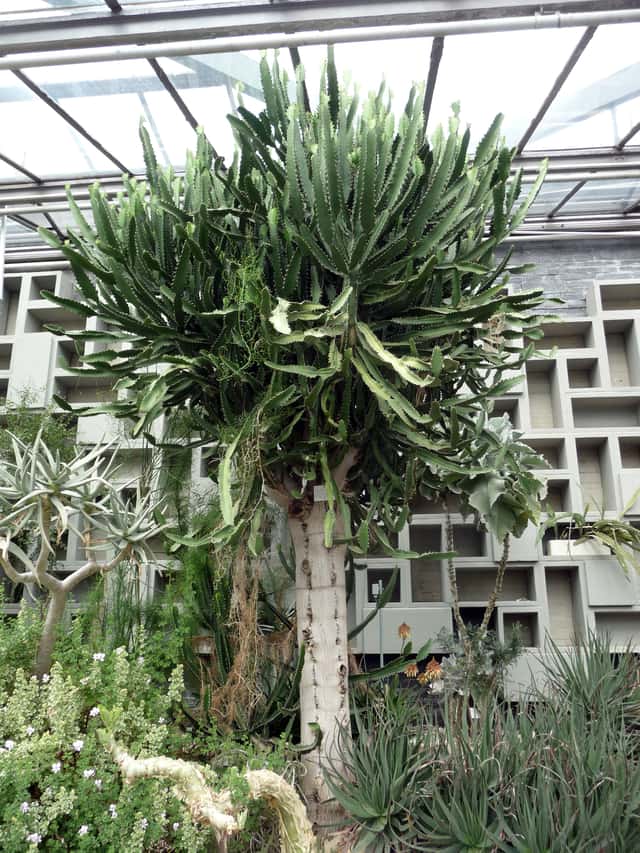
Euphorbiaceae
Chandelier Tree: A Striking South African Succulent
Euphorbia triangularis
Bright direct light, infrequent watering letting soil dry completely, well-draining cactus mix, low humidity.
Every 14 days
Direct sun
10° - 30°C
20% - 40%
Categories
What is Chandelier Tree?
Chandelier Tree (Euphorbia triangularis) is a easy-care plant from the Euphorbiaceae family. Euphorbia triangularis is a tree-like succulent native to South Africa, distinguished by its triangular central stem and chandelier-like branching. It grows slowly but can reach several meters tall in warm climates.
Chandelier Tree grows up to 10.0m, spread of 300cm, watering every 14 days, 10°C – 30°C, 20–40% humidity. It is suitable for indoor environments and not safe for pets.
Unlike many tropical plants, Chandelier Tree tolerates watering mistakes. Best for beginners. Without precautions, ingestion can cause irritation in pets. Keep out of reach of cats and dogs. Without adequate drainage, root rot can develop within 28 days.
How to Care for Chandelier Tree?
TLDR: Chandelier Tree needs Direct sun, watering every 14 days, and temperatures between 10-30°C with 20-40% humidity.
How Often Should You Water Chandelier Tree?
Water only when soil is fully dry — roughly every 10-14 days in summer, much less in winter.
How Much Light Does Chandelier Tree Need?
Prefers bright direct sun; tolerates full sun but shield during peak heat to avoid scorching.
What Is the Best Soil for Chandelier Tree?
Well-draining cactus/succulent mix with coarse sand or perlite, pH 6.0-7.5.
What Pot Should You Use for Chandelier Tree?
Terracotta pot with good drainage, sized to the rootball; upgrade as it grows.
Care Schedule
Fertilize
Every 60 days
Repot
Every 730 days
What Is Chandelier Tree and Where Does It Come From?
Euphorbia triangularis is a tree-like succulent native to South Africa, distinguished by its triangular central stem and chandelier-like branching. It grows slowly but can reach several meters tall in warm climates.
How to Propagate Chandelier Tree?
Stem cutting
Always wear gloves and eye protection. The milky sap irritates skin and eyes. Wash immediately if exposed.
- 1 Wear gloves — the sap is toxic and irritant
- 2 Cut a healthy side branch
- 3 Allow cutting to callous over 1-2 weeks in dry shade
- 4 Plant in dry cactus substrate
- 5 Water only after 2-3 weeks
Materials needed:
How Big Does Chandelier Tree Grow?
TLDR: Chandelier Tree can reach up to 10.0m tall with Slow growth rate.
Max height
10.0m
Spread
3.0m
Growth rate
Slow
Foliage
Evergreen
Warning: Toxic Plant
This plant can be toxic if ingested. Keep out of reach of:
Plant Uses
Ornamental
Great for decoration
Is your plant showing symptoms?
Click on the symptom to discover possible causes:
What Diseases Commonly Affect Chandelier Tree?
TLDR: Chandelier Tree is susceptible to 6 known diseases. Monitor regularly for early detection.
Root Rot
Root rot is a serious fungal disease that affects the root system of plants, causing them to decay and die. It is primarily caused by overwatering, poor drainage, or soil-borne fungi such as Pythium, Phytophthora, Rhizoctonia, and Fusarium. The disease thrives in waterlogged conditions where roots are deprived of oxygen, making them susceptible to fungal infection.
Mealybugs
Mealybugs are small, soft-bodied insects covered with a white, waxy, cottony material. They are common pests of houseplants and outdoor plants in mild climates. These sap-sucking insects feed on plant tissue, causing damage, stunted growth, and can lead to plant death if left untreated. They produce sticky honeydew which attracts sooty mold.
Whiteflies
Whiteflies are small, soft-bodied, winged insects closely related to aphids and mealybugs. They are moth-like in appearance, about 1/16 inch long, triangular in shape, and gray-white in color. These sap-sucking pests feed on plant tissue, causing yellowing, stunted growth, and wilting. They also excrete honeydew, which attracts ants and promotes sooty mold growth. Whiteflies can transmit serious plant viruses.
Scale Insects
Scale insects are small sap-sucking pests that appear as brown, shell-like bumps on plant stems and leaves. There are over 25 species, divided into armored (hard) and unarmored (soft) scales. They feed by piercing plant tissue and extracting sap, which weakens the plant and can lead to yellowing, stunted growth, and even death if left untreated. They also excrete honeydew, which attracts ants and promotes sooty mold growth.
Meaning & Symbolism
Symbol of endurance and longevity.
Fun Facts
Its milky white latex sap is caustic and was historically used as arrow poison in parts of Africa
Forms a tree-like trunk that can reach 6 meters in the wild
Grows in dense colonies forming thickets known as euphorbia veld
Frequently asked questions
Is Euphorbia triangularis toxic?
How often should I water?
Can it be grown indoors?
What soil should I use?
Compare with similar plants
| Attribute | Difficulty | Light | Watering | Pet Safe |
|---|---|---|---|---|
| Field Maple | Easy | Bright indirect | 14d | ✓ |
| Silver Birch | Easy | Direct sun | 14d | ✓ |
| Common Blanketflower | Easy | Direct sun | 10d | ✓ |
| Cushion Bush | Easy | Direct sun | 14d | ✓ |





