Cucurbitaceae
Chayote: Edible Plant
Sechium edule
Prefers full sun and fertile, well-drained soil rich in organic matter. Water 2 to 3 times a week without waterlogging, increasing frequency during fruiting. It requires a robust vertical support structure, fertilization every 30 days, and light pruning to control its vigorous growth.
Every 3 days
Direct sun
15° - 32°C
50% - 70%
Categories
What is Chayote?
Chayote (Sechium edule) is a medium-care plant from the Cucurbitaceae family. The chayote (Sechium edule) is a vigorous herbaceous climbing vine in the Cucurbitaceae family, native to Central America, whose vines can exceed 32 to 49 feet (10 to 15 meters) in length when well-supported by trellises, fences, or arbors. It produces light green fruits with smooth or prickly skin,...
Chayote grows up to 15.0m, spread of 500cm, watering every 3 days, 15°C – 32°C, 50–70% humidity. It is not suitable for indoor environments and safe for pets.
Unlike many popular species, Chayote is safe to keep around pets.
How to Care for Chayote?
TLDR: Chayote needs Direct sun, watering every 3 days, and temperatures between 15-32°C with 50-70% humidity.
How Often Should You Water Chayote?
Water 2 to 3 times a week, keeping the soil moist but never waterlogged—chayote is sensitive to root rot. Increase frequency on dry days and during fruit production.
How Much Light Does Chayote Need?
Requires full sun, with at least 6 hours of direct sunlight daily, for vigorous growth and good fruit production.
What Is the Best Soil for Chayote?
Use fertile, deep, well-drained soil rich in organic matter, with a pH between 5.5 and 6.8. Good moisture retention is important, but avoid waterlogging.
What Pot Should You Use for Chayote?
Prefer planting directly in the ground or in a large, deep pot, always with a firm support structure (trellis, arbor, or fence) nearby, as it is a vigorous climber that needs vertical space.
Care Schedule
Fertilize
Every 30 days
What Is Chayote and Where Does It Come From?
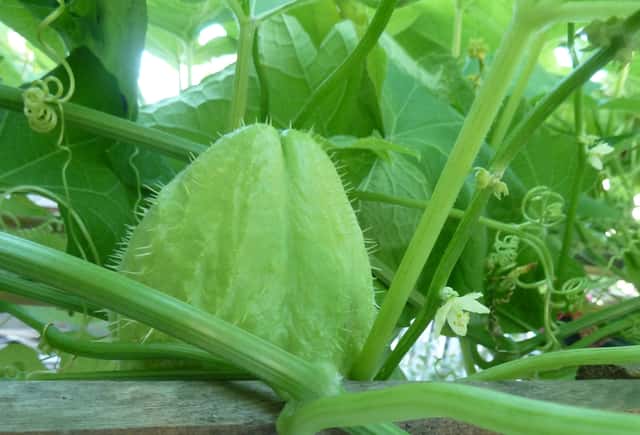
The chayote (Sechium edule) is a vigorous herbaceous climbing vine in the Cucurbitaceae family, native to Central America, whose vines can exceed 32 to 49 feet (10 to 15 meters) in length when well-supported by trellises, fences, or arbors. It produces light green fruits with smooth or prickly skin, heart-shaped leaves, and small greenish-white flowers. It is a fast-growing, highly productive plant that blooms between summer and fall and bears fruit just a few months after planting. All parts of the plant are edible—fruit, shoots, leaves, seeds, and even the tuberous root—making it both a versatile vegetable and an ornamental plant for pergolas and walls.
How to Propagate Chayote?
Sprouted fruit (Seed-fruit)
- The best planting time is between October and February, avoiding cold and strong winds
- Space the seedlings to allow good air circulation and reduce the risk of powdery mildew
- 1 Leave the mature fruit in a dry, ventilated place until it sprouts, forming a whitish 'navel' from which the root and shoot emerge
- 2 When the shoots reach 4 to 6 inches (10 to 15 cm), prepare the permanent site with rich, well-drained soil
- 3 Plant the fruit upside down, covering only the sprout (root) part with soil; do not cover the rest of the fruit to prevent rotting
- 4 Water lightly without soaking, and install the vertical support structure as soon as the vine begins to grow
Materials needed:
How Big Does Chayote Grow?
TLDR: Chayote can reach up to 15.0m tall with Fast growth rate.
Max height
15.0m
Spread
5.0m
Growth rate
Fast
Foliage
Deciduous
Plant Uses
Edible
Can be consumed
Medicinal
Medicinal properties
Medicinal Uses
- Aids in digestion and intestinal function due to its water and fiber content
- Contributes to blood pressure regulation due to high potassium content
- Antioxidant and anti-inflammatory action, thanks to vitamin C and flavonoids like quercetin and kaempferol
- Diuretic and hydrating effect, promoting kidney health
Culinary Uses
- Consumed raw in salads and juices
- Cooked in soups, stews, and soufflés
- Shoots and leaves used in tea preparation
- Seeds and skin are also edible
Is your plant showing symptoms?
Click on the symptom to discover possible causes:
What Diseases Commonly Affect Chayote?
TLDR: Chayote is susceptible to 5 known diseases. Monitor regularly for early detection.
Powdery Mildew
Powdery mildew is a common fungal disease caused by various fungi species including Erysiphe, Podosphaera, Oïdium, and Leveillula. It affects over 10,000 plant species worldwide. The disease thrives in warm, dry climates with high humidity and appears as a distinctive white powdery coating on plant surfaces.
Aphids
Aphids are small, soft-bodied, pear-shaped insects (1/16 to 1/8 inch long) that feed by sucking nutrient-rich sap from plants. They reproduce rapidly and can quickly weaken plants, causing distorted growth and transmitting plant viruses. Aphids come in various colors including green, black, red, yellow, brown, and gray. They secrete honeydew, a sticky substance that attracts ants and encourages sooty mold growth.
Mealybugs
Mealybugs are small, soft-bodied insects covered with a white, waxy, cottony material. They are common pests of houseplants and outdoor plants in mild climates. These sap-sucking insects feed on plant tissue, causing damage, stunted growth, and can lead to plant death if left untreated. They produce sticky honeydew which attracts sooty mold.
Whiteflies
Whiteflies are small, soft-bodied, winged insects closely related to aphids and mealybugs. They are moth-like in appearance, about 1/16 inch long, triangular in shape, and gray-white in color. These sap-sucking pests feed on plant tissue, causing yellowing, stunted growth, and wilting. They also excrete honeydew, which attracts ants and promotes sooty mold growth. Whiteflies can transmit serious plant viruses.
Compare with similar plants
| Attribute | Difficulty | Light | Watering | Pet Safe |
|---|---|---|---|---|
| Dark Fieldcap | Medium | Low light | 2d | ⚠️ |
| Azalea | Medium | Partial shade | 3d | ⚠️ |
| Muriel's Bamboo | Medium | Partial shade | 3d | ✓ |
| Bougainvillea | Medium | Direct sun | 7d | ⚠️ |
Choose & Compare
Sources & References
- Dicas para plantar chuchu no quintal
- Como plantar chuchu com 9 dicas profissionais
- How to Grow Chayote (Sechium edule): A Complete Guide
- Chayote Plant Growing Guide
- Chuchu: benefícios e como fazer
- Como Plantar Chuchu na Terra, no Vaso e na Água
- How Much Humidity Does My Chayote Need?
- How to Plant, Grow, Prune, and Harvest Chayote
- Poda do chuchu




