Asteraceae
Cheerful Sunflower (Helianthus × laetiflorus)
Helianthus × laetiflorus
Easy: full sun, ordinary well-drained soil, water only in long dry spells. Hardy to about -15 °C. It grows and spreads fast; divide clumps every 2 to 4 years and cut down old stems after flowering.
Every 7 days
Direct sun
-15° - °C
% - %
Categories
What is Cheerful sunflower?
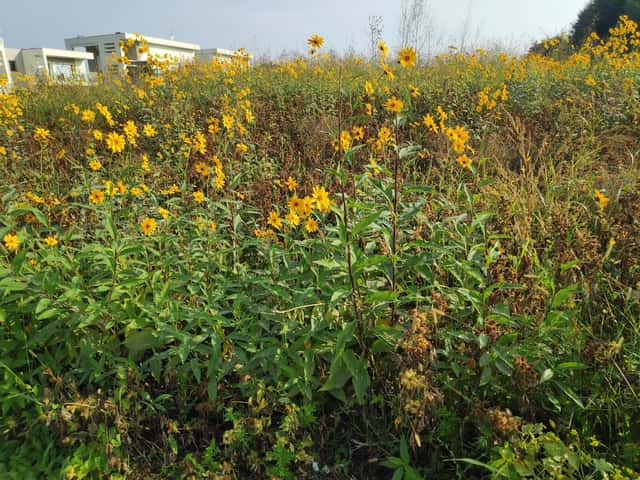
Cheerful sunflower (Helianthus × laetiflorus) is a easy-care plant from the Asteraceae family. Helianthus × laetiflorus is a perennial sunflower from North America, a natural hybrid between Helianthus pauciflorus and Jerusalem artichoke (Helianthus tuberosus). It forms clumps of upright stems 1.5 to 2.5 m tall with dark green, narrow, toothed leaves, and spreads quickly by rhizomes. From late...
Cheerful sunflower grows up to 2.5m, spread of 150cm, watering every 7 days. It is not suitable for indoor environments and safe for pets.
Unlike many tropical plants, Cheerful sunflower tolerates watering mistakes. Best for beginners. Unlike many popular species, Cheerful sunflower is safe to keep around pets.
How to Care for Cheerful sunflower?
TLDR: Cheerful sunflower needs Direct sun, watering every 7 days, and temperatures between -15-30°C with 40-70% humidity.
How Often Should You Water Cheerful sunflower?
Once established it is drought tolerant. In hot, dry spells, water deeply about once a week. Avoid waterlogged soil.
How Much Light Does Cheerful sunflower Need?
Full sun, all day if possible. In shade it gets leggy, flops and flowers poorly.
What Is the Best Soil for Cheerful sunflower?
Ordinary garden soil, loam, chalk or sand, moist but well drained, neutral to alkaline. Very rich or heavily fed soil makes the stems flop.
What Pot Should You Use for Cheerful sunflower?
Best in the ground. In a container, only a very large, deep one with a drainage hole, and even then the rhizomes fill it fast.
What Is Cheerful sunflower and Where Does It Come From?
Helianthus × laetiflorus is a perennial sunflower from North America, a natural hybrid between Helianthus pauciflorus and Jerusalem artichoke (Helianthus tuberosus). It forms clumps of upright stems 1.5 to 2.5 m tall with dark green, narrow, toothed leaves, and spreads quickly by rhizomes. From late summer into autumn it opens bright yellow flowers 10 to 12 cm across with dark centres, which draw many bees and butterflies. The top growth dies back in winter and the plant regrows in spring.
How to Propagate Cheerful sunflower?
Division
Dividing every 2 to 4 years keeps the plant vigorous and keeps the rhizomes in check.
- 1 Lift the clump in early spring or autumn
- 2 Split off rhizome pieces with shoots and roots
- 3 Replant at the same depth with plenty of space
- 4 Water well after planting
Materials needed:
Seed
As it is a hybrid, seedlings may vary.
- 1 Sow in spring in trays or directly in the bed
- 2 Cover with a thin layer of soil
- 3 Keep moist until germination
- 4 Move seedlings to their final sunny spot
Materials needed:
How Big Does Cheerful sunflower Grow?
TLDR: Cheerful sunflower can reach up to 2.5m tall with Fast growth rate.
Max height
2.5m
Spread
1.5m
Growth rate
Fast
Foliage
Deciduous
Plant Uses
Ornamental
Great for decoration
Is your plant showing symptoms?
Click on the symptom to discover possible causes:
What Diseases Commonly Affect Cheerful sunflower?
TLDR: Cheerful sunflower is susceptible to 3 known diseases. Monitor regularly for early detection.
Slugs and Snails
Slugs and snails are mollusks that feed on plant tissue, causing irregular holes in leaves and damage to young seedlings. They are most active at night and in moist conditions, leaving characteristic silvery slime trails. These pests can quickly devastate gardens, especially during wet seasons.
Powdery Mildew
Powdery mildew is a common fungal disease caused by various fungi species including Erysiphe, Podosphaera, Oïdium, and Leveillula. It affects over 10,000 plant species worldwide. The disease thrives in warm, dry climates with high humidity and appears as a distinctive white powdery coating on plant surfaces.
White Mold
White mold (Sclerotinia sclerotiorum) is a devastating fungal disease affecting over 400 plant species worldwide. The fungus produces black, seed-like structures (sclerotia) that can survive in soil for 5 or more years. The disease is favored by cool, moist weather (50-68°F/10-20°C), especially during flowering.
Fun Facts
It is a natural hybrid of two North American sunflowers, one of them the Jerusalem artichoke.
Its flowers draw many bees and butterflies.
It blooms in late summer, when much of the garden is past its best.
Frequently asked questions
Does the cheerful sunflower come back every year?
How tall does it get?
Does it spread?
What problems can it have?
Compare with similar plants
| Attribute | Difficulty | Light | Watering | Pet Safe |
|---|---|---|---|---|
| Field Maple | Easy | Bright indirect | 14d | ✓ |
| Iberian Houseleek | Easy | Direct sun | 14d | ✓ |
| Silver Birch | Easy | Direct sun | 14d | ✓ |
| Common Blanketflower | Easy | Direct sun | 10d | ✓ |





