Caryophyllaceae
Chickweed (Stellaria media)
Stellaria media
Chickweed needs almost no care once established: keep the soil consistently moist, give it partial shade to full sun, and it will self-seed freely. It tolerates cold well but slows or dies back in summer heat.
Every 3 days
Partial shade
-10° - 25°C
40% - 70%
Categories
What is Chickweed?
Chickweed (Stellaria media) is a easy-care plant from the Caryophyllaceae family. Stellaria media, commonly called chickweed, is a low-growing, sprawling annual (or winter annual) native to Europe and now naturalized worldwide. It forms soft mats of small oval leaves and tiny white star-shaped flowers, thriving in cool, moist, disturbed soil such as garden beds, lawns, and greenh...
Chickweed grows up to 40cm, spread of 60cm, watering every 3 days, -10°C – 25°C, 40–70% humidity. It is not suitable for indoor environments and safe for pets.
Unlike many tropical plants, Chickweed tolerates watering mistakes. Best for beginners. Unlike many popular species, Chickweed is safe to keep around pets.
How to Care for Chickweed?
TLDR: Chickweed needs Partial shade, watering every 3 days, and temperatures between -10-25°C with 40-70% humidity.
How Often Should You Water Chickweed?
Water every 2-3 days to keep soil consistently moist; chickweed does not tolerate prolonged drought.
How Much Light Does Chickweed Need?
Grows best in partial shade to full sun; in hot climates, afternoon shade prevents stress and premature bolting.
What Is the Best Soil for Chickweed?
Prefers rich, moist, well-drained soil with a neutral to slightly acidic pH (5.5-7.5) and good organic content.
What Pot Should You Use for Chickweed?
Wide, shallow containers or open garden beds with loose, organic-rich soil work best, as chickweed spreads via a sprawling, shallow root system.
What Is Chickweed and Where Does It Come From?
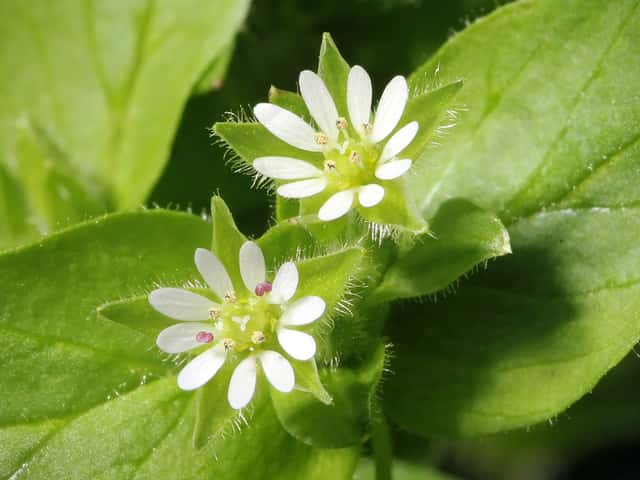
Stellaria media, commonly called chickweed, is a low-growing, sprawling annual (or winter annual) native to Europe and now naturalized worldwide. It forms soft mats of small oval leaves and tiny white star-shaped flowers, thriving in cool, moist, disturbed soil such as garden beds, lawns, and greenhouses. Prized both as a cottage-garden ground cover and as one of the most popular wild edible and medicinal weeds, chickweed grows and flowers almost year-round in temperate climates.
How to Propagate Chickweed?
Seed sowing
Chickweed self-seeds readily; once established in a bed it usually returns each cool season without replanting.
- 1 Scatter seeds over loose, moist, organic-rich soil
- 2 Press seeds gently into the surface without covering, as light aids germination
- 3 Keep soil consistently moist until seedlings appear
- 4 Thin seedlings if overly dense
Materials needed:
How Big Does Chickweed Grow?
TLDR: Chickweed can reach up to 40cm tall with Fast growth rate.
Max height
40cm
Spread
60cm
Growth rate
Fast
Foliage
Deciduous
Plant Uses
Edible
Can be consumed
Medicinal
Medicinal properties
Ground Cover
Soil coverage
Medicinal Uses
- Poultice applied to cuts, burns, bruises, and itchy skin conditions
- Traditional infusion for coughs, bronchitis, and mild respiratory complaints
- Used to ease rheumatic and joint pain
Culinary Uses
- Fresh young leaves and stems eaten raw in salads
- Cooked as a mild spinach substitute
- Blended into pestos, soups, and green smoothies
Is your plant showing symptoms?
Click on the symptom to discover possible causes:
What Diseases Commonly Affect Chickweed?
TLDR: Chickweed is susceptible to 4 known diseases. Monitor regularly for early detection.
Powdery Mildew
Powdery mildew is a common fungal disease caused by various fungi species including Erysiphe, Podosphaera, Oïdium, and Leveillula. It affects over 10,000 plant species worldwide. The disease thrives in warm, dry climates with high humidity and appears as a distinctive white powdery coating on plant surfaces.
Leaf Spot
Leaf spot is a common fungal disease caused by various pathogens including Alternaria, Ascochyta, Colletotrichum, Septoria, and Venturia. It primarily affects leaves, causing discolored spots that can lead to premature leaf drop if left untreated.
Downy Mildew
Downy mildew is a fungal-like disease caused by oomycetes (water molds) that thrives in cool, wet conditions. It affects a wide range of plants, causing yellowing leaves with fuzzy white-gray growth underneath, leading to defoliation and reduced yields if left untreated.
Aphids
Aphids are small, soft-bodied, pear-shaped insects (1/16 to 1/8 inch long) that feed by sucking nutrient-rich sap from plants. They reproduce rapidly and can quickly weaken plants, causing distorted growth and transmitting plant viruses. Aphids come in various colors including green, black, red, yellow, brown, and gray. They secrete honeydew, a sticky substance that attracts ants and encourages sooty mold growth.
Meaning & Symbolism
Known as "winterweed" for thriving through cold months, chickweed symbolizes resilience and quiet renewal.
Fun Facts
Its tiny white flowers have five deeply split petals that make them look like ten petals at first glance
Chickweed can flower and set seed almost year-round in mild climates
The genus name Stellaria comes from the Latin for "star", referring to its star-shaped flowers
Frequently asked questions
Is chickweed safe to eat?
Does chickweed need full sun?
Why is chickweed called winterweed?
How do I stop chickweed from spreading in my garden?
Compare with similar plants
| Attribute | Difficulty | Light | Watering | Pet Safe |
|---|---|---|---|---|
| Field Maple | Easy | Bright indirect | 14d | ✓ |
| Silver Birch | Easy | Direct sun | 14d | ✓ |
| Common Blanketflower | Easy | Direct sun | 10d | ✓ |
| Cushion Bush | Easy | Direct sun | 14d | ✓ |





