Asteraceae
Chicory Plant Care Guide
Cichorium intybus
Chicory is one of the easiest herbs to grow. Give it full sun, well-draining soil, and water regularly while seedlings establish; mature plants tolerate drought and neglect. It self-sows readily and needs almost no fertilizing.
Every 7 days
Bright indirect
10° - 27°C
% - %
Categories
What is Chicory?
Chicory (Cichorium intybus) is a easy-care plant from the Asteraceae family. Chicory (Cichorium intybus) is a hardy herbaceous perennial in the daisy family, prized for its sky-blue, dandelion-like flowers that open at dawn and close by early afternoon. Native to Europe, western Asia and North Africa, it now grows wild across temperate regions worldwide. The plant forms a ba...
Chicory grows up to 1.5m, spread of 90cm, watering every 7 days, 10°C – 27°C. It is not suitable for indoor environments and safe for pets.
Unlike many tropical plants, Chicory tolerates watering mistakes. Best for beginners. Unlike many popular species, Chicory is safe to keep around pets.
How to Care for Chicory?
TLDR: Chicory needs Bright indirect, watering every 7 days, and temperatures between 10-27°C with 40-70% humidity.
How Often Should You Water Chicory?
Keep soil evenly moist for the first few weeks after sowing. Once established, chicory is drought-tolerant and only needs watering during prolonged dry spells or intense summer heat.
How Much Light Does Chicory Need?
Plant in full sun for the best flowering and root development; chicory tolerates partial shade but grows leggier and flowers less.
What Is the Best Soil for Chicory?
Chicory adapts to poor, sandy, or clay soils but performs best in loose, fertile, well-draining soil with a pH between 5.5 and 7.0.
What Pot Should You Use for Chicory?
Best grown directly in garden beds or large deep containers (at least 30 cm deep) to accommodate its long taproot; not suited to shallow pots.
What Is Chicory and Where Does It Come From?
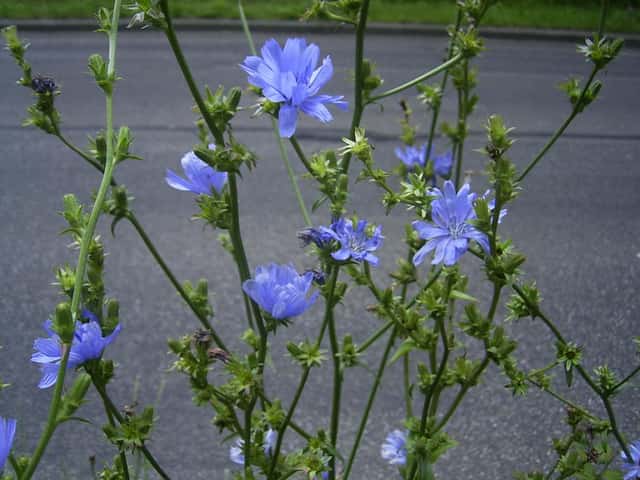
Chicory (Cichorium intybus) is a hardy herbaceous perennial in the daisy family, prized for its sky-blue, dandelion-like flowers that open at dawn and close by early afternoon. Native to Europe, western Asia and North Africa, it now grows wild across temperate regions worldwide. The plant forms a basal rosette of jagged leaves in its first year, then sends up tall, branching flower stalks up to 1.5 m. Both the bitter leaves and the long taproot are edible, and the roasted root has long served as a coffee substitute.
How to Propagate Chicory?
Direct seed sowing
Chicory germinates best in soil temperatures of 18-21°C and needs light to sprout, so barely cover the seed.
- 1 Sow seeds 6 mm deep directly in the garden after the last frost
- 2 Space rows about 50 cm apart and keep soil consistently moist
- 3 Thin seedlings to 20-25 cm apart once they have 3-4 true leaves
- 4 Water regularly until plants are established, about 4-6 weeks
Materials needed:
Root division
Division is less common than seed propagation but useful for perpetuating a specific plant.
- 1 Dig up an established clump in early spring before new growth appears
- 2 Split the crown into sections, each with roots and at least one growth bud
- 3 Replant divisions immediately at the same depth as the parent plant
- 4 Water well until new leaves emerge
Materials needed:
How Big Does Chicory Grow?
TLDR: Chicory can reach up to 1.5m tall with Medium growth rate.
Max height
1.5m
Spread
90cm
Growth rate
Medium
Foliage
Deciduous
Plant Uses
Edible
Can be consumed
Medicinal
Medicinal properties
Ornamental
Great for decoration
Medicinal Uses
- Roots traditionally used to support digestion and liver health
- Inulin-rich root acts as a prebiotic fiber
- Leaf extracts used traditionally to soothe skin irritation
- Traditional use for mild appetite loss and bloating
Culinary Uses
- Young leaves eaten raw or cooked as a bitter salad green
- Roasted, ground root brewed as a caffeine-free coffee substitute
- Forced roots (witloof/Belgian endive) blanched and eaten as a vegetable
- Flowers used as edible garnish
Is your plant showing symptoms?
Click on the symptom to discover possible causes:
What Diseases Commonly Affect Chicory?
TLDR: Chicory is susceptible to 7 known diseases. Monitor regularly for early detection.
Downy Mildew
Downy mildew is a fungal-like disease caused by oomycetes (water molds) that thrives in cool, wet conditions. It affects a wide range of plants, causing yellowing leaves with fuzzy white-gray growth underneath, leading to defoliation and reduced yields if left untreated.
Anthracnose
Anthracnose is a fungal disease caused by fungi in the genus Colletotrichum that affects many plants, including vegetables, fruits, and trees. The disease thrives in cool, wet conditions, causing dark, sunken lesions on leaves, stems, flowers, and fruits.
Root Rot
Root rot is a serious fungal disease that affects the root system of plants, causing them to decay and die. It is primarily caused by overwatering, poor drainage, or soil-borne fungi such as Pythium, Phytophthora, Rhizoctonia, and Fusarium. The disease thrives in waterlogged conditions where roots are deprived of oxygen, making them susceptible to fungal infection.
Leaf Spot
Leaf spot is a common fungal disease caused by various pathogens including Alternaria, Ascochyta, Colletotrichum, Septoria, and Venturia. It primarily affects leaves, causing discolored spots that can lead to premature leaf drop if left untreated.
Meaning & Symbolism
In Victorian flower language, chicory symbolizes frugality, patience and steadfast waiting; European folklore ties its sky-blue flowers, which open at dawn and close by afternoon, to legends of a woman who waited faithfully by the roadside for a lost love.
Fun Facts
Chicory flowers open at dawn and close by early afternoon, earning it folk names like "clock flower"
The root contains up to 40% inulin, a prebiotic fiber that has negligible effect on blood sugar
Forced, blanched chicory roots produce Belgian endive (witloof), a completely different-looking vegetable from the same species
Napoleon popularized chicory coffee in France during a coffee shortage caused by a British naval blockade
Frequently asked questions
Is chicory the same plant used to make coffee substitute?
Is chicory invasive?
Can I eat chicory leaves raw?
Is chicory safe for pets?
Compare with similar plants
| Attribute | Difficulty | Light | Watering | Pet Safe |
|---|---|---|---|---|
| Field Maple | Easy | Bright indirect | 14d | ✓ |
| Silver Birch | Easy | Direct sun | 14d | ✓ |
| Common Blanketflower | Easy | Direct sun | 10d | ✓ |
| Cushion Bush | Easy | Direct sun | 14d | ✓ |





