Gesneriaceae
Codonanthe: Pet-Safe Plant
Codonanthe devosiana
Prefers bright but indirect light, regular watering without waterlogging the substrate, high humidity, and warm, stable temperatures. An airy, well-drained substrate, along with moderate fertilization in spring and summer, promotes continuous flowering.
Every 5 days
Partial shade
15° - 28°C
55% - 85%
Categories
What is Codonanthe?
Codonanthe (Codonanthe devosiana) is a medium-care plant from the Gesneriaceae family. Codonanthe (Codonanthe devosiana) is an epiphytic subshrub from the Gesneriaceae family, related to the African violet. It is native to the Atlantic Forest of southeastern and southern Brazil, where it grows hanging from trunks and branches, rarely rooting in solid ground. Its thin, trailing stems b...
Codonanthe grows up to 25cm, spread of 75cm, watering every 5 days, 15°C – 28°C, 55–85% humidity. It is suitable for indoor environments and safe for pets.
Unlike many popular species, Codonanthe is safe to keep around pets. Without adequate drainage, root rot can develop within 10 days.
How to Care for Codonanthe?
TLDR: Codonanthe needs Partial shade, watering every 5 days, and temperatures between 15-28°C with 55-85% humidity.
How Often Should You Water Codonanthe?
Water when the top 2-3 cm of the substrate is dry to the touch, approximately every 5 days during the growing season and less frequently in winter. Use lukewarm water and avoid letting water sit in the saucer, as excess moisture promotes root rot.
How Much Light Does Codonanthe Need?
Place it near an east or west-facing window with bright but filtered or indirect light. Avoid direct midday sun, which can burn and discolor the fleshy leaves.
What Is the Best Soil for Codonanthe?
Use a light, well-drained substrate based on peat or coconut fiber, perlite, and orchid bark or leaf litter, with a slightly acidic pH of 5.5 to 6.5. Avoid compact mixes that retain excessive water.
What Pot Should You Use for Codonanthe?
As an epiphyte, it grows best in hanging baskets or elevated pots with good drainage that mimic its natural habit of growing suspended on trunks. Clay or plastic pots with multiple drainage holes work well, always avoiding waterlogging.
Care Schedule
Fertilize
Every 21 days
Misting
Every 3 days
Rotate
Every 15 days
Repot
Every 365 days
What Is Codonanthe and Where Does It Come From?
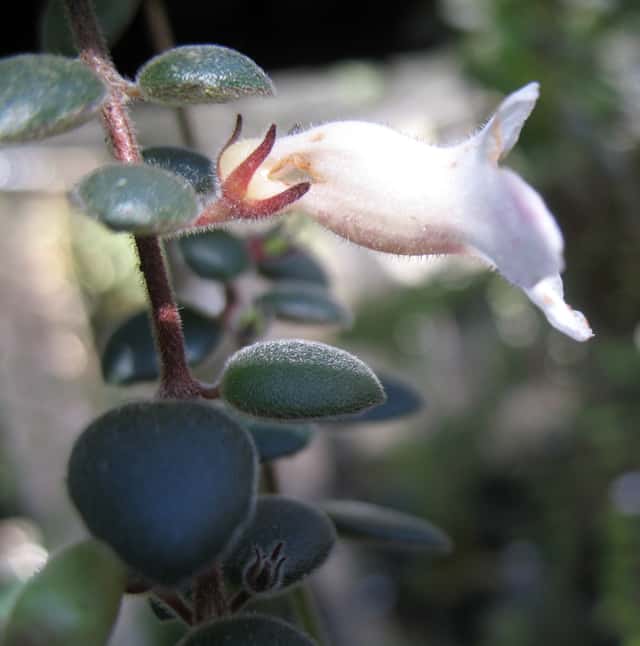
Codonanthe (Codonanthe devosiana) is an epiphytic subshrub from the Gesneriaceae family, related to the African violet. It is native to the Atlantic Forest of southeastern and southern Brazil, where it grows hanging from trunks and branches, rarely rooting in solid ground. Its thin, trailing stems bear small, fleshy, almost round leaves that are dark green on the upper side and reddish or maroon on the underside. Between spring and autumn, it produces white or pale pink tubular flowers, sometimes with a yellow or maroon throat, followed by small, bright orange berries. Due to its trailing habit and prolonged flowering, it is highly valued in hanging baskets and as a houseplant.
How to Propagate Codonanthe?
Stem cutting
- Keep the substrate moist but never waterlogged during rooting.
- Use a plastic bag or dome to maintain humidity while it roots.
- 1 Selection
Cut a 10-15 cm cutting with at least two or three pairs of leaves from a healthy stem.
- 2 Rooting
Place the cutting in water or directly into moist substrate, maintaining warmth (20-25°C) and high humidity.
- 3 Transplanting
Once 2-3 cm roots appear, transplant into a small pot with well-drained substrate.
Materials needed:
Seed propagation
- Germination is slow and irregular.
- Maintain a stable temperature around 22°C.
- 1 Extraction
Extract seeds from fully ripe orange berries.
- 2 Sowing
Scatter the seeds over moist substrate without covering them, as they need light to germinate.
- 3 Care
Maintain high humidity with a transparent cover until germination.
Materials needed:
How Big Does Codonanthe Grow?
TLDR: Codonanthe can reach up to 25cm tall with Medium growth rate.
Max height
25cm
Spread
75cm
Growth rate
Medium
Foliage
Evergreen
Warning: Toxic Plant
This plant can be toxic if ingested. Keep out of reach of:
Plant Uses
Ornamental
Great for decoration
Is your plant showing symptoms?
Click on the symptom to discover possible causes:
What Diseases Commonly Affect Codonanthe?
TLDR: Codonanthe is susceptible to 4 known diseases. Monitor regularly for early detection.
Mealybugs
Mealybugs are small, soft-bodied insects covered with a white, waxy, cottony material. They are common pests of houseplants and outdoor plants in mild climates. These sap-sucking insects feed on plant tissue, causing damage, stunted growth, and can lead to plant death if left untreated. They produce sticky honeydew which attracts sooty mold.
Aphids
Aphids are small, soft-bodied, pear-shaped insects (1/16 to 1/8 inch long) that feed by sucking nutrient-rich sap from plants. They reproduce rapidly and can quickly weaken plants, causing distorted growth and transmitting plant viruses. Aphids come in various colors including green, black, red, yellow, brown, and gray. They secrete honeydew, a sticky substance that attracts ants and encourages sooty mold growth.
Root Rot
Root rot is a serious fungal disease that affects the root system of plants, causing them to decay and die. It is primarily caused by overwatering, poor drainage, or soil-borne fungi such as Pythium, Phytophthora, Rhizoctonia, and Fusarium. The disease thrives in waterlogged conditions where roots are deprived of oxygen, making them susceptible to fungal infection.
Low Humidity Stress
Low humidity stress occurs when indoor air becomes too dry, causing plants to lose moisture faster than they can absorb it through their roots. This is especially common during winter heating periods, near radiators and heating vents, or in air-conditioned spaces. Tropical plants are particularly susceptible to low humidity damage.
Meaning & Symbolism
Like many trailing and constantly flowering plants, the codonanthe is often associated in ornamental gardening with abundance, hospitality, and continuous care—qualities linked to its habit of growing and blooming almost uninterruptedly when receiving proper care.
Compare with similar plants
| Attribute | Difficulty | Light | Watering | Pet Safe |
|---|---|---|---|---|
| Dark Fieldcap | Medium | Low light | 2d | ⚠️ |
| Azalea | Medium | Partial shade | 3d | ⚠️ |
| Muriel's Bamboo | Medium | Partial shade | 3d | ✓ |
| Bougainvillea | Medium | Direct sun | 7d | ⚠️ |




