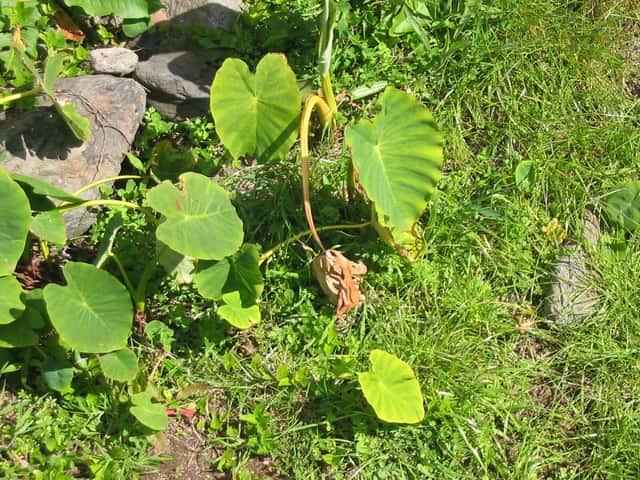
Araceae
Taro: Edible Plant
Colocasia
Give Colocasia bright, indirect light, keep the soil constantly moist to boggy, and provide high humidity and warm temperatures. It thrives outdoors in summer or in a humid greenhouse/indoor spot, dying back in cool weather and resprouting from its corm in spring.
Every 3 days
Partial shade
10° - 35°C
50% - 80%
Categories
What is Taro?
Taro (Colocasia) is a medium-care plant from the Araceae family. Colocasia is a genus of large-leaved tropical perennials native to Southeast Asia, grown worldwide both as a dramatic foliage plant and, in the case of Colocasia esculenta (taro), as one of the world's oldest cultivated food crops. Its broad, heart- or arrow-shaped leaves rise on long petioles from...
Taro grows up to 1.8m, spread of 120cm, watering every 3 days, 10°C – 35°C, 50–80% humidity. It is suitable for indoor environments and not safe for pets.
Without precautions, ingestion can cause irritation in pets. Keep out of reach of cats and dogs. Without adequate drainage, root rot can develop within 7 days.
How to Care for Taro?
TLDR: Taro needs Partial shade, watering every 3 days, and temperatures between 10-35°C with 50-80% humidity.
How Often Should You Water Taro?
Never let the soil dry out - Colocasia is a marginal/wetland plant that tolerates standing water far better than drought. Water generously and often, especially in hot weather, and consider standing the pot in a saucer of water during peak growth.
How Much Light Does Taro Need?
Provide bright, indirect or filtered light; a few hours of gentle morning sun is fine, but shield from intense midday sun which scorches the leaves. Darker-leaved cultivars tolerate more direct sun than plain green ones.
What Is the Best Soil for Taro?
Use a rich, organic, moisture-retentive mix (loam or clay-loam with plenty of compost) with a slightly acidic pH around 5.5-6.5. Unlike most houseplants it does not need sharp drainage and is happy in boggy conditions.
What Pot Should You Use for Taro?
A wide, deep plastic or glazed ceramic pot with a saucer that can hold standing water suits Colocasia's wetland habit better than fast-draining terracotta.
Care Schedule
Fertilize
Every 30 days
What Is Taro and Where Does It Come From?
Colocasia is a genus of large-leaved tropical perennials native to Southeast Asia, grown worldwide both as a dramatic foliage plant and, in the case of Colocasia esculenta (taro), as one of the world's oldest cultivated food crops. Its broad, heart- or arrow-shaped leaves rise on long petioles from an underground corm, giving it the common name "elephant ear". All parts of the raw plant contain needle-like calcium oxalate crystals that irritate skin and mouth, so the corms and leaves are always cooked thoroughly before eating.
How to Propagate Taro?
Corm/Offset Division
Wear gloves - sap can irritate skin. Let cut surfaces callus for a day before planting to reduce rot risk.
- 1 Lift the parent plant or expose the corm at the start of spring
- 2 Look for offset cormels attached to the main corm
- 3 Cut or gently twist offsets away, keeping some roots attached
- 4 Let cuts dry/callus for 24 hours
- 5 Pot each offset in moist, rich soil and keep warm and humid until new growth appears
Materials needed:
Tuber Cutting
Ensure each piece has at least one visible growth bud/eye; keep substrate warm (above 20C) to speed sprouting.
- 1 Cut the main corm/tuber into sections, each with at least one eye
- 2 Dust cut surfaces with fungicide or let them callus
- 3 Plant sections 5-8cm deep in warm, moist medium
- 4 Keep humidity high with a cover until shoots emerge
Materials needed:
How Big Does Taro Grow?
TLDR: Taro can reach up to 1.8m tall with Fast growth rate.
Max height
1.8m
Spread
1.2m
Growth rate
Fast
Foliage
Deciduous
Warning: Toxic Plant
This plant can be toxic if ingested. Keep out of reach of:
Plant Uses
Edible
Can be consumed
Ornamental
Great for decoration
Medicinal Uses
- Cooked corm traditionally used in Pacific and Asian diets as an easily digestible starch for infants, the elderly and convalescents
- Leaves and corm are a good source of dietary fiber, vitamin C and potassium once cooked
Culinary Uses
- Corms boiled, steamed, roasted or fried like potatoes after thorough cooking to neutralize calcium oxalate
- Young leaves cooked as a leafy green vegetable, as in Hawaiian lau lau or Caribbean callaloo
- Corms pounded into poi, a staple fermented paste in Hawaiian cuisine
Is your plant showing symptoms?
Click on the symptom to discover possible causes:
What Diseases Commonly Affect Taro?
TLDR: Taro is susceptible to 11 known diseases. Monitor regularly for early detection.
Root Rot
Root rot is a serious fungal disease that affects the root system of plants, causing them to decay and die. It is primarily caused by overwatering, poor drainage, or soil-borne fungi such as Pythium, Phytophthora, Rhizoctonia, and Fusarium. The disease thrives in waterlogged conditions where roots are deprived of oxygen, making them susceptible to fungal infection.
Downy Mildew
Downy mildew is a fungal-like disease caused by oomycetes (water molds) that thrives in cool, wet conditions. It affects a wide range of plants, causing yellowing leaves with fuzzy white-gray growth underneath, leading to defoliation and reduced yields if left untreated.
Pythium Root Rot
Pythium root rot is a serious fungal disease caused by various Pythium species including P. aphanidermatum, P. ultimum, and P. irregulare. These water molds are present in practically all cultivated soils and attack plant roots under wet conditions, causing rapid wet rot that can extend into the stem. The disease is favored by poor drainage, overwatering, and specific temperatures depending on the species.
Phytophthora Blight
Devastating fungal disease caused by Phytophthora species (primarily P. capsici and P. infestans), famously responsible for the Irish Potato Famine in the 1840s. Affects all plant parts including roots, stems, leaves, and fruits in warm, wet conditions. The pathogen is technically an oomycete (water mold) that thrives in saturated soils and can survive in soil for 5+ years.
Meaning & Symbolism
In Hawaiian and wider Pacific culture, taro (kalo) is regarded as an ancestral, sacred plant symbolizing family, sustenance and community; its broad leaves are also read more generally as a sign of abundance and tropical vitality.
Compare with similar plants
| Attribute | Difficulty | Light | Watering | Pet Safe |
|---|---|---|---|---|
| Dark Fieldcap | Medium | Low light | 2d | ⚠️ |
| Azalea | Medium | Partial shade | 3d | ⚠️ |
| Muriel's Bamboo | Medium | Partial shade | 3d | ✓ |
| Bougainvillea | Medium | Direct sun | 7d | ⚠️ |




