Poaceae
Common Reed: Edible Plant
Phragmites australis
Common Reed is extremely low-maintenance and robust, provided the location is permanently moist to wet or situated directly in shallow water. Pruning of dead stalks is best done in early spring just before new growth emerges. Since the rhizomes spread vigorously, a root barrier is recommended in garden ponds to prevent overgrowth.
Every 1 days
Bright indirect
-20° - 40°C
60% - 100%
Categories
What is Common Reed?
Common Reed (Phragmites australis) is a easy-care plant from the Poaceae family. The Common Reed (Phragmites australis) is a tall, perennial wetland grass that grows in dense stands—known as reed beds—along the banks of standing and slow-flowing bodies of water. It reaches heights of up to four meters and often spreads extensively via vigorous underground rhizomes. The character...
Common Reed grows up to 4.0m, watering every 1 days, -20°C – 40°C, 60–100% humidity. It is not suitable for indoor environments and safe for pets.
Unlike many tropical plants, Common Reed tolerates watering mistakes. Best for beginners. Unlike many popular species, Common Reed is safe to keep around pets.
How to Care for Common Reed?
TLDR: Common Reed needs Bright indirect, watering every 1 days, and temperatures between -20-40°C with 60-100% humidity.
How Often Should You Water Common Reed?
The root zone must never dry out—planting in 10 to 30 cm deep water or in permanently saturated shoreline soil is ideal. During summer droughts and falling water levels, additional watering is essential.
How Much Light Does Common Reed Need?
Full sun is best tolerated, but a semi-shaded location is also possible; at least a few hours of direct light per day promote vigorous growth and flower formation.
What Is the Best Soil for Common Reed?
Common Reed feels most comfortable in nutrient-rich, muddy-loamy substrate with high nitrogen content, but it also tolerates sandy or clayey soils as well as a wide pH range from slightly acidic to alkaline.
What Pot Should You Use for Common Reed?
Common Reed does not belong in a classic flower pot, but rather in a large, stable planting basket or tub without drainage holes that is submerged in the shallow water of a pond; this also prevents the uncontrolled spread of the rhizomes.
What Is Common Reed and Where Does It Come From?
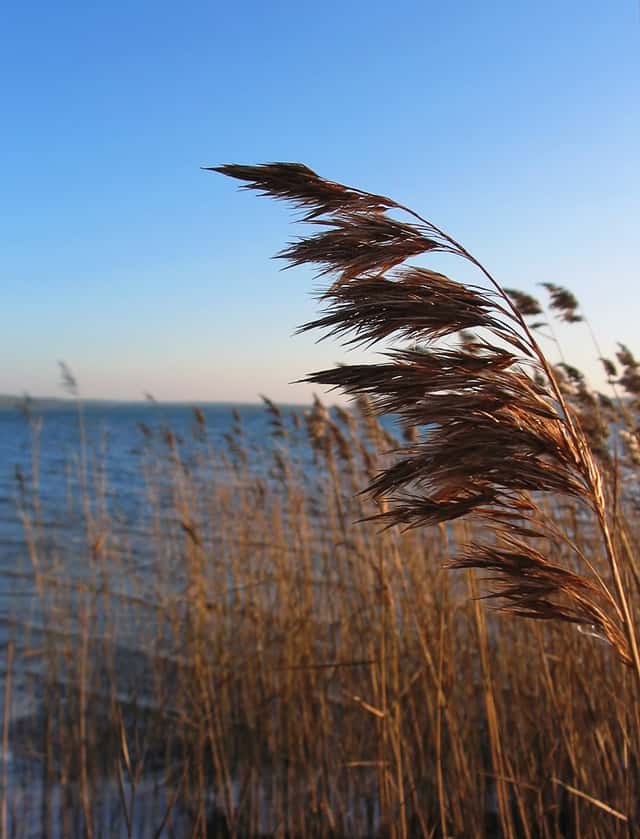
The Common Reed (Phragmites australis) is a tall, perennial wetland grass that grows in dense stands—known as reed beds—along the banks of standing and slow-flowing bodies of water. It reaches heights of up to four meters and often spreads extensively via vigorous underground rhizomes. The characteristic dark purple to silvery-gray flower panicles appear in late summer and autumn above narrow, blue-green leaves that turn golden-brown in winter. Distributed worldwide, the reed is considered an ecologically significant habitat for birds and insects, but once established, it can spread very aggressively.
How to Propagate Common Reed?
How Big Does Common Reed Grow?
TLDR: Common Reed can reach up to 4.0m tall with Fast growth rate.
Max height
4.0m
Growth rate
Fast
Foliage
Deciduous
Plant Uses
Ornamental
Great for decoration
Edible
Can be consumed
Medicinal
Medicinal properties
Medicinal Uses
- Root decoction traditionally used for coughs and congested lungs
- Diuretic application of the root in folk medicine
- Used in Traditional Chinese Medicine for fever and nausea
Culinary Uses
- Young shoots peeled and prepared like vegetables
- Roots dried and ground into flour
- Sugary sap extracted from the stalks with a sweetish taste
- Seeds ground and processed into a nutritious porridge
Is your plant showing symptoms?
Click on the symptom to discover possible causes:
What Diseases Commonly Affect Common Reed?
TLDR: Common Reed is susceptible to 4 known diseases. Monitor regularly for early detection.
Rust
Rust is a common fungal disease caused by fungi in the order Pucciniales that affects a wide variety of plants. The disease gets its name from the characteristic orange, yellow, or reddish-brown pustules that appear on leaves, resembling metal rust. This obligate fungal parasite requires living plants to survive and can cause significant economic losses in agricultural crops.
Scale Insects
Scale insects are small sap-sucking pests that appear as brown, shell-like bumps on plant stems and leaves. There are over 25 species, divided into armored (hard) and unarmored (soft) scales. They feed by piercing plant tissue and extracting sap, which weakens the plant and can lead to yellowing, stunted growth, and even death if left untreated. They also excrete honeydew, which attracts ants and promotes sooty mold growth.
Aphids
Aphids are small, soft-bodied, pear-shaped insects (1/16 to 1/8 inch long) that feed by sucking nutrient-rich sap from plants. They reproduce rapidly and can quickly weaken plants, causing distorted growth and transmitting plant viruses. Aphids come in various colors including green, black, red, yellow, brown, and gray. They secrete honeydew, a sticky substance that attracts ants and encourages sooty mold growth.
Caterpillars
Caterpillars are the larval stage of moths and butterflies that feed voraciously on plant foliage, stems, flowers, and fruits. Common species include cabbage loopers, tomato hornworms, armyworms, and cutworms. These pests can cause extensive damage by consuming large amounts of plant tissue in a short time. They vary in size from small (1/4 inch) to large (5 inches), with colors ranging from green to brown, often featuring stripes or spots. Caterpillars are highly mobile and can quickly spread throughout gardens, making them one of the most destructive common pests.
Meaning & Symbolism
Since antiquity, the reed has been considered a symbol of adaptability, humility, and quiet endurance: it bends in the storm without breaking. As a plant of the Bible (including the parable of the 'reed shaken by the wind') and in European plant symbolism, it also stands for mutability and the strength of the seemingly weak.
Compare with similar plants
| Attribute | Difficulty | Light | Watering | Pet Safe |
|---|---|---|---|---|
| Field Maple | Easy | Bright indirect | 14d | ✓ |
| Muriel's Bamboo | Medium | Partial shade | 3d | ✓ |
| Silver Birch | Easy | Direct sun | 14d | ✓ |
| Common Blanketflower | Easy | Direct sun | 10d | ✓ |





