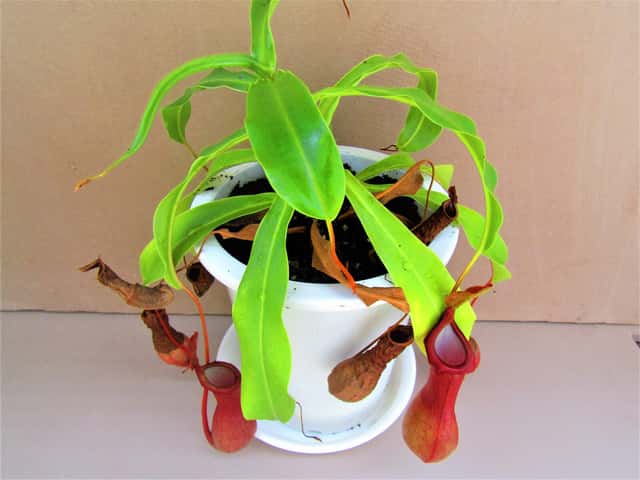
Nepenthaceae
Nepenthes mirabilis (Common Swamp Pitcher-Plant) Care Guide
Nepenthes mirabilis
Give it bright, indirect light for 6-8 hours a day, keep the peat-based substrate constantly moist with pure water, and maintain high humidity (80-100%) for best pitcher production. Never fertilize the soil or use tap water; feed with insects instead.
Every 3 days
Bright indirect
10° - 30°C
80% - 100%
Categories
What is Common Swamp Pitcher-Plant?
Common Swamp Pitcher-Plant (Nepenthes mirabilis) is a easy-care plant from the Nepenthaceae family. Nepenthes mirabilis, known as the common swamp pitcher-plant, is one of the most widespread carnivorous pitcher plants in the world, ranging from southern China through Southeast Asia to northern Australia. A vigorous climbing vine, it produces distinctive jug-shaped pitchers that trap and digest in...
Common Swamp Pitcher-Plant grows up to watering every 3 days, 10°C – 30°C, 80–100% humidity. It is suitable for indoor environments and safe for pets.
Unlike many tropical plants, Common Swamp Pitcher-Plant tolerates watering mistakes. Best for beginners. Unlike many popular species, Common Swamp Pitcher-Plant is safe to keep around pets. Without adequate drainage, root rot can develop within 7 days.
How to Care for Common Swamp Pitcher-Plant?
TLDR: Common Swamp Pitcher-Plant needs Bright indirect, watering every 3 days, and temperatures between 10-30°C with 80-100% humidity.
How Often Should You Water Common Swamp Pitcher-Plant?
Water only with distilled, rain or reverse-osmosis water — tap water minerals and fertilizers will damage the roots. Keep the substrate evenly moist but never waterlogged; avoid the tray/reservoir method as it invites rot.
How Much Light Does Common Swamp Pitcher-Plant Need?
Provide bright, indirect light or filtered sun for 6-8 hours daily. Too much direct sun can scorch leaves and dry out pitchers, while too little light reduces pitcher formation.
What Is the Best Soil for Common Swamp Pitcher-Plant?
Use a nutrient-poor, well-draining mix of sphagnum moss, peat and perlite (roughly 1:1). Standard potting soil or fertilizer will kill the plant — it gets nutrients from trapped insects, not soil.
What Pot Should You Use for Common Swamp Pitcher-Plant?
Use a plastic pot or well-draining hanging basket/net pot rather than glazed ceramic, since Nepenthes roots need excellent aeration and the plant benefits from being able to trail or climb.
What Is Common Swamp Pitcher-Plant and Where Does It Come From?
Nepenthes mirabilis, known as the common swamp pitcher-plant, is one of the most widespread carnivorous pitcher plants in the world, ranging from southern China through Southeast Asia to northern Australia. A vigorous climbing vine, it produces distinctive jug-shaped pitchers that trap and digest insects to supplement the poor nutrient content of its native boggy, sunny habitats. Its adaptability and relative ease of care make it a popular starter species for carnivorous plant enthusiasts.
How to Propagate Common Swamp Pitcher-Plant?
Stem Cutting
Maintain very high humidity (90%+) around the cutting until roots establish; a clear plastic bag or propagator lid works well.
- 1 Cut a healthy stem section with 2-3 leaf nodes below an active growth point
- 2 Remove the lower leaf and dip the cut end in rooting hormone
- 3 Place in a moist mix of sphagnum moss and perlite inside a humid propagation box
- 4 Keep at 24-28°C with bright indirect light until new roots and growth appear
Materials needed:
Seed Propagation
Nepenthes seed loses viability quickly, so use fresh seed and expect slow, low germination rates.
- 1 Sow fresh seed thinly on the surface of moist milled sphagnum moss
- 2 Cover the container to maintain near 100% humidity
- 3 Keep at 25-28°C under bright indirect light or grow lights
- 4 Thin and pot up seedlings once several leaves have formed
Materials needed:
How Big Does Common Swamp Pitcher-Plant Grow?
TLDR: Common Swamp Pitcher-Plant can reach up to ?cm tall with Medium growth rate.
Growth rate
Medium
Foliage
Evergreen
Plant Uses
Ornamental
Great for decoration
Is your plant showing symptoms?
Click on the symptom to discover possible causes:
What Diseases Commonly Affect Common Swamp Pitcher-Plant?
TLDR: Common Swamp Pitcher-Plant is susceptible to 7 known diseases. Monitor regularly for early detection.
Root Rot
Root rot is a serious fungal disease that affects the root system of plants, causing them to decay and die. It is primarily caused by overwatering, poor drainage, or soil-borne fungi such as Pythium, Phytophthora, Rhizoctonia, and Fusarium. The disease thrives in waterlogged conditions where roots are deprived of oxygen, making them susceptible to fungal infection.
Grey Mould
Sooty Mold
Sooty mold is a fungal disease that develops on surfaces coated with honeydew, a sticky sweet substance secreted by sap-sucking insects like aphids, scale insects, and whiteflies. While it does not directly infect plant tissue, it reduces photosynthetic capacity by blocking sunlight and diminishes the plant's aesthetic appearance.
Mealybugs
Mealybugs are small, soft-bodied insects covered with a white, waxy, cottony material. They are common pests of houseplants and outdoor plants in mild climates. These sap-sucking insects feed on plant tissue, causing damage, stunted growth, and can lead to plant death if left untreated. They produce sticky honeydew which attracts sooty mold.
Meaning & Symbolism
The genus name recalls the mythical "nepenthes pharmakon" of Greek legend, a drug of forgetfulness, and the plant is often seen as a symbol of mystery, adaptability and nature's ingenuity in solving scarcity.
Fun Facts
Nepenthes mirabilis has the widest natural range of any pitcher plant species, spanning from southern China to northern Australia.
Its genus name comes from the Greek "nepenthes pharmakon", a mythical potion said to banish grief and sorrow.
The pitchers form a miniature ecosystem, hosting mosquito larvae, mites and other organisms that live in the digestive fluid.
Unlike many Nepenthes species that need cool nights, N. mirabilis tolerates a wide temperature range, making it one of the easiest species for beginners.
Frequently asked questions
Is Nepenthes mirabilis toxic to cats or dogs?
How often should I water Nepenthes mirabilis?
Why are my pitchers turning brown and dying?
Does Nepenthes mirabilis need to be fed insects?
Can I grow Nepenthes mirabilis outdoors?
Compare with similar plants
| Attribute | Difficulty | Light | Watering | Pet Safe |
|---|---|---|---|---|
| Field Maple | Easy | Bright indirect | 14d | ✓ |
| Silver Birch | Easy | Direct sun | 14d | ✓ |
| Common Blanketflower | Easy | Direct sun | 10d | ✓ |
| Cushion Bush | Easy | Direct sun | 14d | ✓ |





