Bromeliaceae
Cone Guzmania (Guzmania conifera)
Guzmania conifera
A warm-climate bromeliad for bright, indirect light: a little water in the central cup, a light, well-drained mix, high humidity and temperatures above 16 °C. After flowering, grow on the pups.
Every 7 days
Partial shade
16° - 27°C
50% - 80%
Categories
What is Cone Guzmania?
Cone Guzmania (Guzmania conifera) is a medium-care plant from the Bromeliaceae family. Guzmania conifera is an epiphytic bromeliad from the wet tropical forests of Colombia, Ecuador and northern Peru, where it grows on tree branches without harming them. It forms a large rosette of long, narrow, glossy dark green leaves around a central cup that holds water. Its highlight is a cone-sh...
Cone Guzmania grows up to watering every 7 days, 16°C – 27°C, 50–80% humidity. It is suitable for indoor environments and safe for pets.
Unlike many popular species, Cone Guzmania is safe to keep around pets. Without adequate drainage, root rot can develop within 14 days.
How to Care for Cone Guzmania?
TLDR: Cone Guzmania needs Partial shade, watering every 7 days, and temperatures between 16-27°C with 50-80% humidity.
How Often Should You Water Cone Guzmania?
Keep the central cup about a quarter full and replace the water every few weeks. Water the mix only as it starts to dry; never let it get soggy. Rain or distilled water is best.
How Much Light Does Cone Guzmania Need?
Bright, indirect light. Strong direct sun scorches the leaves and fades the cone; too little light dulls the colour.
What Is the Best Soil for Cone Guzmania?
A light, airy mix such as orchid or bromeliad mix (bark, coco coir and perlite). It can also be mounted on wood with moss.
What Pot Should You Use for Cone Guzmania?
A small, heavy pot (the plant tips over easily), clay or plastic, with good drainage; the roots are mainly for anchorage.
Care Schedule
Fertilize
Every 30 days
What Is Cone Guzmania and Where Does It Come From?
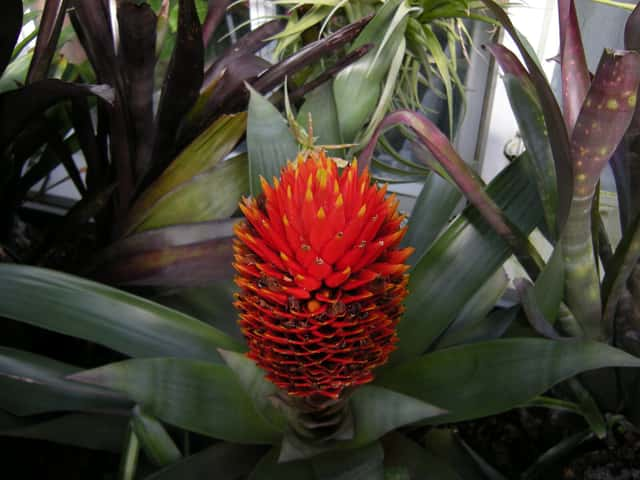
Guzmania conifera is an epiphytic bromeliad from the wet tropical forests of Colombia, Ecuador and northern Peru, where it grows on tree branches without harming them. It forms a large rosette of long, narrow, glossy dark green leaves around a central cup that holds water. Its highlight is a cone-shaped inflorescence held above the leaves on a stalk: bright red to orange bracts tipped with yellow that last for several months. Like other bromeliads it flowers only once; afterwards the mother plant slowly dies, leaving pups at its base.
How to Propagate Cone Guzmania?
Offsets (pups)
Do not separate pups that are too small. Remove the mother plant once it has fully died back.
- 1 After flowering, let pups grow at the base of the mother plant
- 2 When they are about a third of the mother's size, cut them away with a clean knife, with roots if possible
- 3 Pot each pup in a small pot of bromeliad mix
- 4 Put a little water in the cup and keep warm and humid in indirect light
Materials needed:
How Big Does Cone Guzmania Grow?
TLDR: Cone Guzmania can reach up to ?cm tall with Slow growth rate.
Growth rate
Slow
Foliage
Evergreen
Plant Uses
Ornamental
Great for decoration
Is your plant showing symptoms?
Click on the symptom to discover possible causes:
What Diseases Commonly Affect Cone Guzmania?
TLDR: Cone Guzmania is susceptible to 3 known diseases. Monitor regularly for early detection.
Root Rot
Root rot is a serious fungal disease that affects the root system of plants, causing them to decay and die. It is primarily caused by overwatering, poor drainage, or soil-borne fungi such as Pythium, Phytophthora, Rhizoctonia, and Fusarium. The disease thrives in waterlogged conditions where roots are deprived of oxygen, making them susceptible to fungal infection.
Spider Mites
Spider mites are tiny arachnids (less than 1/20 inch long) related to spiders and ticks that feed on plant sap. They thrive in hot, dry conditions and can cause significant damage to ornamental and vegetable plants. During severe infestations, crop losses can reach 14% or higher as these pests disrupt vital plant processes including photosynthesis, carbon dioxide absorption, and transpiration.
Powdery Mildew
Powdery mildew is a common fungal disease caused by various fungi species including Erysiphe, Podosphaera, Oïdium, and Leveillula. It affects over 10,000 plant species worldwide. The disease thrives in warm, dry climates with high humidity and appears as a distinctive white powdery coating on plant surfaces.
Fun Facts
The name conifera refers to its cone-shaped bloom, like a pine cone.
In the wild it lives on trees, drinking rainwater collected in its cup of leaves.
The coloured cone lasts for months, but the true flowers are small and yellow.
Frequently asked questions
Does Guzmania conifera die after flowering?
How do I water it?
Is it toxic to cats and dogs?
Why is the base rotting?
Compare with similar plants
| Attribute | Difficulty | Light | Watering | Pet Safe |
|---|---|---|---|---|
| Dark Fieldcap | Medium | Low light | 2d | ⚠️ |
| Azalea | Medium | Partial shade | 3d | ⚠️ |
| Muriel's Bamboo | Medium | Partial shade | 3d | ✓ |
| Bougainvillea | Medium | Direct sun | 7d | ⚠️ |