Aizoaceae
Cone Plants (Conophytum)
Conophytum
Winter-growing succulents: the key is following their cycle. From late spring to late summer keep them nearly dry (a light misting at most) while the dry sheath protects the new leaves. From late summer through winter, water thoroughly when the mix dries. Give bright light but shield them from strong afternoon sun and summer heat, with good airflow. Protect from frost (below 0 °C) and never waterlog: overwatering is the main killer.
Every 14 days
Bright indirect
0° - 40°C
% - %
Categories
What is Cone plant?
Cone plant (Conophytum) is a medium-care plant from the Aizoaceae family. Conophytum is a genus of about 106 species of dwarf succulents in the family Aizoaceae, native to southern Namibia and the Western and Northern Cape of South Africa, where they grow in rock crevices, quartz gravel and stony slopes. Each "body" is a pair of almost fully fused leaves shaped like a but...
Cone plant grows up to 5cm, spread of 15cm, watering every 14 days, 0°C – 40°C. It is suitable for indoor environments and safe for pets.
Unlike many popular species, Cone plant is safe to keep around pets. Without adequate drainage, root rot can develop within 28 days.
How to Care for Cone plant?
TLDR: Cone plant needs Bright indirect, watering every 14 days, and temperatures between 0-40°C with 40-70% humidity.
How Often Should You Water Cone plant?
In the growing season (late summer to late winter), water thoroughly and let it drain, only once the mix is dry: usually every 1-3 weeks, less in cold weather. In late spring and summer, when the plant is dormant inside its dry sheath, stop watering or just mist lightly now and then. Wrinkled bodies in the growing season mean it needs water.
How Much Light Does Cone plant Need?
Bright light: morning or late-afternoon sun and brightness the rest of the day. Avoid strong mid-afternoon sun, especially in summer, which scorches the bodies. In low light they turn soft, stretched and lose colour.
What Is the Best Soil for Cone plant?
A mineral mix with little organic matter that drains fast: for example 1 part loam, 2 parts coarse sand and 1 part fine gravel or perlite, or cactus mix with plenty of sand and grit.
What Pot Should You Use for Cone plant?
A small, shallow clay pot of 10-20 cm with a drainage hole; clay dries faster than plastic. Refresh the mix every 2 years in late summer.
Care Schedule
Fertilize
Every 365 days
Repot
Every 730 days
What Is Cone plant and Where Does It Come From?
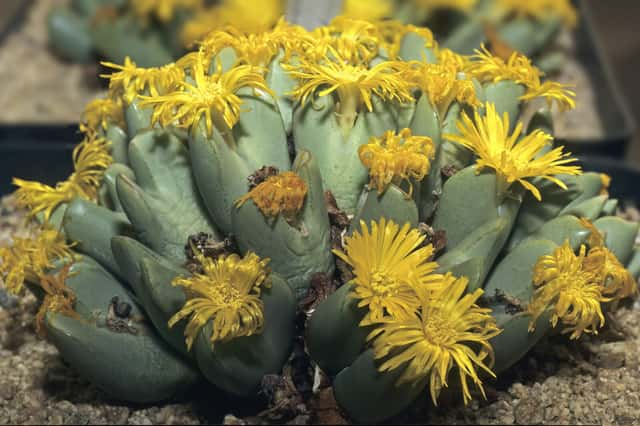
Conophytum is a genus of about 106 species of dwarf succulents in the family Aizoaceae, native to southern Namibia and the Western and Northern Cape of South Africa, where they grow in rock crevices, quartz gravel and stony slopes. Each "body" is a pair of almost fully fused leaves shaped like a button, heart, cone or sphere, up to about 2.5 cm tall; many species form cushions of dozens of bodies. The surface can be smooth or hairy, green, bluish or yellowish, sometimes with dark dots and lines or translucent "windows". They grow in autumn and winter and rest in summer, when the old leaves dry into a papery sheath that protects the new pair. In autumn they open white, yellow, pink, magenta or orange flowers; many are nocturnal and scented. Growth is very slow: a 50-year-old plant may be no bigger than a walnut.
How to Propagate Cone plant?
Division
Only divide well-formed clumps; single bodies without roots take longer to establish.
- 1 In late summer, before the plant wakes, take the clump out of its pot
- 2 Separate bodies or groups that already have roots
- 3 Plant them in dry mineral mix
- 4 Wait a few days, then start watering lightly
Materials needed:
Body cuttings
No rooting hormone is needed.
- 1 In the growing season, cut off a body with a short piece of stem
- 2 Let it dry for a few days to callus
- 3 Rest it on slightly moist mineral mix
- 4 Mist lightly until it roots
Materials needed:
Seeds
Seedlings take a few years to flower.
- 1 In autumn, mix the seed with a little fine sand
- 2 Scatter it on the surface of the mix without covering
- 3 Mist to keep it moist for the first few weeks
- 4 Use a fungicide against damping off and cut back water once seedlings firm up
Materials needed:
How Big Does Cone plant Grow?
TLDR: Cone plant can reach up to 5cm tall with Slow growth rate.
Max height
5cm
Spread
15cm
Growth rate
Slow
Foliage
Evergreen
Plant Uses
Ornamental
Great for decoration
Is your plant showing symptoms?
Click on the symptom to discover possible causes:
What Diseases Commonly Affect Cone plant?
TLDR: Cone plant is susceptible to 3 known diseases. Monitor regularly for early detection.
Mealybugs
Mealybugs are small, soft-bodied insects covered with a white, waxy, cottony material. They are common pests of houseplants and outdoor plants in mild climates. These sap-sucking insects feed on plant tissue, causing damage, stunted growth, and can lead to plant death if left untreated. They produce sticky honeydew which attracts sooty mold.
Root Rot
Root rot is a serious fungal disease that affects the root system of plants, causing them to decay and die. It is primarily caused by overwatering, poor drainage, or soil-borne fungi such as Pythium, Phytophthora, Rhizoctonia, and Fusarium. The disease thrives in waterlogged conditions where roots are deprived of oxygen, making them susceptible to fungal infection.
Damping Off
Damping off is a soil-borne fungal disease that affects seeds and young seedlings, causing rotting of stem and root tissues at and below the soil line. It is caused by several fungi including Pythium, Rhizoctonia, Fusarium, and Phytophthora. The disease thrives in cold, wet conditions with poor air circulation.
Fun Facts
A 50-year-old plant may be no bigger than a walnut
Many species open scented flowers at night to attract moths
In South Africa they are called knopies, Afrikaans for little buttons
Frequently asked questions
When should I water Conophytum?
Why did my Conophytum turn dry and brown in summer?
Does Conophytum like sun?
Is Conophytum toxic to pets?
Compare with similar plants
| Attribute | Difficulty | Light | Watering | Pet Safe |
|---|---|---|---|---|
| Dark Fieldcap | Medium | Low light | 2d | ⚠️ |
| Azalea | Medium | Partial shade | 3d | ⚠️ |
| Muriel's Bamboo | Medium | Partial shade | 3d | ✓ |
| Bougainvillea | Medium | Direct sun | 7d | ⚠️ |