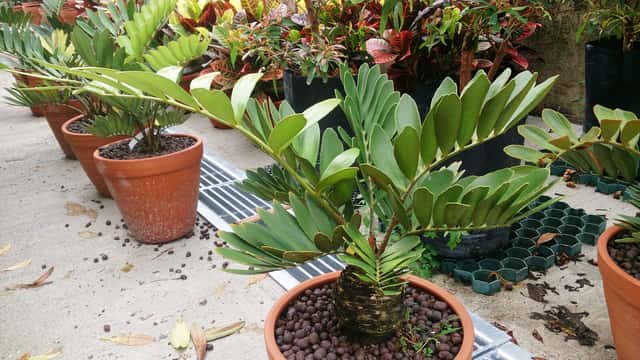
Zamiaceae
Zamia Care Guide: Growing the Ancient Coontie Cycad
Zamia
Zamia is a slow-growing, drought-tolerant cycad that thrives in bright light and well-draining soil. Let the soil dry out between waterings to avoid root rot, and keep it warm and frost-free. It is low-maintenance once established but extremely toxic if ingested, so keep it well away from pets and children.
Every 10 days
Bright indirect
15° - 32°C
40% - 60%
Categories
What is Coontie?
Coontie (Zamia) is a medium-care plant from the Zamiaceae family. Zamia is a genus of roughly 80 cycad species native to the tropics and subtropics of the Americas, from the southeastern United States to South America. Despite its palm-like rosette of stiff, feathery fronds, Zamia is not a palm or fern but an ancient gymnosperm - a living relative of plants that p...
Coontie grows up to watering every 10 days, 15°C – 32°C, 40–60% humidity. It is suitable for indoor environments and not safe for pets.
Without precautions, ingestion can cause irritation in pets. Keep out of reach of cats and dogs. Without adequate drainage, root rot can develop within 20 days.
How to Care for Coontie?
TLDR: Coontie needs Bright indirect, watering every 10 days, and temperatures between 15-32°C with 40-60% humidity.
How Often Should You Water Coontie?
Water deeply, then let the top 2-5 cm of soil dry out completely before watering again - roughly every 10-14 days. Never let the pot sit in standing water.
How Much Light Does Coontie Need?
Provide bright light with some direct sun; indoors, place within a foot of a sunny window. Too little light causes weak, stretched growth.
What Is the Best Soil for Coontie?
Use a very well-draining mix - combine potting soil with perlite, coarse sand, or pine bark to prevent waterlogging around the caudex.
What Pot Should You Use for Coontie?
Use a heavy, well-draining terracotta pot with ample drainage holes to prevent water pooling around the caudex.
Care Schedule
Fertilize
Every 90 days
Repot
Every 1095 days
What Is Coontie and Where Does It Come From?
Zamia is a genus of roughly 80 cycad species native to the tropics and subtropics of the Americas, from the southeastern United States to South America. Despite its palm-like rosette of stiff, feathery fronds, Zamia is not a palm or fern but an ancient gymnosperm - a living relative of plants that predate the dinosaurs. It grows from a partly underground caudex (stem) and produces cone-like reproductive structures instead of flowers.
How to Propagate Coontie?
Seed propagation
Germination can be slow and uneven; be patient and avoid overwatering the seed tray.
- 1 Collect ripe seeds from a mature female cone
- 2 Clean off the fleshy outer coating
- 3 Soak seeds in water for 24-48 hours
- 4 Sow in a well-draining seed mix with the seed half-buried
- 5 Keep warm and lightly moist until germination
Materials needed:
Offset division
Only remove offsets that already have some roots of their own for best success.
- 1 Locate a basal offset (pup) growing from the caudex
- 2 Carefully separate it with a clean, sharp knife
- 3 Let the cut surface callus for a few days
- 4 Pot the offset in well-draining soil
- 5 Keep lightly moist until new roots establish
Materials needed:
How Big Does Coontie Grow?
TLDR: Coontie can reach up to ?cm tall with Slow growth rate.
Growth rate
Slow
Foliage
Evergreen
Warning: Toxic Plant
This plant can be toxic if ingested. Keep out of reach of:
Plant Uses
Ornamental
Great for decoration
Is your plant showing symptoms?
Click on the symptom to discover possible causes:
What Diseases Commonly Affect Coontie?
TLDR: Coontie is susceptible to 5 known diseases. Monitor regularly for early detection.
Root Rot
Root rot is a serious fungal disease that affects the root system of plants, causing them to decay and die. It is primarily caused by overwatering, poor drainage, or soil-borne fungi such as Pythium, Phytophthora, Rhizoctonia, and Fusarium. The disease thrives in waterlogged conditions where roots are deprived of oxygen, making them susceptible to fungal infection.
Leaf Spot
Leaf spot is a common fungal disease caused by various pathogens including Alternaria, Ascochyta, Colletotrichum, Septoria, and Venturia. It primarily affects leaves, causing discolored spots that can lead to premature leaf drop if left untreated.
Scale Insects
Scale insects are small sap-sucking pests that appear as brown, shell-like bumps on plant stems and leaves. There are over 25 species, divided into armored (hard) and unarmored (soft) scales. They feed by piercing plant tissue and extracting sap, which weakens the plant and can lead to yellowing, stunted growth, and even death if left untreated. They also excrete honeydew, which attracts ants and promotes sooty mold growth.
Mealybugs
Mealybugs are small, soft-bodied insects covered with a white, waxy, cottony material. They are common pests of houseplants and outdoor plants in mild climates. These sap-sucking insects feed on plant tissue, causing damage, stunted growth, and can lead to plant death if left untreated. They produce sticky honeydew which attracts sooty mold.
Meaning & Symbolism
As one of the oldest surviving lineages of seed plants on Earth, Zamia is often seen as a symbol of endurance, resilience, and survival through the ages.
Fun Facts
Zamia belongs to one of the oldest surviving lineages of seed plants, predating the dinosaurs by millions of years.
The genus name comes from the Latin 'azaniae', referring to the scaly appearance of its seed cones.
Historically, the starchy caudex of some Zamia species was processed (after removing toxins) into a starch known as "Florida arrowroot".
Despite its palm-like look, Zamia is completely unrelated to true palms - it is a cycad, a distinct group of ancient gymnosperms.
Frequently asked questions
Is Zamia toxic to cats and dogs?
Is Zamia toxic to humans?
How often should I water Zamia?
Does Zamia flower?
How fast does Zamia grow?
Compare with similar plants
| Attribute | Difficulty | Light | Watering | Pet Safe |
|---|---|---|---|---|
| Dark Fieldcap | Medium | Low light | 2d | ⚠️ |
| Azalea | Medium | Partial shade | 3d | ⚠️ |
| Muriel's Bamboo | Medium | Partial shade | 3d | ✓ |
| Bougainvillea | Medium | Direct sun | 7d | ⚠️ |




