Caryophyllaceae
Corn spurry: Ground Cover Plant
Spergula arvensis
An undemanding, sun-loving plant for light, well-drained sandy soil with an acidic to neutral pH. It tolerates poor soils but requires regular moisture without waterlogging. It grows poorly and flowers less in the shade.
Every 7-10 days
Bright indirect
° - °C
% - %
Categories
What is Corn spurry?
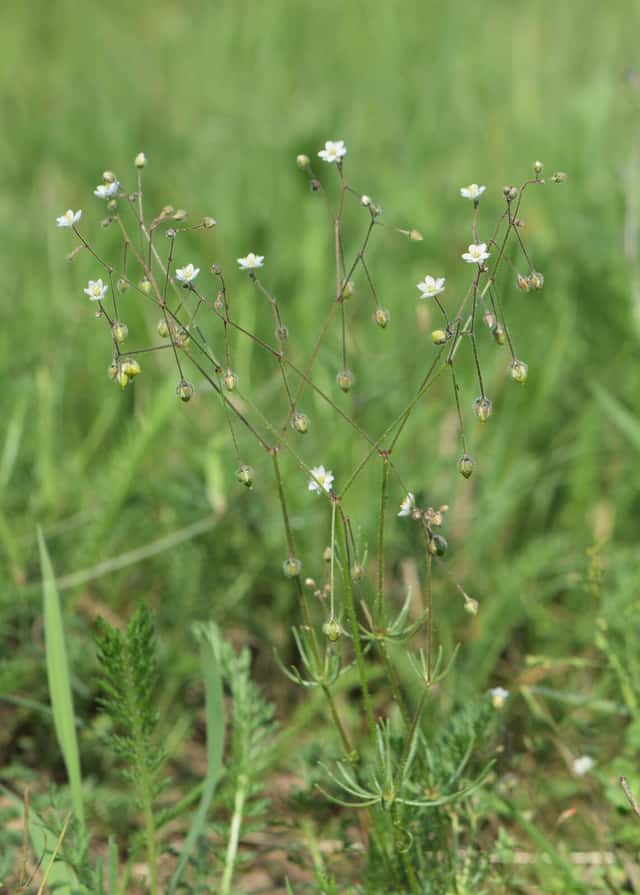
Corn spurry (Spergula arvensis) is a easy-care plant from the Caryophyllaceae family. Corn spurry (Spergula arvensis) is an annual herb in the pink family (Caryophyllaceae), widespread as a weed in fields across Europe, North Africa, and parts of Asia. It grows to a height of approximately 10–50 cm, featuring narrow, linear leaves arranged in whorls, and blooms from summer to autumn...
Corn spurry grows up to 50cm. It is not suitable for indoor environments and safe for pets.
Unlike many tropical plants, Corn spurry tolerates watering mistakes. Best for beginners. Unlike many popular species, Corn spurry is safe to keep around pets.
How to Care for Corn spurry?
TLDR: Corn spurry needs Bright indirect, watering every 7 days, and temperatures between 15-30°C with 40-70% humidity.
How Often Should You Water Corn spurry?
Water moderately and regularly so that the soil dries out slightly between waterings—constant waterlogging promotes root rot.
How Much Light Does Corn spurry Need?
Requires full sun; it does not thrive in the shade and will hardly bloom.
What Is the Best Soil for Corn spurry?
It thrives best in light sandy soil with a pH around 5.0–6.0, low in calcium.
What Pot Should You Use for Corn spurry?
In a container, it needs a wider and medium-deep bowl with sandy substrate and a good drainage hole, as the plant quickly forms dense clumps through self-seeding.
What Is Corn spurry and Where Does It Come From?
Corn spurry (Spergula arvensis) is an annual herb in the pink family (Caryophyllaceae), widespread as a weed in fields across Europe, North Africa, and parts of Asia. It grows to a height of approximately 10–50 cm, featuring narrow, linear leaves arranged in whorls, and blooms from summer to autumn with small, white, five-petaled flowers. It typically occurs on light, sandy, acidic soils low in calcium, especially in cereal crops like spring barley. Seeds can remain viable in the soil for several years.
How to Propagate Corn spurry?
Seed sowing
- 1 Soil preparation
Prepare an area with light, sandy soil cleared of competing weeds.
- 2 Sowing
Sow seeds shallowly on the soil surface, as they need light to germinate, and press them down gently.
- 3 Post-sowing care
Keep the soil moderately moist until the plants germinate and establish; the plant will handle subsequent sowing itself.
Materials needed:
How Big Does Corn spurry Grow?
TLDR: Corn spurry can reach up to 50cm tall with Fast growth rate.
Max height
50cm
Growth rate
Fast
Foliage
Deciduous
Plant Uses
Edible
Can be consumed
Medicinal
Medicinal properties
Ground Cover
Soil coverage
Medicinal Uses
- In folk medicine, the herb was traditionally used as a mild diuretic
- Poultices from the aerial parts were occasionally used for minor skin irritations
Culinary Uses
- Young leaves and shoots were eaten raw or cooked as an emergency vegetable in the past
- During times of famine, seeds were dried and ground into flour to be mixed into bread
Is your plant showing symptoms?
Click on the symptom to discover possible causes:
What Diseases Commonly Affect Corn spurry?
TLDR: Corn spurry is susceptible to 5 known diseases. Monitor regularly for early detection.
Root Rot
Root rot is a serious fungal disease that affects the root system of plants, causing them to decay and die. It is primarily caused by overwatering, poor drainage, or soil-borne fungi such as Pythium, Phytophthora, Rhizoctonia, and Fusarium. The disease thrives in waterlogged conditions where roots are deprived of oxygen, making them susceptible to fungal infection.
Mosaic Virus
Mosaic virus is a group of plant viruses that cause mottled, patchy patterns on leaves and can affect a wide variety of plants. The virus creates characteristic yellow, white, and green mosaic patterns, often accompanied by stunted growth and deformed plant parts. This highly contagious disease spreads rapidly through insect vectors and contaminated tools.
Aphids
Aphids are small, soft-bodied, pear-shaped insects (1/16 to 1/8 inch long) that feed by sucking nutrient-rich sap from plants. They reproduce rapidly and can quickly weaken plants, causing distorted growth and transmitting plant viruses. Aphids come in various colors including green, black, red, yellow, brown, and gray. They secrete honeydew, a sticky substance that attracts ants and encourages sooty mold growth.
Root-Knot Nematodes
Root-knot nematodes (Meloidogyne species) are microscopic roundworms that parasitize plant roots, causing characteristic galls or knots. These soil-borne pests are among the most economically damaging plant pathogens worldwide, affecting a wide range of ornamental and edible plants. The nematodes inject enzymes into root cells, causing abnormal swelling and disrupting water and nutrient uptake.
Meaning & Symbolism
A symbol of modesty and survival on poor, acidic soil; in agriculture, it serves as a bioindicator of calcium deficiency.
Compare with similar plants
| Attribute | Difficulty | Light | Watering | Pet Safe |
|---|---|---|---|---|
| Field Maple | Easy | Bright indirect | 14d | ✓ |
| Silver Birch | Easy | Direct sun | 14d | ✓ |
| Common Blanketflower | Easy | Direct sun | 10d | ✓ |
| Cushion Bush | Easy | Direct sun | 14d | ✓ |





