Asteraceae
Crassothonna
Crassothonna
Lots of light, fast-draining soil, and water only when the soil is dry. It can't take frost: in cold areas, keep it in a pot and bring it in for winter.
Every 14 days
Bright indirect
0° - °C
% - %
Categories
What is Crassothonna?
Crassothonna (Crassothonna) is a easy-care plant from the Asteraceae family. Crassothonna is a genus of about 14 succulents in the daisy family, almost all from South Africa, with a few in southern Namibia. Until 2012 these plants were called Othonna, and many nurseries still sell them under that name. What sets the group apart is the thick, water-filled leaves, round, sausa...
Crassothonna grows up to 1.0m, watering every 14 days. It is suitable for indoor environments and safe for pets.
Unlike many tropical plants, Crassothonna tolerates watering mistakes. Best for beginners. Unlike many popular species, Crassothonna is safe to keep around pets. Without adequate drainage, root rot can develop within 28 days.
How to Care for Crassothonna?
TLDR: Crassothonna needs Bright indirect, watering every 14 days, and temperatures between 0-30°C with 40-70% humidity.
How Often Should You Water Crassothonna?
Water thoroughly, then wait until the soil is completely dry, roughly every 14 days in warm weather. Water much less in the cold. Soft, wrinkled leaves mean thirst; soft, translucent leaves or a dark stem base mean too much water.
How Much Light Does Crassothonna Need?
Direct sun or very bright light. Indoors, put it by your brightest window. In strong sun the leaves and stems of some species turn purple, which is normal.
What Is the Best Soil for Crassothonna?
Cactus and succulent mix with coarse sand or perlite. Nothing that stays soggy.
What Pot Should You Use for Crassothonna?
A terracotta pot with a drainage hole, which dries out faster. For trailing species, a hanging basket or a wide, shallow pot so the stems can spill over.
What Is Crassothonna and Where Does It Come From?
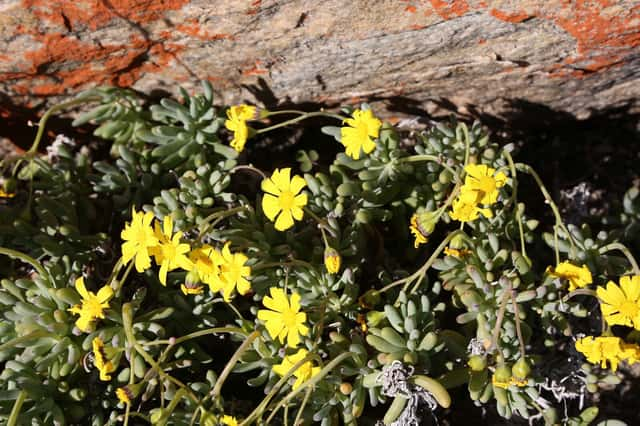
Crassothonna is a genus of about 14 succulents in the daisy family, almost all from South Africa, with a few in southern Namibia. Until 2012 these plants were called Othonna, and many nurseries still sell them under that name. What sets the group apart is the thick, water-filled leaves, round, sausage-shaped or bead-like, green or bluish. Some species trail along the ground; others form small shrubs up to 1 metre, sometimes with a swollen stem. The flowers look like small yellow daisies, and white in one species. The best known is Crassothonna capensis, the ruby necklace, which has its own entry. Most are easy to keep, though two are threatened in the wild.
How to Propagate Crassothonna?
Stem cuttings
On trailing species, stems that touch the soil often root on their own: just cut them off and replant.
- 1 Cut a 5-10 cm stem with several leaves
- 2 Strip the lower leaves
- 3 Let the cut end dry for 1-2 days
- 4 Push the base into lightly moist succulent mix
- 5 Water sparingly until you feel resistance when you tug gently
Materials needed:
Seed
Seed is hard to find, and cuttings are much quicker.
- 1 Scatter the seeds on moist sandy mix
- 2 Cover with a very thin layer of sand
- 3 Keep in a bright, cool spot out of strong sun
- 4 Keep lightly moist until seedlings appear
Materials needed:
How Big Does Crassothonna Grow?
TLDR: Crassothonna can reach up to 1.0m tall with Medium growth rate.
Max height
1.0m
Foliage
Evergreen
Plant Uses
Ornamental
Great for decoration
Ground Cover
Soil coverage
Is your plant showing symptoms?
Click on the symptom to discover possible causes:
What Diseases Commonly Affect Crassothonna?
TLDR: Crassothonna is susceptible to 4 known diseases. Monitor regularly for early detection.
Root Rot
Root rot is a serious fungal disease that affects the root system of plants, causing them to decay and die. It is primarily caused by overwatering, poor drainage, or soil-borne fungi such as Pythium, Phytophthora, Rhizoctonia, and Fusarium. The disease thrives in waterlogged conditions where roots are deprived of oxygen, making them susceptible to fungal infection.
Overwatering
Overwatering occurs when plants receive too much water, depriving roots of oxygen and causing root rot. This environmental stress is one of the most common causes of houseplant death, as waterlogged soil prevents roots from breathing and functioning properly.
Mealybugs
Mealybugs are small, soft-bodied insects covered with a white, waxy, cottony material. They are common pests of houseplants and outdoor plants in mild climates. These sap-sucking insects feed on plant tissue, causing damage, stunted growth, and can lead to plant death if left untreated. They produce sticky honeydew which attracts sooty mold.
Aphids
Aphids are small, soft-bodied, pear-shaped insects (1/16 to 1/8 inch long) that feed by sucking nutrient-rich sap from plants. They reproduce rapidly and can quickly weaken plants, causing distorted growth and transmitting plant viruses. Aphids come in various colors including green, black, red, yellow, brown, and gray. They secrete honeydew, a sticky substance that attracts ants and encourages sooty mold growth.
Fun Facts
The name combines Latin crassus, thick, with Othonna, the genus these plants were split from
The plant sold for years as Othonna carnosa is now Crassothonna cacalioides, which confuses even collectors
Crassothonna opima is critically endangered in South Africa
Frequently asked questions
How often should I water Crassothonna?
Why did the leaves turn purple?
Are Crassothonna and Othonna the same plant?
Is Crassothonna toxic to cats and dogs?
Compare with similar plants
| Attribute | Difficulty | Light | Watering | Pet Safe |
|---|---|---|---|---|
| Field Maple | Easy | Bright indirect | 14d | ✓ |
| Iberian Houseleek | Easy | Direct sun | 14d | ✓ |
| Silver Birch | Easy | Direct sun | 14d | ✓ |
| Common Blanketflower | Easy | Direct sun | 10d | ✓ |





