Solanaceae
Cup of Gold Vine: Fast Growing
Solandra maxima
Requires full sun (at least 6 hours of direct light) to bloom well; in very hot inland areas, it appreciates some shade. It needs moderate watering, rich, well-drained soil, and a very sturdy support structure. It does not tolerate frost, suffering damage below 32°F (0°C). It blooms on new wood, so pruning after flowering keeps it manageable and stimulates more blooms.
Every 7 days
Bright indirect
-1° - 35°C
50% - 80%
Categories
What is Cup of Gold Vine?
Cup of Gold Vine (Solandra maxima) is a medium-care plant from the Solanaceae family. The Cup of Gold Vine (Solandra maxima) is a woody, evergreen climber from the Solanaceae family, native to Mexico and Central America. It is a fast grower, typically reaching about 40 feet (12 m) and in exceptional cases much more. Its leaves are leathery, dark green, and glossy, ranging from 2 to 7...
Cup of Gold Vine grows up to 12.0m, watering every 7 days, -1°C – 35°C, 50–80% humidity. It is not suitable for indoor environments and not safe for pets.
Without precautions, ingestion can cause irritation in pets. Keep out of reach of cats and dogs.
How to Care for Cup of Gold Vine?
TLDR: Cup of Gold Vine needs Bright indirect, watering every 7 days, and temperatures between -1-35°C with 50-80% humidity.
How Often Should You Water Cup of Gold Vine?
Keep the soil evenly moist without waterlogging. Reduce watering in winter; once established, it requires less supplemental water.
How Much Light Does Cup of Gold Vine Need?
Full sun, with at least six hours of direct light. In low light, it produces fewer and smaller flowers; in partial shade, it will grow but bloom less frequently.
What Is the Best Soil for Cup of Gold Vine?
Soil rich in organic matter with good drainage. A 2 to 4-inch (5 to 10 cm) layer of compost feeds the plant and helps retain moisture.
What Pot Should You Use for Cup of Gold Vine?
If not planted in the ground, use a large, heavy container with good drainage and potting soil enriched with compost; move to a larger pot as it grows. In frost-prone climates, container planting allows for winter protection.
What Is Cup of Gold Vine and Where Does It Come From?
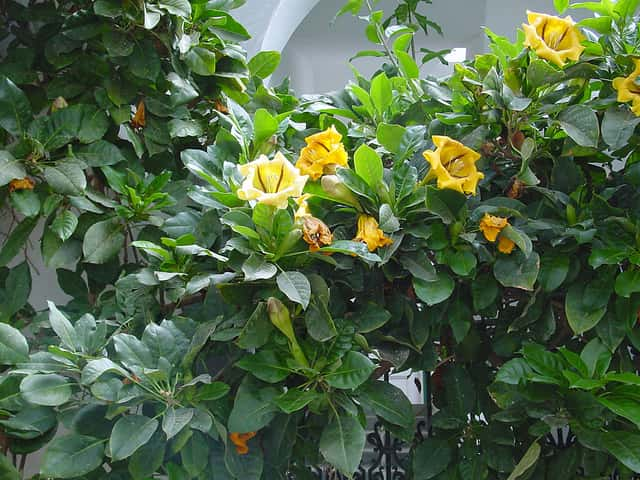
The Cup of Gold Vine (Solandra maxima) is a woody, evergreen climber from the Solanaceae family, native to Mexico and Central America. It is a fast grower, typically reaching about 40 feet (12 m) and in exceptional cases much more. Its leaves are leathery, dark green, and glossy, ranging from 2 to 7 inches (5 to 18 cm). The solitary, cup-shaped flowers measure 6 to 10 inches (15 to 24 cm) long; they open creamy white or pale yellow and darken toward gold and ochre, with purple or brown stripes on the interior. They open at dusk and are especially fragrant at night. All parts of the plant are poisonous.
How to Propagate Cup of Gold Vine?
Stem cuttings
- The entire plant is toxic and the sap irritates skin and eyes: wear gloves and do not touch your face.
- Wash your hands thoroughly when finished.
- 1 Cutting
While wearing gloves, cut a section of healthy stem that has no flowers.
- 2 Preparation
Remove the lower leaves to clear the section that will be buried.
- 3 Planting
Bury the base in well-drained substrate and keep it slightly moist in a warm, bright spot without direct sun until it takes root.
Materials needed:
How Big Does Cup of Gold Vine Grow?
TLDR: Cup of Gold Vine can reach up to 12.0m tall with Fast growth rate.
Max height
12.0m
Growth rate
Fast
Foliage
Evergreen
Warning: Toxic Plant
This plant can be toxic if ingested. Keep out of reach of:
Plant Uses
Ornamental
Great for decoration
Is your plant showing symptoms?
Click on the symptom to discover possible causes:
What Diseases Commonly Affect Cup of Gold Vine?
TLDR: Cup of Gold Vine is susceptible to 3 known diseases. Monitor regularly for early detection.
Aphids
Aphids are small, soft-bodied, pear-shaped insects (1/16 to 1/8 inch long) that feed by sucking nutrient-rich sap from plants. They reproduce rapidly and can quickly weaken plants, causing distorted growth and transmitting plant viruses. Aphids come in various colors including green, black, red, yellow, brown, and gray. They secrete honeydew, a sticky substance that attracts ants and encourages sooty mold growth.
Scale Insects
Scale insects are small sap-sucking pests that appear as brown, shell-like bumps on plant stems and leaves. There are over 25 species, divided into armored (hard) and unarmored (soft) scales. They feed by piercing plant tissue and extracting sap, which weakens the plant and can lead to yellowing, stunted growth, and even death if left untreated. They also excrete honeydew, which attracts ants and promotes sooty mold growth.
Cold Damage
Cold damage, also known as frost injury, occurs when plants are exposed to freezing or near-freezing temperatures. This environmental stress can cause cellular damage as ice crystals form within plant tissues, rupturing cells and disrupting normal plant functions. Chilling injury can also occur in sensitive species at temperatures between 32-55°F (0-10°C), even without actual freezing.
Compare with similar plants
| Attribute | Difficulty | Light | Watering | Pet Safe |
|---|---|---|---|---|
| Dark Fieldcap | Medium | Low light | 2d | ⚠️ |
| Azalea | Medium | Partial shade | 3d | ⚠️ |
| Muriel's Bamboo | Medium | Partial shade | 3d | ✓ |
| Bougainvillea | Medium | Direct sun | 7d | ⚠️ |