Asteraceae
Cupid's dart: Full Sun Plant
Catananche caerulea
Cupid's dart is an easy-to-grow perennial with a true Mediterranean character: it requires a sunny, well-ventilated spot and loose, nutrient-poor, excellently draining soil. Due to its strong taproot, it is highly drought-tolerant; conversely, it tolerates standing moisture and wet winter soil poorly, which can easily lead to root or crown rot. It does not require regular fertilization, as over-fertilizing can be harmful. Removing spent flower stems extends the blooming period, and in autumn, it is advisable to cut the plant back to about 10 cm above the ground.
Every 10 days
Direct sun
-15° - 35°C
30% - 60%
Categories
What is Cupid's dart?
Cupid's dart (Catananche caerulea) is a easy-care plant from the Asteraceae family. Catananche caerulea, commonly known as Cupid's dart, is a short-lived perennial ornamental plant belonging to the Asteraceae family. It is native to the western Mediterranean, Southern Europe (Spain, Portugal, France, Italy), and North Africa (Morocco, Algeria, Tunisia). Its grayish-green, narrow le...
Cupid's dart grows up to 60cm, spread of 30cm, watering every 10 days, -15°C – 35°C, 30–60% humidity. It is not suitable for indoor environments and safe for pets.
Unlike many tropical plants, Cupid's dart tolerates watering mistakes. Best for beginners. Unlike many popular species, Cupid's dart is safe to keep around pets.
How to Care for Cupid's dart?
TLDR: Cupid's dart needs Direct sun, watering every 10 days, and temperatures between -15-35°C with 30-60% humidity.
How Often Should You Water Cupid's dart?
Water only when the top layer of soil has completely dried out — in summer, this usually means a thorough watering once a week. Avoid standing water and overwatering, as the taproot of Catananche is sensitive to rot from lack of oxygen; good drainage is vital for survival during winter.
How Much Light Does Cupid's dart Need?
Requires full sun, at least 6–8 hours of direct sunlight daily — in shade, it blooms sparsely and the stems tend to stretch. Plant it in the sunniest, driest spot in the garden.
What Is the Best Soil for Cupid's dart?
Prefer loose, sandy, or gravelly, nutrient-poor soil with excellent drainage and a neutral to alkaline pH (approx. pH 6.5–8.5). Avoid heavy, clayey, or water-retentive soils, and do not over-fertilize — rich soil results in weaker, floppier growth.
What Pot Should You Use for Cupid's dart?
If growing in a pot, choose a wide, deep container with excellent drainage (preferably unglazed clay or terracotta) with large drainage holes — this helps drain excess moisture and provides space for the strong taproot. Mix gravel or perlite into the potting soil for better drainage.
Care Schedule
Fertilize
Every 60 days
Repot
Every 730 days
What Is Cupid's dart and Where Does It Come From?
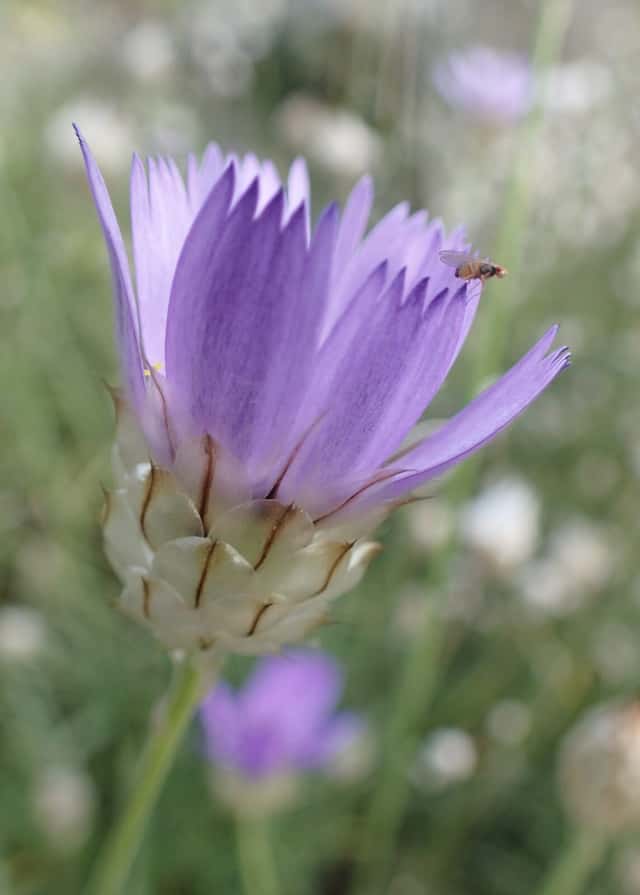
Catananche caerulea, commonly known as Cupid's dart, is a short-lived perennial ornamental plant belonging to the Asteraceae family. It is native to the western Mediterranean, Southern Europe (Spain, Portugal, France, Italy), and North Africa (Morocco, Algeria, Tunisia). Its grayish-green, narrow leaves form a basal rosette and are covered with fine, downy hairs. Growing 30–60 cm tall, its branched stems are topped with papery, bluish-purple (rarely white) flower heads with dark centers. These bloom from early summer to late autumn, decorating the garden and attracting butterflies. They remain decorative even when dried, making them a popular choice for dried flower arrangements.
How to Propagate Cupid's dart?
How Big Does Cupid's dart Grow?
TLDR: Cupid's dart can reach up to 60cm tall with Medium growth rate.
Max height
60cm
Spread
30cm
Growth rate
Medium
Foliage
Semi-evergreen
Plant Uses
Ornamental
Great for decoration
Is your plant showing symptoms?
Click on the symptom to discover possible causes:
What Diseases Commonly Affect Cupid's dart?
TLDR: Cupid's dart is susceptible to 6 known diseases. Monitor regularly for early detection.
Aphids
Aphids are small, soft-bodied, pear-shaped insects (1/16 to 1/8 inch long) that feed by sucking nutrient-rich sap from plants. They reproduce rapidly and can quickly weaken plants, causing distorted growth and transmitting plant viruses. Aphids come in various colors including green, black, red, yellow, brown, and gray. They secrete honeydew, a sticky substance that attracts ants and encourages sooty mold growth.
Spider Mites
Spider mites are tiny arachnids (less than 1/20 inch long) related to spiders and ticks that feed on plant sap. They thrive in hot, dry conditions and can cause significant damage to ornamental and vegetable plants. During severe infestations, crop losses can reach 14% or higher as these pests disrupt vital plant processes including photosynthesis, carbon dioxide absorption, and transpiration.
Powdery Mildew
Powdery mildew is a common fungal disease caused by various fungi species including Erysiphe, Podosphaera, Oïdium, and Leveillula. It affects over 10,000 plant species worldwide. The disease thrives in warm, dry climates with high humidity and appears as a distinctive white powdery coating on plant surfaces.
Crown Rot
Crown rot is a serious fungal disease that attacks the crown (base) of the plant where the stem meets the soil. It is caused by various fungal pathogens including Phytophthora, Fusarium, and Rhizoctonia. The disease thrives in waterlogged conditions and can quickly spread to kill the entire plant if not addressed promptly.
Meaning & Symbolism
The name originates from the Greek word katananke ('compulsion' or 'force'), which according to legend refers to the ancient Greeks using the flower as a primary ingredient in love potions — hence the English name Cupid's Dart. The flower is a symbol of lasting, faithful love and steadfast devotion, as opposed to a fleeting infatuation.
Compare with similar plants
| Attribute | Difficulty | Light | Watering | Pet Safe |
|---|---|---|---|---|
| Field Maple | Easy | Bright indirect | 14d | ✓ |
| Silver Birch | Easy | Direct sun | 14d | ✓ |
| Common Blanketflower | Easy | Direct sun | 10d | ✓ |
| Cushion Bush | Easy | Direct sun | 14d | ✓ |





