Primulaceae
Cyclamen Care Guide
Cyclamen
Keep cyclamen cool (10-18°C / 50-65°F) and in bright, indirect light. Water from below or around the tuber, never over the crown, when the top of the soil starts to dry; reduce watering gradually as leaves yellow and let the tuber rest during summer dormancy.
Every 6 days
Partial shade
10° - 18°C
50% - 60%
Categories
What is Cyclamen?
Cyclamen (Cyclamen) is a medium-care plant from the Primulaceae family. Cyclamen is a genus of about 20 tuberous perennial species in the family Primulaceae, native to the Mediterranean basin and parts of Europe, North Africa and Iran. The most widely cultivated species as a houseplant is Cyclamen persicum, the florist's cyclamen, prized for its upswept, butterfly-like...
Cyclamen grows up to 30cm, spread of 25cm, watering every 6 days, 10°C – 18°C, 50–60% humidity. It is suitable for indoor environments and not safe for pets.
Without precautions, ingestion can cause irritation in pets. Keep out of reach of cats and dogs. Without adequate drainage, root rot can develop within 12 days.
How to Care for Cyclamen?
TLDR: Cyclamen needs Partial shade, watering every 6 days, and temperatures between 10-18°C with 50-60% humidity.
How Often Should You Water Cyclamen?
Water from the base (bottom-watering or around the tuber edge) to keep water off the crown and tuber top, which easily rot if kept wet. Let the top inch of soil dry slightly between waterings.
How Much Light Does Cyclamen Need?
Bright, indirect light is ideal - a spot near an east or shaded south-facing window. Avoid direct sun, which fades flowers and scorches leaves; avoid deep shade, which weakens blooming.
What Is the Best Soil for Cyclamen?
Use a well-draining, slightly acidic potting mix based on peat or coco coir with added perlite or bark for aeration, so excess water drains away from the tuber quickly.
What Pot Should You Use for Cyclamen?
A wide, shallow terracotta or plastic pot with generous drainage holes, sized only slightly larger than the tuber, so the mix dries evenly and the tuber does not sit in excess moisture.
Care Schedule
Fertilize
Every 30 days
Rotate
Every 14 days
Repot
Every 365 days
What Is Cyclamen and Where Does It Come From?
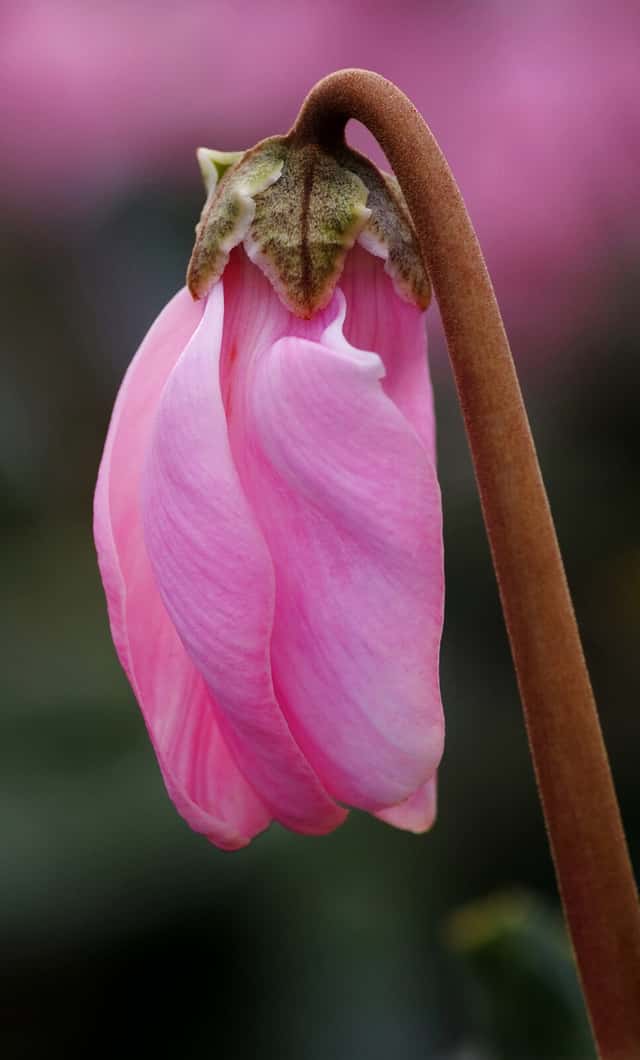
Cyclamen is a genus of about 20 tuberous perennial species in the family Primulaceae, native to the Mediterranean basin and parts of Europe, North Africa and Iran. The most widely cultivated species as a houseplant is Cyclamen persicum, the florist's cyclamen, prized for its upswept, butterfly-like flowers in white, pink, red and magenta held above heart-shaped, often silver-marbled leaves. Cyclamen grow from a flattened tuber and follow a distinct seasonal cycle: active growth and flowering in cool months (fall through spring), followed by a summer dormancy when the foliage yellows and dies back.
How to Propagate Cyclamen?
Seed propagation
This is the primary method used by commercial growers because it produces sturdier, longer-lived plants than division; be patient, as flowering can take over a year.
- 1 Soak fresh cyclamen seeds in lukewarm water for 12-24 hours before sowing
- 2 Sow seeds 1cm deep in a moist, well-draining seed mix and cover to exclude light, as cyclamen seeds germinate best in darkness
- 3 Keep at 15-18°C and consistently moist until germination
- 4 Once seedlings have 2-3 leaves, transplant into individual small pots
- 5 Grow on in bright, indirect light and cool temperatures until the tuber matures
Materials needed:
Tuber division
Division is far less reliable than seed for Cyclamen persicum and carries a high risk of rot; only attempt with a large, healthy, multi-eyed tuber.
- 1 Wait until foliage has fully yellowed and the plant has entered dormancy
- 2 Lift the tuber and gently clean off soil
- 3 Using a sterile, sharp knife, cut the tuber into sections, ensuring each section has at least one visible growing point (eye)
- 4 Dust cut surfaces with fungicide or cinnamon to prevent rot
- 5 Pot each section shallowly, with the top of the tuber level with or just above the soil surface
Materials needed:
How Big Does Cyclamen Grow?
TLDR: Cyclamen can reach up to 30cm tall with Slow growth rate.
Max height
30cm
Spread
25cm
Growth rate
Slow
Foliage
Deciduous
Warning: Toxic Plant
This plant can be toxic if ingested. Keep out of reach of:
Plant Uses
Ornamental
Great for decoration
Is your plant showing symptoms?
Click on the symptom to discover possible causes:
What Diseases Commonly Affect Cyclamen?
TLDR: Cyclamen is susceptible to 6 known diseases. Monitor regularly for early detection.
Gray Mold (Botrytis Blight)
Gray mold, caused by the fungus Botrytis cinerea, is a widespread necrotrophic pathogen affecting over 1,400 plant species. It thrives in cool, humid conditions and attacks weakened or aging plant tissues, causing soft rot and characteristic gray fuzzy growth.
Root Rot
Root rot is a serious fungal disease that affects the root system of plants, causing them to decay and die. It is primarily caused by overwatering, poor drainage, or soil-borne fungi such as Pythium, Phytophthora, Rhizoctonia, and Fusarium. The disease thrives in waterlogged conditions where roots are deprived of oxygen, making them susceptible to fungal infection.
Fusarium Wilt
Fusarium wilt is a serious fungal disease caused by the soil-borne fungus Fusarium oxysporum. The fungus invades roots and blocks the water-conducting vessels (xylem) of the plant, causing progressive wilting and eventual death. Host-specific forms of the pathogen exist that attack different plant species.
Bacterial Soft Rot
Bacterial soft rot is a destructive plant disease caused primarily by bacteria from the genera Pectobacterium (formerly Erwinia) and Dickeya. These bacteria produce enzymes that break down plant cell walls, causing rapid and foul-smelling tissue decomposition. It mainly affects succulent tissues such as tubers, fruits, stems, and bulbs, being especially problematic in warm and humid conditions.
Meaning & Symbolism
In Victorian flower language, cyclamen symbolizes resignation, farewell and sincerity; it is a traditional sympathy and goodbye gift, and in some cultures represents lasting love and devotion.
Fun Facts
Cyclamen tubers can live and rebloom for decades with proper dormancy care.
The flowers open by folding their petals sharply backward, giving them a butterfly- or shooting-star-like shape.
The genus name comes from the Greek "kyklos" (circle), referring to the coiling flower stalk after pollination, which helps bury the seed pod near the tuber.
Frequently asked questions
How often should I water my cyclamen?
Is cyclamen poisonous to cats and dogs?
Why did my cyclamen's leaves turn yellow and die back?
Why is my cyclamen wilting even though the soil is moist?
Can I grow cyclamen outdoors?
Compare with similar plants
| Attribute | Difficulty | Light | Watering | Pet Safe |
|---|---|---|---|---|
| Dark Fieldcap | Medium | Low light | 2d | ⚠️ |
| Azalea | Medium | Partial shade | 3d | ⚠️ |
| Muriel's Bamboo | Medium | Partial shade | 3d | ✓ |
| Bougainvillea | Medium | Direct sun | 7d | ⚠️ |




