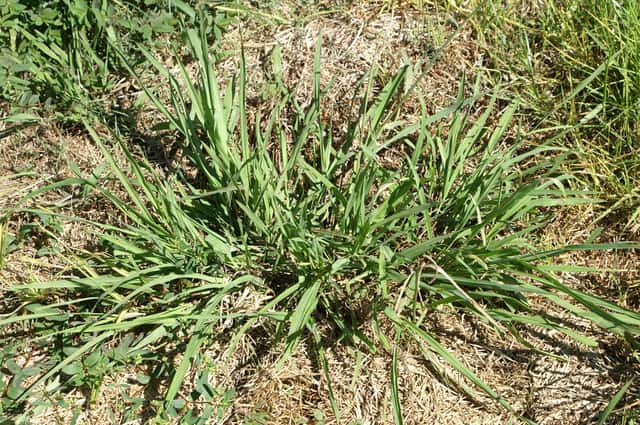
Poaceae
Dallisgrass (Paspalum dilatatum)
Paspalum dilatatum
Grows vigorously in full sun to partial shade on moist, well-drained loam or clay soils. Tolerates occasional flooding and short dry spells thanks to its deep rhizomes. Rarely needs frequent fertilizing outside of pasture management.
Every 4 days
Bright indirect
10° - 35°C
% - %
Categories
What is Dallisgrass?
Dallisgrass (Paspalum dilatatum) is a easy-care plant from the Poaceae family. Dallisgrass (Paspalum dilatatum) is a robust, clump-forming perennial grass native to southern Brazil, Argentina, Uruguay, and Paraguay. It forms dense tufts with short rhizomes and deep fibrous roots, and is widely grown as a warm-season pasture forage grass, though it is also considered a weed in...
Dallisgrass grows up to 1.5m, watering every 4 days, 10°C – 35°C. It is not suitable for indoor environments and safe for pets.
Unlike many tropical plants, Dallisgrass tolerates watering mistakes. Best for beginners. Unlike many popular species, Dallisgrass is safe to keep around pets.
How to Care for Dallisgrass?
TLDR: Dallisgrass needs Bright indirect, watering every 4 days, and temperatures between 10-35°C with 40-70% humidity.
How Often Should You Water Dallisgrass?
Keep soil consistently moist during the growing season (spring through fall); tolerates brief waterlogging but avoid prolonged drought to maintain vigor.
How Much Light Does Dallisgrass Need?
Prefers full sun (6+ hours) but tolerates partial shade; growth and seedhead production decline in deep shade.
What Is the Best Soil for Dallisgrass?
Adapts to moist loam, silt, sand, and clay soils with pH 5.5-7.0; performs poorly in very dry sandy soils.
What Pot Should You Use for Dallisgrass?
Not suited for container growing; best grown directly in garden beds, pastures, or open ground.
Care Schedule
Fertilize
Every 180 days
What Is Dallisgrass and Where Does It Come From?
Dallisgrass (Paspalum dilatatum) is a robust, clump-forming perennial grass native to southern Brazil, Argentina, Uruguay, and Paraguay. It forms dense tufts with short rhizomes and deep fibrous roots, and is widely grown as a warm-season pasture forage grass, though it is also considered a weed in lawns and disturbed ground. Its inflorescences bear pale green to purplish spikelets, which often develop a sticky black exudate when infected by ergot fungus.
How to Propagate Dallisgrass?
Seeding
Fresh seed germinates best; germination rate can be low with seed stored for a long time.
- 1 Prepare the soil by removing weeds and lightly tilling the surface
- 2 Distribute seed evenly and cover with a thin layer of soil
- 3 Keep soil moist until germination
Materials needed:
Clump division
Water thoroughly right after transplanting to reduce division stress.
- 1 Dig up an established clump keeping rhizomes and roots intact
- 2 Divide the clump into smaller sections, each with at least one growth bud
- 3 Replant immediately into moist, well-drained soil
Materials needed:
How Big Does Dallisgrass Grow?
TLDR: Dallisgrass can reach up to 1.5m tall with Fast growth rate.
Max height
1.5m
Growth rate
Fast
Foliage
Deciduous
Plant Uses
Ground Cover
Soil coverage
Is your plant showing symptoms?
Click on the symptom to discover possible causes:
Meaning & Symbolism
Symbolizes resilience and adaptability, reflecting its role as a tough, fast-establishing forage grass across South American grasslands.
Fun Facts
The name "dallisgrass" honors A.T. Dallis, a Georgia farmer who helped popularize the grass in the 19th century.
Its spikelets can develop a sticky black secretion when infected by ergot fungus (Claviceps paspali), which is toxic to grazing livestock.
Despite being a valued forage grass in South America, it is classified as a noxious weed in lawns across much of the United States.
Frequently asked questions
Is dallisgrass toxic to animals?
How often should I water dallisgrass?
Does dallisgrass need full sun?
Compare with similar plants
| Attribute | Difficulty | Light | Watering | Pet Safe |
|---|---|---|---|---|
| Field Maple | Easy | Bright indirect | 14d | ✓ |
| Muriel's Bamboo | Medium | Partial shade | 3d | ✓ |
| Silver Birch | Easy | Direct sun | 14d | ✓ |
| Common Blanketflower | Easy | Direct sun | 10d | ✓ |
Choose & Compare
Sources & References
- Paspalum dilatatum | NC State Extension Gardener Plant Toolbox
- Dallis grass (Paspalum dilatatum) | Feedipedia
- An Update in Claviceps paspali Disease | Plant Disease
- Claviceps Paspali - an overview | ScienceDirect Topics
- Capim melado (Paspalum dilatatum) | Agrolink
- Paspalum dilatatum | SIB, Parques Nacionales, Argentina
- Paspalum dilatatum | Wikipedia





